Showing posts with label children. Show all posts

Wednesday, July 17, 2019

A Letter to My Son About the Soul


Monday, May 7, 2019

Dear Aidan,

It was a blessing and a curse watching you compete Saturday. Yes, it was Bible Quiz (of all things), but it’s the same emotions any parent feels watching their kid play a weekend sport. I hoped you would take to this, and you have beyond any expectations.

So it was a blessing watching you remember words precisely and play the little parts of the game expertly, especially when you guess right and gain a lot of points.

But your high-risk strategy has a necessary downside, when you guess wrong and lose a lot of points. You take a lot of three-point shots, and the percentage is worse, but they’re worth more.

After that one prelim round, when your losses clustered all together, I saw my own reaction mirrored in yours. You couldn’t talk. You collapsed into yourself and walked away. I tried to put a hand on your shoulder but I don’t know if you even felt it. I could only let you be, and wait for the next round, if there was a next round.

There was, and you brought it all. You sailed through it with a tight precision. Then you went on, climbing step by step to take the top prize, winning a trophy so big it can only be classified as baggage. The trophy shows in its own ludicrous size that it is not the point. Who wants this chunk of wood and “gold” paint?

I wasn’t happy to have to make space for that thing in the trunk, but I was happy because it culminated months of your hard work. You wanted this, you considered the cost, planned a path, executed a strategy, ran into an obstacle, and overcame it.

I thought about why you were doing this, and I recalled the musical version of Percy Jackson that we had seen two nights before. The first song was all about the young demigods trying to catch their distant god-parents’ attention by accomplishing something big, something that the distracted gods just HAVE to notice. Did you notice how even their camp schedule was based around competition, and how the daughter of Athena honed her own battle strategy so that her god-mother would notice her? That’s the natural consequence of a world of competition: winning forces people to take notice. It was true for the Greeks, it was true for the Egyptians, and the Norse, and the soccer moms today.

Percy Jackson is missing his god-father, and that aspect to his character fits with the Greco-Roman world. All the powerful people believed this 2000 years ago: a god was a powerful man who gave you life but is off on business now and has left you to make a mark. Make some noise and maybe he’ll notice.

Jesus contradicted all this. He said God is near, God is love, God scatters life through a world like a sower scattering seed through a world of obstacles -- but God doesn’t just leave it there. God makes every seed grow, even the tiniest mustard seed, without us knowing exactly how. God gives Godself, overflowing as the Spirit, a bubbling stream to anyone who asks.

This is very different from a world where the person who captures the flag or wins the quest might get his father’s attention. Jesus was building on a foundation of Hebrew prophecies, laws, and songs showing that God is the good creator and sustainer of all things. Jesus took it farther by saying God is so good at giving gifts that God knows not just what you want but what you need. What we need is, ultimately, the Spirit of the Good Giver, who made us to need that Spirit.

Since it’s the week after Easter, I’m reminded of John’s picture of Jesus, risen from the grave, giving the disciples the Spirit by breathing on them. Kind of weird -- not the kind of image that has been repeated in Western Art that often -- but deep and resonant in its weirdness. That action means a lot:

First, don’t miss the obvious. Jesus had breath, a physical body that does the one thing physical, living bodies do all the time, in that it exhaled air.

Second, he gave that breath away, emptying himself to lift them up.

And he did so in a deliberate repetition of what happened thousands of years before in the Garden of Eden, when God breathed into Adam’s nostrils the breath of life, and he became a living soul.

This last image is from Genesis 2. It takes place in the same Bible as John 20, but many pages before, written at a different time in a different language. The Genesis verse doesn’t have much detail beyond a few solid, earthy words: “blow”; “nostrils” (they were face to face); and the mysterious term “soul.”

At this point in the story, God had formed Adam’s body from the dust, but that wasn’t enough. God was the good father to the first man and gave the gift of breath, and Adam started to move. I like the Latin term for soul best: “anima.” (Knowing the many sides of this word is why you’re learning Latin!) God blew on Adam and Adam became ANIMA-ted. “Soul” is an earthy term like “dust” and “nostrils,” and can be applied to all things that move. But in Adam’s case it was a special gift of God, reflected in the special phrase “breathed into his nostrils the breath of life.” God only knows precisely how that worked, but somehow something thin, active, and without parts flooded the physical, soulish body of Adam.

I can take apart an animated thing in the lab and learn something about how it works. The amazing thing is how much I can see. Living things are built from an untold number of chemical cycles, in which food comes in, is broken down, is used to build new cells, is breathed out as carbon dioxide, which a plant can “breathe in” and build up. The atoms are constantly cycling. As you breathe in and out, some atoms get lodged in your body but others fly away. I read once that 98% of the atoms in your body are replaced every year.

But you’re clearly the same Aidan who competed in Bible Quiz last year, right? So whatever it is that makes you “you,” it’s not the atoms. And whatever made Adam Adam, it wasn’t the atoms. The point of Genesis 2 is not to trace the atoms, it’s to show God giving the soul, face to face with the first man. (The point of chemistry is to trace the atoms, and that’s so relatively unimportant that we could wait a couple more millenia before learning it.)

Adam’s body of chemical cycles, reproducing and repairing, breathing air in and out, it all came from the earth. Each cycle moves because it is missing something: the atoms bind and the chemicals react to make something new. Also, each cycle has a hole in the middle. There’s a lot of empty space in the cycles. Even the atoms themselves, which seem so solid to us, are mostly empty space, with each dense nucleus relative to the atomic radius being only the size of a pea in a cathedral. Even the most solid things and the most dynamic things are open and empty, matter moving in the void. If this seems inadequate, that’s because it is inadequate. I think this is a sign that behind the void is a Creator without parts who has non-material, non-dissectable ways of filling all that emptiness.

Can I reiterate how much I don’t know here? It doesn’t really matter how long it took for these cycles to build from the dust, because there wasn’t anyone around to be impatient about it. Adam only became a soul when his eyes faced God’s (we know that that means on his side but not on God’s) and God’s breath became his. Whatever atoms were involved would soon leave him.

What would always remain in him was thin, strong, and without parts: Adam’s memory of the fact that there was once a relationship, face to face, Creator to creature. God had the same memory. God remembered Adam and his descendants.

The word-picture in Genesis 2 is like the verse in Genesis 1 where humans are all made in God’s “image,” to bring in another mysterious word. The simplest way to make an image of something is to hold a mirror to it. When Adam saw God, imagine God’s own image reflecting off Adam’s eyes, being pieced together in Adam’s brain, and therefore flooding and shaping Adam’s being. Carefully put Genesis 1:27 and Genesis 2:7 side by side, and imagine Adam face to face with God, reflecting his Creator, shining for all others to see.

There’s a lot of questions you probably have about the rest of Genesis 2, but this letter’s already long enough. In the rest of Genesis 2 relationships are made, and in Genesis 3, they are broken.

The image language shows up in a few other places scatted through the Hebrew scriptures. In Psalm 73, the same Hebrew word for image is used for God looking on the proud and mighty, the demigods of this world, but here something is broken: “Like one waking from a dream, Lord, when arising, you will despise their image.” We’ve all warped the mirror and defaced the image in some ways, all of us except Jesus, the perfect and accurate image of God. Paul uses the word “image” to say this exact thing in Colossians 1.

Adam’s body was a bottle of flesh, made with dynamic cycles of atoms with empty space scatted throughout, from the dust of this world, according to the patterns of this world. God gave Adam a puff of “breath” that made him a living soul, able to move deliberately, think, and speak, able to relate. God gave you this same “breath,” through Adam and Eve, through Cain and Cain’s wife or Seth and his wife, through … … … , through Grandpa and Nana, through me, to you. You can also move, think, speak, relate, and choose. For example, you can choose to work hard to win Bible Quiz, and I respect and admire that choice. I want it to pay off, even as I know it won’t always.

The gift of God comes from above and is not subject to scientific study or dissection. It has no parts we can pry open, but a secret center only you (and God) can detect. The rules of science, worked out over hundreds of years, apply to atoms, but the soul was forged by a relationship with a God not made of atoms, or any parts at all.

Science can only dissect what’s below it, so that God’s gifts of spirit and soul were excluded from it at this beginning. We can hear the sound of God’s breath with our own God-given minds, but we can’t tell where it came from or where it is going.

But we have something better than science for studying the soul. I have my own soul and you have yours. This is the secret place at the center, the closet where Jesus says only the Father can see. Only God knows what was going on inside you when you had that terrible round of quizzing, I could only guess. I couldn’t reach you, but God heard every word you prayed, however frantically or half-heartedly or even unknowingly in groans too deep for words.

Others have talked about this mystery: the soul as a gift of God, embedded in but independent from the atoms of the flesh. Philosophers like Descartes and Spinoza might have something to offer, some good, some not. However, my current favorite word-picture for the soul comes not from a philosopher but from a poet.

That poet is John Davies, who lived around the time of Shakespeare, when people were struggling with this same question and we started to learn how to take the world apart. From this struggle, Davies wrote a poem in which he approached the problem systematically, like a scientist, but with poetry in the place of the scientific method. Davies tries on eight metaphors and discards each as not fitting:

The soul doesn’t dwell in the body like a tent;
it’s not like a pilot sitting in a ship;
or a spider in its web;
or an imprint in wax;
or water in a bottle;
or as a liquid mixed in another;
or as heat emitted from a fire;
or as a voice spreading through the air.

Each of these has its points (I’m intrigued by the idea of a soul as an imprint in wax), but each also has a flaw (if the soul’s an empty imprint, then what is the part that thinks and feels and stays with God, that part of the dying thief that Jesus promised would be with him this day “in Paradise”?).

Davies finds a metaphor that exceeds the rest when he finally compares the soul to sunlight through air. Specifically, the soul is in the body the same way that morning light fills a room, which “in an instant doth herself unite / To the transparent air, in all and part.”

This works really well as a metaphor, especially given all the empty space inside atoms and in the biochemical cycles of life. Imagine how the light is independent of the air, how it can be blocked by the air, but it’s still there. The sun still shines outside, and the sunlight is still given to even the most clouded room.

In the same way, if the body corrupted by disease or decay, or weighed down by stress or depression, the soul is still there, given by its Giver, diffusing every part of the body as the sunlight fills the room. You can’t dissect or control the sunlight, you can only reflect it. And I read somewhere that God made the light and Jesus is the light of the world: “God from God, Light from Light, true God from true God,  begotten, not made, one in Being with the Father” as Christians have recited for more than a millennium in the Nicene Creed.

Another Christian picked up on the same sort of image in a different way, this one a father of four called J.R.R. Tolkien. You probably figured I’d bring him into this sooner or later. Tolkien’s metaphor of soul and body is the Phial of Galadriel. Galadriel, one of the characters closest to the Creator, gives Frodo a tiny bottle. I remember being disappointed the first time I read this. Bilbo got a glowing sword, but Frodo gets a fragile bottle?

Of course, this isn’t just any bottle. The water holds the light of Earendil’s star, from a jewel called a Silmaril that itself holds the brilliant light of the Two Trees that once lit the world, in a chain reaching back to the beginning of creation. Imagine it glimmering like the light of Venus or Jupiter, unwavering in the western sky on our evening walks. It doesn’t seem like much, but it drives the darkness of monstrous, entangling evil away.

Your soul is a light filling the bottle of your flesh. You choose how you hold it up and pour out its light. This is the gift God gave to you, through Adam and through me.

Jesus reflected and embodied this light, with a hidden, humble glory that only some saw. Take care of your soul like Frodo took care of the Phial of Galadriel, and at a moment when “even the memory of colours and of forms and of any light faded out of thought” you may find yourself holding it high as you recite ancient words in the moment of need. Frodo found that “another voice spoke through his, clear, untroubled by the foul air of the pit.” This voice can speak through you too.

As you trudge along the path, you might wonder if that light is even there, but in the darkness it will shine. When you struggled on Saturday at the Quiz Meet, things got dark and you had to trust that the habits you formed in secret would return by God’s grace. That’s just a foretaste to the bigger challenges that you cannot meet alone. Saturday, you met a big spider, but Shelob herself is out there.

Fear not. Jesus defeated the darkness by standing firm and taking the worst sin can do – which is that it killed him and stopped all his motion, all his “anima,” down to the atoms. Jesus stood firm as others mocked because he knew that all they could do was destroy his body. Jesus trusted that God would give him a new “bottle” after the old one was destroyed.

Jesus was right. God’s light shines on even when the body is destroyed by death, and that part of you that perceives and feels and dreams will be with Jesus always. God will hold you safe, as the good Father who is better than we can ask or imagine.

Jesus studied his Bible, the Hebrew Scriptures, as you studied. Those scriptures told him that God has always worked this way: God’s Messiah would suffer shame and would die, then would rise after three days. Even study itself is filled with empty spaces and pauses, with times of blankness that God fills with the light of God’s Spirit. As you work to push these words into your memory, they shape faith and literally reshape the atoms in your neurons into windows that light can shine through.

I believe that shaping your brain to follow his words will open the space to let God’s light fill your body and soul. It’s not about the words themselves, but the space they open for God to move.

Even if this space closes, and you lose sight of God’s grace in the heat of competition, and if a fleshly and idolatrous brain drains the meaning from words by rote repetition, even if the quiz round crashes and burns and you don’t move on, God is in the failure too, because God himself failed according to the world’s standards, yet we call that day of failure “Good Friday.” Trust that God sees in secret and God gives life in secret, even in the face of failure, whatever befall.

Even in a stuffy Bible Quiz room when you’re hungry and tired and you have hours to go, and you’ve disappointed yourself after months of work, you have never disappointed me and you have never disappointed your heavenly Father, who always runs with open arms toward his prodigal son.

Remember that God’s light shines like the sun behind the clouds, and that Jesus himself is the reality that made everything and sits enthroned above and behind everything. Let God’s light be your vision, filling you and lifting you to see the hidden, generous glory of Christ that has sustained creation since God first said, “Let there be light.”

On March 25 fifteen years ago God said “Let there be Aidan.” I held your tiny form and saw that light when I first looked into your eyes, face to face. The light between us revealed to me that God gave us to each other. At that moment God created a truth that will never change: that I am filled with light when I remember you, because I love you. And I love you because God loved you first, and made you for this.

Love, Dad

Saturday, September 19, 2015

Finding Burgess Shale Fossils with Kids, Part 3: The Science

We found a great family day hike in Kootenay National Park in Canada and found small but important fossils. It worked well for our kids, and also for me -- I dug up some of the scientific literature describing this find after the fact. I'll describe what we found in three parts: The Prep, The Hike, and The Science.


So after our hike we found fossils. Or at least what I could pass off to the kids as possibly fossils? We took pictures of our putative fossils and left them in the field.

This looks like a leaf-shaped form with fuzzy appendages flowing out from it (found by my wife):


This looks like a bean with legs:


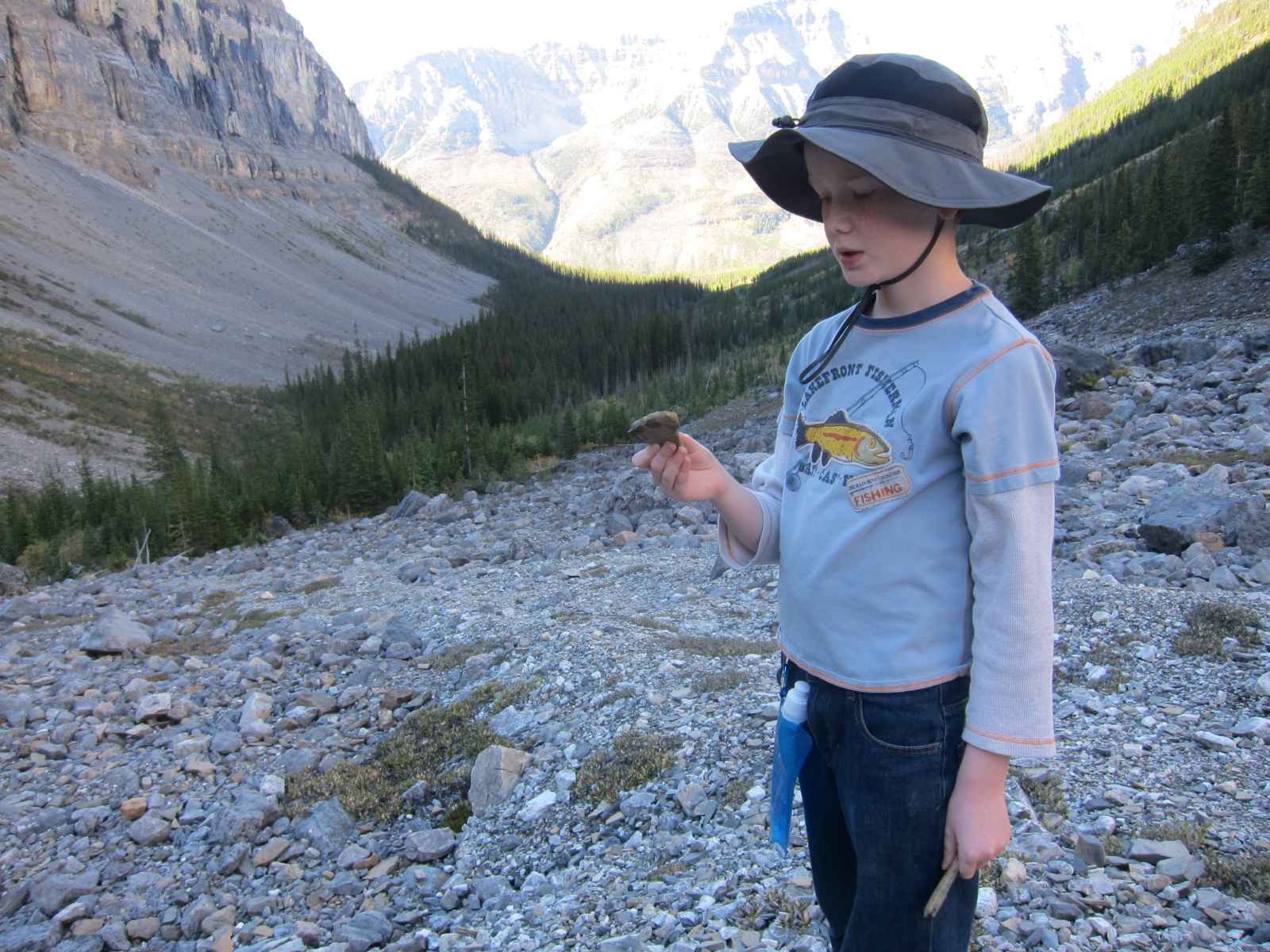
And these might be trails of something wormy (found by my 12-year-old):


Notice how, at least, these are all in a similar type of rock. This is the shale that used to be sandy seafloor. I think they might actually be something.

Finally, I looked up a little on the science of the area and pieced together some interesting leads for further study in the academic literature. First off, this appears to be a newer site than the others. At least two major sites are located north a few dozen kilometers, close to the town of Field and Kicking Horse Pass, including the Wolcott Quarry and the area where the first specimens were found.

It wasn't until 2010 that a paper came out describing the Stanley Glacier site. This paper discusses how the previous sites were part of a "thick" formation but the Stanley Glacier rock is part of a "thin" part of the formation. Previously scientists had thought the thin part wouldn't preserve specimens, but from our own exploration we can confirm that it did.

I imagine that someone may have been hiking the trail to the glacier, noticed the black-stained layered cliffs on the west end of the valley, and crossed over to the waterfall to check for fossils. Maybe other sites can be found by similar cliffs. We caught a glimpse of some in the area of Kicking Horse Pass, for example, where the older sites are located. Seems to be a good excuse for more hiking in the area.

Here is the map from the paper showing the site and how it relates to the other sites near Field, which are part of the Cathedral Escarpment:

In 2014, word got out that yet another site was found north of the Stanley Glacier site, across the road near Marble Canyon. This was a major find with many diverse new shapes, showing that buried in those rocks there are many, many lifeforms waiting to be discovered. Connecting the dots (or the "F's" in the map above), perhaps there are other sites located along this line. How many unknown shapes are stacked up in those black-stained cliffs?

I believe the other sites are rightfully kept off-limits to the public, so the Stanley Glacier may be the easiest way to play paleontologist and see for yourself what this kind of discovery is like. As we showed, even a four-year-old, with some help, can do it. There's nothing like a treasure hunt to motivate small legs to keep moving, and the likelihood of finding fossils seems amazingly high.

Finding Burgess Shale Fossils with Kids, Part 2: The Hike

We found a great family day hike in Kootenay National Park in Canada and found small but important fossils. It worked well for our kids, and also for me -- I dug up some of the scientific literature describing this find after the fact. I'll describe what we found in three parts: The Prep, The Hike, and The Science.

The trailhead for the hike is only about fifteen minutes west of the main highway through Banff, along Highway 93, just across into Alberta, so it's central and easy to get to from either the towns of Lake Louise or Banff. (We came in from Calgary and spent a couple hours in Banff, including a stop at the rock store to show the boys what fossils look like, before grabbing lunch from the supermarket and driving to the trailhead while eating on the way.) We left Banff at 1:15, started the hike at 2pm and got back to the car at 6:30. From there it was a quick hour's drive to Golden, BC for our next hotel stay.

The trail runs south from the trailhead, up to a hanging valley between ridges that you can see from the beginning. You proceed through very different stages, which can be used as goals to motivate the little ones. First you climb up through a landscape recovering from a fire maybe a decade ago:


You're climbing up a hill, and the grade is taxing on little legs, but actually easier than the grade on the Lake Agnes Tea House trail in Lake Louise that we had done the previous day. There's little shade on the slope, so an early afternoon start meant that the sun was getting easier to take as we went.

Early on there's a stream running to the east as you switch back and forth:
The top of the stream is about where this first stage ends. At our pace it's about an hour, and you can tell the kids that the hardest part is first.

Once you get to the top of that slope, the trail flattens out and turns toward the valley. Soon you cross a stream that used to be spanned with just a two-log bridge but now has a wider bridge that you could cartwheel across if you like:


This is a view heading south into the valley. The glacier is ahead and up to the right. Closer on the right is a sheer wall of layers of tan and brown rock smeared with black. This contains the shale of the Burgess shale and forms the backdrop of most of our pictures. There's a waterfall running down it at the south end that had helped to pull down some rocks from the cliff for little fossil hunters.


The flat part lets you catch your breath until the trail starts to climb again. It's not nearly as steep as before but much more rocky. At some point you'll feel a wave of chilly air blowing in your face from the valley, definitely cooler than the air on the sunlit hill. We also crossed into shade and at this point, were more certain that we could actually do this thing.

When you see this rocky staircase, you know you're maybe half an hour from your goal (and if you have a four-year-old you're probably going to have to carry him):


The trail is rougher from this point on. As you get closer to the glacier, you will soon be able to make out the waterfall, tiny against the huge cliffs of rock. This is your goal.


The glacier is just beyond it. If you have the energy you can hike all the way up to it, but for us, turning off at the waterfall was certainly enough. Here you can see the glacier peeking out on the left.


Stay on the trail until you are almost directly across from the waterfall on your right. There's a place where it looks like the trail branches, and stay on the rightward, downward branch. This takes you right next to a rock field in the center of the valley that is your final challenge. Scramble across to the base of the waterfall and you're there. I think the littler ones had an easier time with scrambling than we did, but we all had to watch out for shifty rocks.


Once  across (and even before), look for tan or beige flat ones with multiple layers, about the size of a dessert plate or a dinner plate (I may have been getting hungry by this point). Flip these rocks over and examine them closely. Just from a few minutes of searching ,we were able to find several tiny fossils.

The nice part about mountain hikes is that down is faster than up. It took us an easy 90 minutes to get back to the car.

In the next post, I'll show what our "fossils" looked like and describe some of the scientific literature about this particular site.

Finding Burgess Shale Fossils with Kids, Part 1: The Prep

We found a great family day hike in Kootenay National Park in Canada and found small but important fossils. It worked well for our kids, and also for me -- I dug up some of the scientific literature describing this find after the fact. I'll describe what we found in three parts: The Prep, The Hike, and The Science.

Right after Labor Day, we wanted to take a quick vacation that would take advantage of the fact that under the quarter system, school doesn't start till the last week in September. So we drove from Seattle to the Canadian Rockies for a five-day vacation.

Since I've written about the Burgess Shale fossils, I wanted to take the family to hike up and see a place where those fossils were found. The Burgess Shale contains evidence of life's Cambrian explosion, where  diverse forms most wonderful suddenly appear in the rocks a little more than half a billion years ago. I wondered if there was anything special about the rocks up there and wanted to feel what it would have been like to find these fossils.

Before we went I found an official site for this hike and several trip reports indicating that it would work for older kids, such as this one. We also found the guided tours offered to the two other official Burgess Shale sites, but we were too late to sign up, had kids below the age cut-off, and wanted to be able to go at our own pace (and turn back if need be). The Stanley Glacier hike looked like the one we could do, and it's a public hike that we can try on our own.

We have four boys, age 12 (going on 30), 11, 6, and 4. I wasn't sure that we'd make it, but I promised them if we did, they might find their own fossils. And it worked -- here's the proof, with the fossil area in the background:


I'll describe the hike in detail in the next post, so you can decide if your kids will make it. Most kids ages 10 and up should have no problem with this hike. It was a challenge for our little ones, but it actually got a bit easier as we went along. I want to publish that it worked for us, so it might work for you.

We spent four and a half hours total on this hike: 2 hours up, maybe an hour looking for fossils, and 1.5 hours back. To get to the fossils, you don't go all the way to Stanley Glacier, but turn off after about three miles. The first mile or so is a medium-grade upward climb that went the slowest for us, then there was a flat, fast part before the trail roughened and climbed again for the last half mile (ish). Then you turn off toward a waterfall on your right, scramble over some rocks, and there are the fossils.

Next I'll describe the hike in detail and how to find the fossil site.


Tuesday, November 19, 2013

How to Hack Where's Waldo

Slate has a nice article about how to use an objective method to determine the optimal search pattern for Waldo. There are certain places where Waldo will be more than half the time, so you look there first. I can't wait to try this out on my kids. It also may be a good teaching exercise for a stats class ... or even a psychology, or design class? Are there other methods of analysis we can apply to Waldo's xy coordinates?

Tuesday, September 10, 2013

The LEGO Laboratory

Who needs 3D printing in the lab? Just use LEGOs. See these two instruments from the Brothers Brick website:

1.) The working LEGO compound microscope
LEGO Microscope MkII - Hero

2.) The working LEGO balance
Scientific Scales

What's next? The working LEGO GC-MS? (It could work at low temps, right?)

Thursday, August 29, 2013

Calvin and Hobbes Apocrypha

I found this at Paste magazine. Words by Bill Watterson, creator of Calvin and Hobbes, art so closely inspired by his style that it might as well be by him. A good end to a busy day (click to embiggen):


Friday, June 21, 2013

Colbert's Mom

This has already made the rounds on social media by this point, but just in case someone is out there who hasn't seen it, Stephen Colbert paid tribute to his mother in this clip from his show, one of the best written three minutes of TV I've seen this year:


The fact that he's "in character" 99% of the time makes the moments when he steps out of character that much more powerful.

Another brick in the wall of evidence that (IMHO) the sequel has outdone the original Daily Show, which I didn't think would be possible.

Wednesday, May 8, 2013

Best Commencement Speech Ever?: The Film

In 2007 (is it possible I've been blogging that long?) I commented on the full text of David Foster Wallace's commencement speech at Kenyon College, so you should check that out again. A different part of the speech has been made into a film, with visuals that don't interfere with but rather amplify DFW's words. Well worth checking out the film at this link.

(In a side note, I tried to tell the fish joke at the beginning in my biochemistry class about water, in 2008 or 2009. I initially thought it didn't "work" because it didn't get a laugh, but I don't think it's intended to be a haha funny joke, come to think of it. Still, it turns out that Sam and Aidan were "visiting" the class that day and I named the fish Sam and Aidan, and Sam still remembers that. So it had a different level of value than intended. There's something appropriate about that.)


Friday, April 12, 2013

Book Review: How Children Succeed by Paul Tough


I'm tired of teaching-reform books. Finding a good one is as difficult as finding most anything on the Internet these days: you have to wade through hundreds of half-baked attempts to find the gem you're looking for. And there's a lot of them too: here's an op-ed on the topic running today/tomorrow in the New York Times. Good ideas, but a definite sense of futility, and I feel like I've read it before. Also, couldn't it really be edited to one page instead of two?

It's in this context that How Children Succeed really does stand out. It's not a perfect book, but it's the best on the topic that I've read. Paul Tough writes like he has a personal stake in the topic, and by the end of the book you find out that he indeed does, in multiple ways. He covers ground from the famous KIPP academy to public schools in Chicago to a tournament-winning chess team from the Bronx. There's some good science in here, but it's not wielded like a club, it's integrated into the conclusions, and it points beyond itself (perhaps that is the sign of good science).

A few of the points are contradictory -- is it optimism or pessimism that builds success? -- and a few of the initiatives, like the new "character GPA" focus, are so new they are untested and feel faddish. (There's nothing more faddish than education reform ... ) These are exceptions. Most of this book is much more solid than average.

And don't be thrown by the "children" in the title: several parts of the book have to do with undergraduate retention and definite "young adult" areas of success.

One point Tough hits on but also tends to shy away from is how close all these character-building traits are to a traditional concept of virtue. I understand that, recently, virtue tends to bring to mind compulsive Republican gamblers (it's a long story if it doesn't for you), but to me at least, the notion only works if it is grounded in a community of oft-confused pilgrims working their way toward a goal rather than having arrived at it. In that context, virtue is the best single word to describe what this book recommends. Virtue and love, especially the love of a parent. That definition of virtue must involve love.

My best recommendation of this book is that Tough covers the same ground as Malcolm Gladwell in several places, in a much less flashy yet somehow more lasting manner. So in that sense, he's a more humble and more accurate Gladwell, writing in book length rather than essay length. What's not to like about that?

Thursday, March 28, 2013

Q: How is a Newborn Baby like the Color Red?

A: Both of them are philosophically transformative (in the proper context).

Let me explain: There's an old philosophical story about how experience differs from knowledge. It's about a color researcher who happens to be color blind. She has studied wavelengths and spectra and knows all about the color red, but has never truly seen it. She may even be considered the world's expert on knowledge about the color red. She knows how the brain fires when it sees red and has read about how it's a different color from green. But does she truly know what "red" is?

Then one day she gets gene therapy and receives properly working opsins in her retina which allow her to see the color red. She turns to a red Rothko painting (hey, this is my story, I can tell it how I like) and sees a brilliant wash of crimson for the first time. She has gained something from the operation. But what is it exactly that she has gained? Not knowledge but a new experience. She sees red for the first time. This subjective experience is what philosophers call qualia.

Now comes along an argument from a philosopher that puts this into a new context. According to this argument, before you have a baby, you know all about it (including your own experience of being a baby). Maybe you can even test its DNA to find out about the baby. But you have never experienced being a parent. When you hold that baby for the first time, you're like the color researcher seeing red for the first time. This is a totally new, subjective experience, and this is so uniquely valuable that (philosophically speaking) it outweighs all the inconveniences and stress that result from that tiny squalling mass. The baby is a new color, a color no one in the world has even seen before, and (for the biological parents) a color literally mixed from the two parents' colors.

All this and more is summarized in the Percolator blog post "Maybe You Should Have a Baby". Including this quote:

Moreover, since having one’s own child is unlike any other human experience, before she has had the experience of seeing and touching her newborn child, not only does she not know what it is like to have a child, she cannot know. Without having the experience itself, she cannot even have an approximate idea as to what it is like to have that experience. Like the experience of seeing color for the first time, the experience of having a child is not projectable. All of this results from the fact that having one’s own child is transformative—and far more so than the experience of seeing color for the first time.

I would only add that, being the parent of four boys, I can attest that each of their "colors" is a brand-new gift to the world, unlike the others yet equally beautiful. One of the joys of parenting is finding out just how different your children are from eachother, and from you. It's also one of the greatest difficulties. Yet each child is indeed a work of art, and I'm grateful for each one.

Tuesday, January 22, 2013

Climbing on Carbon

Not only do regular chemical structures have a certain crystalline beauty about them, they also look like playground equipment. The Carbon Playground at the Discovery Center Museum in Rockville, IL illustrates this concept perfectly. There kids can climb on a buckyball/jungle-gym, a graphene/climbing-wall, and a nanotube/robe-climb. I thought about putting up some stills but the best way to show it is to see children playing on it. Now carbon's nice, but I want to see other elements too ... like a caffeine rocking-horse? Enjoy:

Wednesday, December 26, 2012

The Last "Real" Chemistry Kit?

The New York Times had a nice set of articles yesterday about a chemistry sets: that is, Chemistry Kits for kids. What's nice about this is that the set of articles covers all the bases: one recognizes the Harry-Potter-ish origin of the sets, another shows how the old experiments inspired today's scientists, a third explains why they can't explode so much anymore (and yet also describes the current sets' advantages), and at last there's a slideshow of old sets so you can see what's changed.

I agree that there's a bit of a sepia-tinged nostalgia about how dangerous the old sets used to be, but I agree even more that most of the sets sold today are not worth buying because they can be recreated with stuff you already have on hand. Why spend ten bucks when you can spend two? (For example: the typical red-blue acid-base indicator can be easily extracted from red cabbage for pennies on the dollar.) But recently I did find a set worth buying: the Thames and Kosmos CHEM C1000 and related sets.

The Thames and Kosmos sets have real chemicals, some of which are actually slightly dangerous, and real equipment like what I'd use in the lab. Although the reactions aren't too exothermic (i.e., no explosions) they do teach chemistry and safety with colorful, quick experiments. And if you really need explosions there's some gas-expanding experiments that come close. There's some little points of ingenuity, such as the way the chemical vials are opened, which is simple yet child-safe enough that it took this Ph.D. chemist an embarrassingly long time to figure out how to do it. So it's ingenious, real, and safe. If you're going to spend money on a chemistry set, I'd recommend this one. And Merry Christmas everyone!


Friday, December 21, 2012

Book Review: Exploring J.R.R. Tolkien's The Hobbit


There should be more books like this one. I used to listen to The Tolkien Professor's podcasts on iTunesU -- in fact, it's where I got the idea for the Day of Common Learning Lecture that turned into the "Trees of Life" book chapter on J.R.R. Tolkien and Paul Brand. In Exploring J.R.R. Tolkien's The Hobbit, Corey Olsen (AKA The Tolkien Professor) recapitulates his Hobbit podcasts in book form.

Olsen's focus is on the character of Bilbo Baggins, on the nature of luck in Tolkien's writing, and on what we can get from the frequent songs and poems. It gave me a new appreciation for the quiet faith of Tolkien: in his writing, luck is never just luck and the wind is also spirit, just like in the ancient Greek. Also, Olsen points out the teasing of the elves and the natural beauty of the Arkenstone. Tolkien's pure joy in the natural world is something we all share, and one of the reasons everyone can relate to these books. Although the elves are too somber in Jackson's movies, the natural beauty of New Zealand does provide this element. In Olsen's book, I would have liked more connections to Old English literature and to The Silmarillion (there's a really nice one comparing Gollum's riddle to Sauron's old speeches that left me wanting more). That can be the next book.

This book's unique strength is that it is written for the ordinary person interested in The Hobbit, and as such, it's a very nice gateway drug into the land of scholarship. In fact, I was able to give this book to my 10-year-old son Sam and he finished it before I did. That is as valuable as the Arkenstone to me. So while the writing at times felt a bit baggy and redundant to me, I've got to say there's enough scholarly articles out there for me as it is. Fellow profs, let's write more things like this for my boy ... and who knows what he'll be some day?

Friday, December 7, 2012

The Thinking Brain's Music


This is what a brain sounds like. With a little help from math and science, that is. In a recent issue of PLoS ONE, researchers used math to turn brain waves into music. The result sounds to me a bit like some of the music James Horner put into the most recent Spider-Man movie when Gwen was hiding from the lizard in the tower -- in other words, it actually almost sounds like music! (That was one of my favorite moments of the movie, by the way.) For those of us who can't read that music above in our heads ... um, for all of us ... the music itself is can be heard from where it's embedded on the left side of this Wired article.

The upshot of all this is that if brain waves can be turned into sound waves this easily, perhaps there's something to the idea that music is fundamental to consciousness. Your neurons are all singing together in concert as the waves of chemotransmitters and sodium/potassium fluxes rock to and fro inside your head.

Or, in fewer words, life is music.

Considering that tomorrow is the Christmas concert that my whole family* has been preparing for, for months now, it gives me hope that all those hours of prep for an hour or so of sounds might be worthwhile and real.


* Baby Ben and Brendan have been helping out by keeping us in shape running after them so that our stamina is up for the concert. Sam and Aidan will be in it!

Wednesday, November 7, 2012

Play Without Ceasing


Great article (with a great title) written by my friend Jeffrey Overstreet about the overlap of play and work in the recently released issue of Response (the SPU magazine). Oh, and they took a picture of me playing with LEGOs in my lab too, but I'm too self-conscious to put that on my blog. Maybe it's time to change my Facebook profile pic?

Saturday, October 20, 2012

And Now For the Trolls' Point of View

This is a very well made and very short take-off on the Mines of Moria. Now I'm feeling bad for those poor trolls.

Wednesday, October 3, 2012

LEGO to Teach Color Inversion?

So there's a use for all those pink pieces after all! If you build something like this:

And then invert the colors of the picture, it suddenly looks like this:
Something tells me someone could make a pretty cool color physics learning exercise out of something like this ... let the students build structures and invert the colors to see what happens.

[backlink]

Wednesday, September 19, 2012

A Galaxy for a Driveway

No, this isn't about Rainbow Road in Mario Kart. It's about glow-in-the-dark pebbles you can scatter on a gravel driveway so at night it looks like this:

I'm thinking this could be useful for dark paths at a campground, too. The possibilities are endless. An "easter egg"-like hunt after the sun goes down? Cosmic-Bowling-style fish tanks? Kitchen countertops for midnight snacks? Feel free to develop your own...

[via Discovery News]

Written With the Heavens

The site at this link can turn any message into a collection of galaxies that appears to spell out that message. Even, for example, a certain blog title:


My first reaction was to spell out Sam's name since he was the birthday boy yesterday. A nice (and free) gift.

For some reason, about 2% of the messages arrange the galaxies to spell out swear words ...

[via Popsci]