Flash Boys explains some of the mysterious behavior of Wall Street: why some firms would build a special fiber-optic line from New Jersey to Chicago to shave a few milliseconds off the time it takes to make a trade; why the stock market has frightening blips of instability, like the "flash crash" when it lost a huge chunk of value and then regained it in a matter of seconds; and what firms do with the computer-programming geniuses they hire for big money (but not nearly as big as traders' salaries).
As a piece of extended technical journalism, it's fabulous at explaining complex subjects that most people in the field don't understand. As a piece of general writing, it's a little too quick to assign white hats and black hats, especially when one of the main "black hats" (Goldman Sachs) actually gains quite a bit of gray by the end. (Don't worry, they're still a vampire squid, but they're an old and sometimes self-contradictory vampire squid. Gödel's Vampire Squid.)
The most surprising value of this is that you understand more of how computer programmers work, so if you love someone who codes and want to understand more of what they do, by the end you've have a few glimpses into the universalities of coding life -- distorted by the financial greed of the markets, which is the book's main subject, but computer programmers seem to be much the same in whatever field.
The book jumps around a little too much, trying to make a narrative out of disparate stories that don't really go together. It would have worked better as a collection of essays with a short intro and extro, I think. But it's an education in modern economics and computer science, with a good dose of old-fashioned morality thrown in. I would welcome a theologian's reflection on the nature of evil after reading this book, in fact.
Showing posts with label economics. Show all posts
Showing posts with label economics. Show all posts
Monday, June 22, 2015

Wednesday, June 5, 2013
Should We All Just Give Cash Directly to the Poor?
Should We All Just Give Cash Directly to the Poor?
[In case anyone's wondering, I'm trying to use the share button more to see how it works, because I have at least 20 stories in my backlog that haven't seen the light of day on the blog yet. Consider this an experiment.]
Now this story gets the left and right halves of my brain yelling at each other. It's about a charity that just transfers money to poor people. Talk about minimal administration. No buildings, no campaigns, no nothing except giving the poor money.
It cuts out corruption and intrusive bureaucratic structures, so the libertarian in me rejoices.
But it has no regulation or constraint for how it's too be used, so the teacher in me (who watches out for student cheating) is concerned.
But it is simple and uses the freely available technology (cell phones) well, so the tech-efficiency side of me rejoices.
But there are so many poor people that I have to wonder about unfair distribution or spreading it out so much that it's too small to do any good, like that $8 class action settlement check I got a week ago, so the financial side of me is concerned. How does this work without relationship?
Bottom line, however, is when I turn to what Jesus and the prophets say about giving, they don't seem to be worried about how, they just say do it, give. This is the most straight-forward fulfillment of that command that I've seen short of a hand-to-hand transfer.
And that's the question: is this good enough or not good, because there is no relationship whatsoever? How much of a relationship is there when one of the disciples would give to one of the beggars at the gate of the temple, after all?
[In case anyone's wondering, I'm trying to use the share button more to see how it works, because I have at least 20 stories in my backlog that haven't seen the light of day on the blog yet. Consider this an experiment.]
Now this story gets the left and right halves of my brain yelling at each other. It's about a charity that just transfers money to poor people. Talk about minimal administration. No buildings, no campaigns, no nothing except giving the poor money.
It cuts out corruption and intrusive bureaucratic structures, so the libertarian in me rejoices.
But it has no regulation or constraint for how it's too be used, so the teacher in me (who watches out for student cheating) is concerned.
But it is simple and uses the freely available technology (cell phones) well, so the tech-efficiency side of me rejoices.
But there are so many poor people that I have to wonder about unfair distribution or spreading it out so much that it's too small to do any good, like that $8 class action settlement check I got a week ago, so the financial side of me is concerned. How does this work without relationship?
Bottom line, however, is when I turn to what Jesus and the prophets say about giving, they don't seem to be worried about how, they just say do it, give. This is the most straight-forward fulfillment of that command that I've seen short of a hand-to-hand transfer.
And that's the question: is this good enough or not good, because there is no relationship whatsoever? How much of a relationship is there when one of the disciples would give to one of the beggars at the gate of the temple, after all?
Friday, August 24, 2012
Book Review: Thinking, Fast and Slow
This is a sprawling book that covers the entire research life of a Nobel-Prize-winning psychologist/economist (Daniel Kahneman). I never failed to be impressed by Kahneman's crystal-clear explanations, but his own philosophy that the stories we tell ourselves about the world are just constructs gets in his way: he makes no effort to shape the separate stories into any kind of narrative. As a result, many of the stories do not "stick" (at least for this audiobook listener, maybe it's different with the book). So, in the spirit of the author, I have a bunch of bullet points of random thoughts. There were a LOT more, but Kahneman leaves a lot of the interpretation to you, so, there's no way I could capture them all. It's too bad, because every well-done experient has several implications, but again, Kahneman's own philosophy interferes with them being put together into any kind of story. And it is so long that, despite the fact that it's always moving, there were some dry spells, especially when I had heard of the experiment before. I may recommend that the reader approach this as a book, not an audiobook.
-- Body-mind connection demonstrated through the lemonade/Splenda body language experiment: Thinking uses glucose and you only have a limited budget of energy. So eat more sugar to think better?
-- Iris experiment can determine the difficulty of a talk from physical dilation of the iris. It's true: "The eye is the window of the soul" (Jesus)
-- "The Anchoring Effect" in negotiations is just "Ask and Ye Shall Receive" as well.
-- In his academic career, Kahneman deliberately sought out and worked with those who disagreed with him. This is his most unique and admirable trait as a researcher. I was particularly struck by his investigations of intuition when he combined his skepticism with Gary Klein, who was more trusting of the power of intuition. Together they made the excellent point that intuition is learning to read (just reading LIFE instead of books) and it requires both experience and a regular non-random situation. Kahneman dwells on the randomness, but I'm with the Klein: I see order.
-- Because Kahneman's behavioral economics overthrew the too-rational "utility theory," he has personal experience with how a scientific community can accept a theory for too long without question. I find this particularly disturbing. Kahneman doesn't seem to ask, where are we doing this groupthink now, as scientists? He's already smashed his icons, no need to look for more, I guess.
-- Behavioral economics is in some ways accounting for the sin of pride in the economic agent. Conversely, humility is seeing things fairly. Humility is seeing truthfully, objectively. The person acting with humility would be the rational actor!
-- The real value of something good is not a constant straight line, but it is curved -- like thermodynamic functions looked at in detail. Value depends on history, and is relative to the previous state -- like thermodynamic functions in physical chemistry (delta G, delta H ... ). More in the context of plenty gives diminishing returns of good -- like entropy (see Atkins' third example of entropy in Physical Chemistry for the Life Sciences). Are there more connections between physical chemistry and behavioral economics? This is as far as I can get while listening in my car, so we may never know ...
-- After finding out so many interesting things, Kahneman's conclusions are again, somewhat flat and predictable/political. His refusal to tell a story once again gets in the way. Oh well.
-- Body-mind connection demonstrated through the lemonade/Splenda body language experiment: Thinking uses glucose and you only have a limited budget of energy. So eat more sugar to think better?
-- Iris experiment can determine the difficulty of a talk from physical dilation of the iris. It's true: "The eye is the window of the soul" (Jesus)
-- "The Anchoring Effect" in negotiations is just "Ask and Ye Shall Receive" as well.
-- In his academic career, Kahneman deliberately sought out and worked with those who disagreed with him. This is his most unique and admirable trait as a researcher. I was particularly struck by his investigations of intuition when he combined his skepticism with Gary Klein, who was more trusting of the power of intuition. Together they made the excellent point that intuition is learning to read (just reading LIFE instead of books) and it requires both experience and a regular non-random situation. Kahneman dwells on the randomness, but I'm with the Klein: I see order.
-- Because Kahneman's behavioral economics overthrew the too-rational "utility theory," he has personal experience with how a scientific community can accept a theory for too long without question. I find this particularly disturbing. Kahneman doesn't seem to ask, where are we doing this groupthink now, as scientists? He's already smashed his icons, no need to look for more, I guess.
-- Behavioral economics is in some ways accounting for the sin of pride in the economic agent. Conversely, humility is seeing things fairly. Humility is seeing truthfully, objectively. The person acting with humility would be the rational actor!
-- The real value of something good is not a constant straight line, but it is curved -- like thermodynamic functions looked at in detail. Value depends on history, and is relative to the previous state -- like thermodynamic functions in physical chemistry (delta G, delta H ... ). More in the context of plenty gives diminishing returns of good -- like entropy (see Atkins' third example of entropy in Physical Chemistry for the Life Sciences). Are there more connections between physical chemistry and behavioral economics? This is as far as I can get while listening in my car, so we may never know ...
-- After finding out so many interesting things, Kahneman's conclusions are again, somewhat flat and predictable/political. His refusal to tell a story once again gets in the way. Oh well.
Friday, August 10, 2012
Greece's Problem, South Africa's Solution?
Could the answer to Greece's problems lie in a South-African style amnesty and starting fresh, with an economic rather than racial focus? The idea is more fully explained in this blog post by Dan Ariely. I'm intrigued by how the general idea of reconciliation (and jubilee) applies to both cases. It's worth noting that Ariely is a behavioral economist and so the economic angle is not far from his mind, yet he's making what's ultimately a moral analysis. What I appreciate about Ariely is how seamlessly he integrates the economics and the morals, more successfully (and less preachingly) than most, and with a solid experimental foundation to boot.
Monday, February 6, 2012
Book Review: Civilization by Niall Ferguson
This book is a history of civilization, and the first book by Ferguson I've read. I thought Ferguson's economic focus and anecdotal arguments worked rather well in the early parts of the book, but when he got to the latter half of the 20th century it seems the wheels started to come off. Intriguing arguments: that the Chinese have imported a work ethic and savings mentality along with Christianity (especially interesting coming from an atheist, albeit right-wing, author). I-don't-buy-it: that clothes shaped the consumer society, I think causes and effects are being totally mangled there. Wait-and-see: that the US will be in decline precisely because China is becoming more Western (nothing about India?!). At the end of the day, a short book in popular style can't help but be incomplete, and Ferguson is so intent on making iconoclastic arguments that it ends up reading like Malcolm Gladwell-lite applied to history. The problem of cherry-picking is pervasive. But like Ferguson says about climate change, he'll have to let the qualified people argue about it. I'll let the historians argue about the overall arguments, but at least this provided some interesting anecdotes and new angles about empire and economics. So if I don't buy Krugman that debt is no problem, but if I also don't buy Ferguson that it's totally out of control yet, then who do I buy??
Tuesday, January 4, 2011
No Team is an Island ... Except the 2010 Mariners

At least on this graph the Mariners are similar to Houston, but if you break it down by league, the Mariners are, as the author of part one of this series put it, "an island." It can only get better!
Friday, September 10, 2010
More Michael Lewis
Michael Lewis has now traveled to Greece to report on the economic crisis there. This has more to it than just credit default swaps and questionable profits, because the center of the scandal is a monastery that is a center of Greek Orthodox spiritual life. Instead of interviewing "suits," Lewis interviews "robes." Underneath it all is a spiritual question of why these monks do what they do, and Lewis never quite gets down to his own beliefs beyond his atheism (leading to duplicity needed to enter the holy mountain, but the monks don't really care and seem strikingly hospitable). It appears the monks are using the real-estate windfall they concocted to benefit their monastery and community, not the "elite" monks at the top. The question remains, isn't that a form of selfishness too? What is going on with Greece here? Any American who made money in any way on the real estate bubble (and that includes me) is fundamentally no different than these monks. And why is it the American investment bankers who are EVERYWHERE promoting the irresponsible finances of the last decade? Michael Lewis opens the door on this situation but by no means are all or even most of the questions answered. Something to chew on.
Here's a great quote:
Here's a great quote:
The tsunami of cheap credit that rolled across the planet between 2002 and 2007 has just now created a new opportunity for travel: financial-disaster tourism. The credit wasn’t just money, it was temptation. It offered entire societies the chance to reveal aspects of their characters they could not normally afford to indulge. Entire countries were told, “The lights are out, you can do whatever you want to do and no one will ever know.” What they wanted to do with money in the dark varied. Americans wanted to own homes far larger than they could afford, and to allow the strong to exploit the weak. Icelanders wanted to stop fishing and become investment bankers, and to allow their alpha males to reveal a theretofore suppressed megalomania. The Germans wanted to be even more German; the Irish wanted to stop being Irish. All these different societies were touched by the same event, but each responded to it in its own peculiar way. No response was as peculiar as the Greeks’, however: anyone who had spent even a few days talking to people in charge of the place could see that. But to see just how peculiar it was, you had to come to this monastery.
Wednesday, July 8, 2009
Cool Business Graph: Are We Coming Out of the Funk?
This is a VERY cool graph from the New York Times that manages to show both the severity of the current slump and the signs that we may be pulling out of it. Put the emphasis on "may" and "long time to get out." I'm personally holding off on both refinancing and buying airline tickets because I think things will get a little worse before they get better (or at least the rates will drop and oil prices will drop) ... but for now this is a VERY cool graph!
http://www.nytimes.com/interactive/2009/07/02/business/economy/20090705-cycles-graphic.html
http://www.nytimes.com/interactive/2009/07/02/business/economy/20090705-cycles-graphic.html
Tuesday, March 10, 2009
Crisis of Credit Visualized
Here's a great animation (about 10 minutes long) describing how the current economic problems got started. Even if you already know most of the story, the way they draw it will tell you a lot about how good teaching works!
The only part I think is missing is the extreme overwillingness of the credit rating agencies to stamp everything as AAA due to their own lack of independence.
The Crisis of Credit Visualized from Jonathan Jarvis on Vimeo.
The only part I think is missing is the extreme overwillingness of the credit rating agencies to stamp everything as AAA due to their own lack of independence.
The Crisis of Credit Visualized from Jonathan Jarvis on Vimeo.
Tuesday, February 17, 2009
Another Reading About the Economic Crisis
Here's a prediction from The Atlantic about how the economic crisis will reshape America:
http://www.theatlantic.com/doc/200903/meltdown-geography
I don't agree with this article in several places, but at least it's the kind of broad discussion that I think is actually useful. I've gotta like anything that compares cities to organisms, each with a distinctive "metabolism"! Part of posting it here is to remind myself to come back to it in a few years and think about what it got right and what it got wrong.
Near the end it brings out a contested point: we should remove home ownership from the center of our economic model. I really don't go along with that. Obviously the idea of home ownership was associated with unsustainable growth economics in the 2004-2007 range of years. But don't tell me "studies show renters and owners are just as happy and have similar levels of stress" and use that to justify something as complex as homeownership -- that argument's only useful for deciding between Pepsi and Coke.
I do think that have someone be "tied down" to a region because they can't get rid of their house is a problem. But the "rootedness" of home ownership is an important intangible. The stress of moving, and then moving again, can't really be underestimated in my book. We aren't little robots that move around the country like game pieces. If the first part of the article is right, that place is still important and will continue to be, then rootedness in a place should be important as well.
In any case, this is the kind of article that gives me something to chew on, as I disagree with many of its points and solutions (one other thing: if we're moving toward an idea-based economy, then who's making all the stuff we eat and drive and live in? And are they happy about that?). I'll be thinking about this as the day goes on ... so I'll let you try it too.
http://www.theatlantic.com/doc/200903/meltdown-geography
I don't agree with this article in several places, but at least it's the kind of broad discussion that I think is actually useful. I've gotta like anything that compares cities to organisms, each with a distinctive "metabolism"! Part of posting it here is to remind myself to come back to it in a few years and think about what it got right and what it got wrong.
Near the end it brings out a contested point: we should remove home ownership from the center of our economic model. I really don't go along with that. Obviously the idea of home ownership was associated with unsustainable growth economics in the 2004-2007 range of years. But don't tell me "studies show renters and owners are just as happy and have similar levels of stress" and use that to justify something as complex as homeownership -- that argument's only useful for deciding between Pepsi and Coke.
I do think that have someone be "tied down" to a region because they can't get rid of their house is a problem. But the "rootedness" of home ownership is an important intangible. The stress of moving, and then moving again, can't really be underestimated in my book. We aren't little robots that move around the country like game pieces. If the first part of the article is right, that place is still important and will continue to be, then rootedness in a place should be important as well.
In any case, this is the kind of article that gives me something to chew on, as I disagree with many of its points and solutions (one other thing: if we're moving toward an idea-based economy, then who's making all the stuff we eat and drive and live in? And are they happy about that?). I'll be thinking about this as the day goes on ... so I'll let you try it too.
Friday, November 14, 2008
The Liar's Poker Author Takes on the Current Financial Crisis
I haven't had time to read this in detail but I've read enough to think this guy's onto something about how we got where we are today, financially:
http://www.portfolio.com/news-markets/national-news/portfolio/2008/11/11/The-End-of-Wall-Streets-Boom
[NOTE: Rated TV-M for coarse language and financial carnage]
The author of this piece is Michael Lewis, who penned Liar's Poker in 1989 at the end of the Gordon Gekko 80's. He's got the "science writer's" flair, as in he can summarize well, although whether he's right or wrong is harder to judge (as in the writing of the late Michael Crichton). Lewis talks about how he sees this crisis as being an extension of those policies, with a sentence I know I can agree with:
"[After the 80's ...] The changes were camouflage. They helped distract outsiders from the truly profane event: the growing misalignment of interests between the people who trafficked in financial risk and the wider culture."
Notably missing: What to do about it apart from a massive societal attitude adjustment. As Suzie Orman says, we're moving from a credit society to a pay-as-you-go society. Which is why, as in my previous post about these things, I doubt that the market will rebound quickly, and think a philosophical shift may be in order. But what happens then?
Dangit Jim, I'm a biochemist, not a banker ...
http://www.portfolio.com/news-markets/national-news/portfolio/2008/11/11/The-End-of-Wall-Streets-Boom
[NOTE: Rated TV-M for coarse language and financial carnage]
The author of this piece is Michael Lewis, who penned Liar's Poker in 1989 at the end of the Gordon Gekko 80's. He's got the "science writer's" flair, as in he can summarize well, although whether he's right or wrong is harder to judge (as in the writing of the late Michael Crichton). Lewis talks about how he sees this crisis as being an extension of those policies, with a sentence I know I can agree with:
"[After the 80's ...] The changes were camouflage. They helped distract outsiders from the truly profane event: the growing misalignment of interests between the people who trafficked in financial risk and the wider culture."
Notably missing: What to do about it apart from a massive societal attitude adjustment. As Suzie Orman says, we're moving from a credit society to a pay-as-you-go society. Which is why, as in my previous post about these things, I doubt that the market will rebound quickly, and think a philosophical shift may be in order. But what happens then?
Dangit Jim, I'm a biochemist, not a banker ...
Thursday, October 16, 2008
Worth
SPU's Day of Common Learning yesterday hosted Nicholas Wolterstorff, philosopher previously from Calvin College, now from Yale, to speak on "Beauty, Love, Worship, and Justice" (not necessarily in that order). In inimitable philosopher fashion, he boiled down those four words to measures of worth (and didn't even have to mention the low-hanging fruit that is the etymology of the word "worship" which INCLUDES the word "worth"!). We implicitly judge worth with spending in the four dimensions: in space (with money) and in time. Whether you like it or not. And we're limited in what we can give. It's easy to forget the worth of invisible things. Recent advertising, the realms of the visible, is tuned to trumpet the worth of the immediate, to make watching five more minutes of that show seem to be worth so much, when the silence of turning it off would be worth much more. I write this blog because it's worth it to react and record, and to make it public. The action of writing is the end, not the means.
I've served on lots of committees and boards lately where financial questions are asked, and as a globe we're asking financial questions, obviously. Those questions are directly related to Wolterstorff's talk, it's what I found myself thinking of as he spoke. What's a organ worth to the congregation of the church if it only gets played twice a month? What's worship worth? What's a playground worth? General education requirements? An expensive instrument for a new class? A conference in Switzerland? A time investment in a Sunday class about Acts, what's that worth?
What will you give in exchange for your soul? What's that worth?
And then there's the time you respond to those questions in love, under material limits to be sure, but with the gratitude of being able to do any of it. Love is the most expensive thing in the world. Costly, yes -- but free.
I've served on lots of committees and boards lately where financial questions are asked, and as a globe we're asking financial questions, obviously. Those questions are directly related to Wolterstorff's talk, it's what I found myself thinking of as he spoke. What's a organ worth to the congregation of the church if it only gets played twice a month? What's worship worth? What's a playground worth? General education requirements? An expensive instrument for a new class? A conference in Switzerland? A time investment in a Sunday class about Acts, what's that worth?
What will you give in exchange for your soul? What's that worth?
And then there's the time you respond to those questions in love, under material limits to be sure, but with the gratitude of being able to do any of it. Love is the most expensive thing in the world. Costly, yes -- but free.
Friday, October 10, 2008
A Confused Biochemist's Theory about the Economy
So I'm as puzzled as anyone else as to why suddenly everything is worth less today than a month ago, and why suddenly no one can be trusted with money or credit. But I have some ideas, mostly tied to aspects of the economy that I've always thought were irrational, or at least unsustainable.
For what it's worth, I'm thinking we may be seeing the end of a certain style of thinking on Wall Street. The current huge correction we're seeing is on the order of a philosophical shift, and I'm thinking an old broken philosophy needs to be left behind. That old philosophy would be the idea that for a company to be valuable, for its stock to go up, not only must it be profitable but it must be increasing in profitability. That is, the idea that a linearly growing company isn't growing enough but all companies should grow exponentially in order to succeed/drive values up. And that is simply not sustainable in the long run. People intent on making money placed a lot of bets that come down to that one assumption, and borrowed money to keep placing bets because their philosophy told them it must be true. And we Americans have been working harder and harder to make our companies grow exponentially because if we don't someone else will. We think "The Secret" is that we haven't thought positively enough or put in enough hours. And we're finding out we are inadequate to the task.
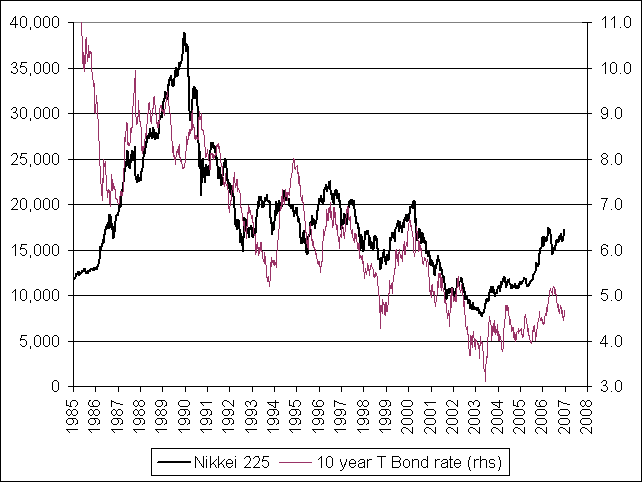
If we have to correct from an assumption of exponential growth back to linear growth, it's going to be very painful for people who've assumed the former. Especially for those with retirement accounts that are built on the idea that the stock market will always go up, given a long enough period. That has been true for America for the past 50 years, but I'm not sure it will always be true, especially if the stock growth is based on unsustainable trends and a bad assumption of permanent exponential growth. Look at Japan -- stock markets don't always go up if you wait even 20 years.
I just hope the credit crisis will not be so bad that it forces students to stay away from college because they can't get loans -- that's my personal stake in this! Of course I have a suspicion that we in the college business can respond by making tuition growth more normal. Well, we'll have to respond that way if things keep going like this, and you know, that's another correction that will bring a long-term trend back to sustainable levels. Tuition rising faster than inflation is not right, and we've got to bring that exponential growth down.
Growing is fine. But having to grow upon growing or you don't survive? That's wrong.
Part of this comes from a very insightful (and even Disney-related) blog post by Phil Vischer, creator of Veggie Tales. He posted this in July, back when oil was $140 a barrel and the Dow was 14,000, and I still think about it now several months later:
http://www.philvischer.com/?p=142
We have to help each other more now, more than ever. I see a lot of silver linings, but that's also because there's a lot of clouds. In the Bible the clouds are a sign of God's presence. Let's see how that works out -- because God often has things to say we may not want to hear.
For what it's worth, I'm thinking we may be seeing the end of a certain style of thinking on Wall Street. The current huge correction we're seeing is on the order of a philosophical shift, and I'm thinking an old broken philosophy needs to be left behind. That old philosophy would be the idea that for a company to be valuable, for its stock to go up, not only must it be profitable but it must be increasing in profitability. That is, the idea that a linearly growing company isn't growing enough but all companies should grow exponentially in order to succeed/drive values up. And that is simply not sustainable in the long run. People intent on making money placed a lot of bets that come down to that one assumption, and borrowed money to keep placing bets because their philosophy told them it must be true. And we Americans have been working harder and harder to make our companies grow exponentially because if we don't someone else will. We think "The Secret" is that we haven't thought positively enough or put in enough hours. And we're finding out we are inadequate to the task.
If we have to correct from an assumption of exponential growth back to linear growth, it's going to be very painful for people who've assumed the former. Especially for those with retirement accounts that are built on the idea that the stock market will always go up, given a long enough period. That has been true for America for the past 50 years, but I'm not sure it will always be true, especially if the stock growth is based on unsustainable trends and a bad assumption of permanent exponential growth. Look at Japan -- stock markets don't always go up if you wait even 20 years.
I just hope the credit crisis will not be so bad that it forces students to stay away from college because they can't get loans -- that's my personal stake in this! Of course I have a suspicion that we in the college business can respond by making tuition growth more normal. Well, we'll have to respond that way if things keep going like this, and you know, that's another correction that will bring a long-term trend back to sustainable levels. Tuition rising faster than inflation is not right, and we've got to bring that exponential growth down.
Growing is fine. But having to grow upon growing or you don't survive? That's wrong.
Part of this comes from a very insightful (and even Disney-related) blog post by Phil Vischer, creator of Veggie Tales. He posted this in July, back when oil was $140 a barrel and the Dow was 14,000, and I still think about it now several months later:
http://www.philvischer.com/?p=142
We have to help each other more now, more than ever. I see a lot of silver linings, but that's also because there's a lot of clouds. In the Bible the clouds are a sign of God's presence. Let's see how that works out -- because God often has things to say we may not want to hear.
Subscribe to:
Posts (Atom)

 Posts
Posts