Showing posts with label astronomy. Show all posts
Showing posts with label astronomy. Show all posts
Monday, October 12, 2015
"Streams in the Martian Desert" Posted at the BioLogos Blog
I wrote a response to NASA's recent press conference about water on the surface of Mars, and the resulting public shrug from most commentators. It also has a paragraph about a recent scientific finding that highlights the unique nature of Earth's geology. Here is the article, enjoy!

Friday, December 27, 2013
The Sun of Many Colors
This video combines the different colors we can see in the sun. One of them is yellow (surprise). Several of the others are colors that we can't see and sit beyond human eyesight, but reveal features like particular helium energy emissions and things like that. Each of these wavelengths was assigned a different color that we can see in the video. It's kind of mesmerizingly beautiful, like peeling layers off of the sun to see the dynamics inside.
For more information see this blog post at Discover.
Friday, November 22, 2013
A 3-D Supernova
The Cassiopeia A supernova remnant has been reconstructed in 3-D. It looks like a big, big explosion, with purple lines that might be "surprise lines" in a comic strip, but here must be some superheated jets of matter and radiation. If we can't travel to the stars, through astronomy we can bring the stars to us. (The rotatable version above doesn't work on IE but does work on Chrome for me.)
Friday, July 12, 2013
The Stained-Glass Planet

"Captain's Log, Stardate 071213. We have now ventured close to the planet HD 189733b and can see it with our own eyes for the first time. It is a deep blue, not an ocean-blue, but brilliant sapphire against the backdrop of space. The away team is preparing their protective gear to withstand the raining glass shards and 9000 mile-per-hour winds... "
If we can't go to this planet, at least we can see the light. For the first time the light from a distant planet has been analyzed and, at the risk of mixing genres, it is the blue of the TARDIS. See the graph above to see how different this is from our system's planets. Two words: silicate rain.
This planet is so inhospitable to conceivable life that it makes our Jupiter seem downright cozy. But it's not about the possibility of life for this planet. It's about the color, and what a glorious color it is.
More information and a link to the paper preprint here.
Wednesday, June 5, 2013
Barns Are Painted Red Because of the Physics of Dying Stars
Barns Are Painted Red Because of the Physics of Dying Stars | Smart News
The upshot of this link? Because of nuclear physics, iron has the most stable nucleus of all the elements. It just does. All else follows from this: Because iron is the most stable nucleus available, when stars smash atoms together, they will make more and make stable atoms till they get to iron, and then they will stop. Therefore there's a lot of iron, therefore iron is cheap. It's red when it combines with oxygen, so it's the most cost-effective paint pigment around, and it was used on all the barns.
I'd turn it around and say that barns and Mars are red for the same reason. Mars is pigmented like a barn.
It's interesting to think about this ... even more interesting to think about what it leaves out from the equation. But it works for a nice little blog post.
The upshot of this link? Because of nuclear physics, iron has the most stable nucleus of all the elements. It just does. All else follows from this: Because iron is the most stable nucleus available, when stars smash atoms together, they will make more and make stable atoms till they get to iron, and then they will stop. Therefore there's a lot of iron, therefore iron is cheap. It's red when it combines with oxygen, so it's the most cost-effective paint pigment around, and it was used on all the barns.
I'd turn it around and say that barns and Mars are red for the same reason. Mars is pigmented like a barn.
It's interesting to think about this ... even more interesting to think about what it leaves out from the equation. But it works for a nice little blog post.
Friday, March 15, 2013
Rocks from the Bottom of a Martian Lake

The most amazing part is all the water it implies. It's a perfect clay that was probably deposited at the bottom of an ancient lake, meaning, holy cow, there was a whole LAKE on Mars. Since water is the most probable sine qua non for life, then this is exciting news for possible Martian microbes. Assuming existence is an exciting thing for microbes.
With all the evidence for water, Mars has just become a fascinating test case of how easy it is for simple life to emerge. If it didn't happen there, then it must be very hard. Looks like Mars was playing with a rather full deck, chemically speaking. Was it enough? Was the game rigged to win or lose? The question is still open, and it's the open questions that keep us moving forward.
The other things I note include that the red oxidized iron is not present below the surface, so most of Mars is gray, sulfur-rich rock without much oxygen. Life must have been simple and not photosynthesizing or oxygen-using.
Where did all that water go? What forms of life were able to take hold in those Martian lakes? Times like this I half think they shouldn't have called the rover Curiosity ... they should have called it Patience, because that's what we need to wait for these tests to be done ... which is a virtue, I know, I know ...
Thursday, February 21, 2013
A Little Green Meteorite from Mercury
It's not quite the shade of the aliens from Toy Story 3, but it's close:

This odd rock is definitely from outside our planet, and the best hypothesis right now is that it's from Mercury. Its color comes from chromium and there's a lot of magnesium and calcium in it, but the weirdest thing is that it is almost completely devoid of iron. Iron is the most stable nucleus possible and there tends to be a lot of it in our rocks and normal asteroids. Although there's a lot of it around here, there's not a lot of it closer to the sun. Mercury is the best candidate for this profile of elements in the local environs (taking "local" somewhat loosely, of course).
So do we have a piece of rock that reflected traveling light ages ago -- a fragment of the messenger of the gods? Not sure yet, but there's several chemical tests to find out, detailed here. More to come ...

This odd rock is definitely from outside our planet, and the best hypothesis right now is that it's from Mercury. Its color comes from chromium and there's a lot of magnesium and calcium in it, but the weirdest thing is that it is almost completely devoid of iron. Iron is the most stable nucleus possible and there tends to be a lot of it in our rocks and normal asteroids. Although there's a lot of it around here, there's not a lot of it closer to the sun. Mercury is the best candidate for this profile of elements in the local environs (taking "local" somewhat loosely, of course).
So do we have a piece of rock that reflected traveling light ages ago -- a fragment of the messenger of the gods? Not sure yet, but there's several chemical tests to find out, detailed here. More to come ...
Monday, January 7, 2013
The Drake Equation: Easy to Calculate but Hard to Solve
The Drake equation was put together to estimate the probability of (detectable) extraterrestrial life. That is, the number of planets who might be able to talk to us. As equations go, the math's not hard. All you need to do is multiply seven probabilities together:
N = R* * fp *ne * fl * fi * fc * L
Straight outta Wikipedia:
N = the number of civilizations in our galaxy with which communication might be possible (i.e. which are on our current past light cone); and
But the story doesn't end there. Notice that term three includes the phrase "that can potentially support life." Our best guess is that this requires liquid water and temperatures between 0 and 100C. Our system does this but the other systems don't look like our system:
"... according to Johnson ... our solar system is extremely rare. 'It's just a weirdo,' he says."
Of course, these other systems are around cooler stars, and so the liquid-water zone will be closer to the planet, and we know at least some planets are in the right zone. So there's hope yet for alien life, but it's worth noting that we live in a weird solar system (on galactic terms). How necessary is the weirdness? Is it possible that being too close to a cooler star could doom the prospects of life for some reason, even if liquid water persists? (I'm thinking radiation damage may be greater closer in?)
At any rate, we're closer to getting more parameters fixed but I'm not sure how much closer to solving the Drake equation we actually are. The bootom line is that our solar system appears exceptional -- but is it unique? Still don't know.
N = R* * fp *ne * fl * fi * fc * L
Straight outta Wikipedia:
- R* = the average rate of star formation per year in our galaxy
- fp = the fraction of those stars that have planets
- ne = the average number of planets that can potentially support life per star that has planets
- fℓ = the fraction of the above that actually go on to develop life at some point
- fi = the fraction of the above that actually go on to develop intelligent life
- fc = the fraction of civilizations that develop a technology that releases detectable signs of their existence into space
- L = the length of time for which such civilizations release detectable signals into space
But the story doesn't end there. Notice that term three includes the phrase "that can potentially support life." Our best guess is that this requires liquid water and temperatures between 0 and 100C. Our system does this but the other systems don't look like our system:
"... according to Johnson ... our solar system is extremely rare. 'It's just a weirdo,' he says."
Of course, these other systems are around cooler stars, and so the liquid-water zone will be closer to the planet, and we know at least some planets are in the right zone. So there's hope yet for alien life, but it's worth noting that we live in a weird solar system (on galactic terms). How necessary is the weirdness? Is it possible that being too close to a cooler star could doom the prospects of life for some reason, even if liquid water persists? (I'm thinking radiation damage may be greater closer in?)
At any rate, we're closer to getting more parameters fixed but I'm not sure how much closer to solving the Drake equation we actually are. The bootom line is that our solar system appears exceptional -- but is it unique? Still don't know.
Saturday, January 5, 2013
To Boldly Tweet Where No Man Has Tweeted Before
When you read the address for this link you may be skeptical. But after reading it I would at least nominate it for best thread of the month. What happens when real astronauts in space and Star Trek cast members start tweeting back and forth? Read and find out:
http://www.cyberbuzz.com/2013/01/05/the-single-greatest-meme-to-ever-happen-on-twitter/
(My favorite involves the Nanites but that's because I remember the Nanites ... )
http://www.cyberbuzz.com/2013/01/05/the-single-greatest-meme-to-ever-happen-on-twitter/
(My favorite involves the Nanites but that's because I remember the Nanites ... )
Saturday, December 29, 2012
Jupiter Rising Over the Moon on Christmas Day
In Brazil on Christmas Day, there was an occultation. Lest you think this is the beginning to a sub-par Edgar Allan Poe story, let me note that Jupiter was occulted -- covered -- by the moon. An astronomer named Rafael Defavari caught the following video with a 20-cm telescope. It's a beautifully inverted echo of a sunset and sunrise. Consider this another belated Christmas gift.
(found on the Bad Astronomy blog)
(found on the Bad Astronomy blog)
Thursday, December 20, 2012
Looking Back at Saturn

PS: Try clicking on the "art and science" label link to see more incredible astronomy pics -- many are showing up on year-end best-of lists even now ...
Saturday, November 10, 2012
Are We in a Goldilocks Zone in Time as Well as Space?
A recent finding has just blown my mind and I'm not sure if anyone else has put it together with other results yet. To me at least, putting it together, it makes the universe look much different than I thought at the beginning of the day, so I'd like to share it with you and see what you think. It also suggests that Earth is that much more special. Let me explain.
The Kepler space telescope is exciting stuff, because it's looking for planets around distant stars and finding them all over the place. Here's an orrery of the planets found by Kepler (and even this is more than 18 months old now!):
The real key is to find a planet in the habitable zone (the "Goldilocks zone"), which is the right distance away from a sun so that ice melts and steam condenses, giving liquid water. Note that even this is only one element in the recipe for life, but it's got to be one of the most important ones. Here's one planet recently discovered to be "in the zone."
But, like I mentioned, you need more than liquid water for life. For instance, you need metals far down on the periodic table like iron, molybdenum, etc., to build a rocky planet out of, and to provide important catalysts for life. Basically, you need a decent portion of the periodic table built in order to do complex chemistry. After the Big Bang you start with the simple stuff, hydrogen and helium, and have to build up to iron and company. That's takes a while, past the first generation of stars, at least, according to this article, "a few billion years."
I've been aware of that for a while, and that some people say you need more than "a few" billion years, you need something more like 7 or 8 billion years. (You need at least three because the oldest stars of this type are about 10 billion years old, and our sun's right in the middle of that.) The universe is 13.7 billion years old and the earth is 4.5 billion years old, so by that logic, there's a "few billion"-year window in which an earth-like planet could have been built and produce complex life. Kind of like a "Goldilocks zone" in time rather than space. I've always wondered if the reason why we're not hearing much through SETI or seeing many aliens coming down from the sky (well, I haven't seen them, have you?) is if we're kind of the first kids on the block, because it's taken this long for the periodic table to form and then a planet to form and gestate life. I've assumed there's plenty of time for more planets and stars to form in the universe. I may have assumed wrong.
So, you need water and you need metals. But don't forget, you also need a star to have formed at the same time as the planet. The "photo" part of the whole photosynthesis thing is kind of important. That's why I was shocked to hear that a recent comprehensive study of star formation has suggested that the universe is almost done making new stars. By looking at star formation rates, the astronomers concluded that the golden age for star formation was 11 billion years ago and has been declining ever since, and recently it's just dropped off the table. Check out this graph:

It's not that the universe's biological clock is ticking ... it's more like it's wheezing its last. The universe is not just out of childbearing age, it's close to collecting retirement. [Insert bad "my universe is so old/how old is it?" joke here.] This -- if it holds up, and it looks solid to me -- is one of the most mind-boggling things I've read. It also means that complex life is that much more likely to be rare and precious. If it ain't happened yet, it ain't happening.
Maybe complex life can form in 3 billion years rather than 4 (maybe the "boring billion" didn't have to happen ... but my impression is that it did). Maybe a star has formed 2 billion years ago that will have complex life in 2 billion years. But it looks like the constantly-expanding universe combined with limited energy and matter would suggest that if something hasn't happened yet it will not have much more of a chance to happen. That's a "few billion"-year window that may have already closed. The numbers are adding up to be surprisingly restrictive in time, even in a universe that is huge in space beyond comprehension.
As my physics colleague likes to quote, "There are two possibilities: either we are alone in the universe or there are others like us out there. Either way it blows your mind." For me, the likelihood of the former just got raised, and my mind is suitably blown.
The Kepler space telescope is exciting stuff, because it's looking for planets around distant stars and finding them all over the place. Here's an orrery of the planets found by Kepler (and even this is more than 18 months old now!):
The real key is to find a planet in the habitable zone (the "Goldilocks zone"), which is the right distance away from a sun so that ice melts and steam condenses, giving liquid water. Note that even this is only one element in the recipe for life, but it's got to be one of the most important ones. Here's one planet recently discovered to be "in the zone."
But, like I mentioned, you need more than liquid water for life. For instance, you need metals far down on the periodic table like iron, molybdenum, etc., to build a rocky planet out of, and to provide important catalysts for life. Basically, you need a decent portion of the periodic table built in order to do complex chemistry. After the Big Bang you start with the simple stuff, hydrogen and helium, and have to build up to iron and company. That's takes a while, past the first generation of stars, at least, according to this article, "a few billion years."
I've been aware of that for a while, and that some people say you need more than "a few" billion years, you need something more like 7 or 8 billion years. (You need at least three because the oldest stars of this type are about 10 billion years old, and our sun's right in the middle of that.) The universe is 13.7 billion years old and the earth is 4.5 billion years old, so by that logic, there's a "few billion"-year window in which an earth-like planet could have been built and produce complex life. Kind of like a "Goldilocks zone" in time rather than space. I've always wondered if the reason why we're not hearing much through SETI or seeing many aliens coming down from the sky (well, I haven't seen them, have you?) is if we're kind of the first kids on the block, because it's taken this long for the periodic table to form and then a planet to form and gestate life. I've assumed there's plenty of time for more planets and stars to form in the universe. I may have assumed wrong.
So, you need water and you need metals. But don't forget, you also need a star to have formed at the same time as the planet. The "photo" part of the whole photosynthesis thing is kind of important. That's why I was shocked to hear that a recent comprehensive study of star formation has suggested that the universe is almost done making new stars. By looking at star formation rates, the astronomers concluded that the golden age for star formation was 11 billion years ago and has been declining ever since, and recently it's just dropped off the table. Check out this graph:

It's not that the universe's biological clock is ticking ... it's more like it's wheezing its last. The universe is not just out of childbearing age, it's close to collecting retirement. [Insert bad "my universe is so old/how old is it?" joke here.] This -- if it holds up, and it looks solid to me -- is one of the most mind-boggling things I've read. It also means that complex life is that much more likely to be rare and precious. If it ain't happened yet, it ain't happening.
Maybe complex life can form in 3 billion years rather than 4 (maybe the "boring billion" didn't have to happen ... but my impression is that it did). Maybe a star has formed 2 billion years ago that will have complex life in 2 billion years. But it looks like the constantly-expanding universe combined with limited energy and matter would suggest that if something hasn't happened yet it will not have much more of a chance to happen. That's a "few billion"-year window that may have already closed. The numbers are adding up to be surprisingly restrictive in time, even in a universe that is huge in space beyond comprehension.
As my physics colleague likes to quote, "There are two possibilities: either we are alone in the universe or there are others like us out there. Either way it blows your mind." For me, the likelihood of the former just got raised, and my mind is suitably blown.
Friday, October 12, 2012
Set the Controls for the Heart of the Nebula
(This makes two old Pink Floyd references today -- the first was when I was talking about separation science in biochem lecture and showed the cover of Dark Side of the Moon as an example.)
Here is a very detailed 3-D reconstruction of what a nearby nebula located in the constellation of Cepheus looks like (probably). It's quite beautiful, and reminds me of the Doomsday Machine from the original Star Trek:

Here is a very detailed 3-D reconstruction of what a nearby nebula located in the constellation of Cepheus looks like (probably). It's quite beautiful, and reminds me of the Doomsday Machine from the original Star Trek:
There's a whole site of these out there located here. And thanks to this post for alerting me to this work of art. Or is it science? Hard to tell.
Saturday, September 22, 2012
My Favorite Astronomy Photo of the Year
Since this link has the Royal Society's best astronomy photos of the year, and this photo below is my favorite of the Royal Society's album, then it must therefore be the best astronomy photo of the year. I see no problem with that logic. Enjoy the photo. (The green is oxygen, which may mean oxygen is my favorite element?)


Friday, August 24, 2012
Which is Bigger: The Universe or the Brain?
Here is a nice essay by Robert Krulwich bridging the two cultures divide by comparing the complexity of the universe with that of the brain that beholds the universe. I only wish Marilynne Robinson had been consulted ... but I'm sure she'd say something like this (from "Reclaiming a Sense of the Sacred" in The Chronicle of Higher Education):
Having read recently that there are more neurons in the human brain than there are stars in the Milky Way, and having read any number of times that the human brain is the most complex object known to exist in the universe, and that the mind is not identical with the brain but is more mysterious still, it seems to me this astonishing nexus of the self, so uniquely elegant and capable, merits a name that would indicate a difference in kind from the ontological run of things, and for my purposes "soul" would do nicely.
The illuminating part of the question is not necessarily the answer you give it, which may be somewhat arbitrary. The illuminating part of the question is that the two things are comparable in the first place, and that one of them is yours.
Having read recently that there are more neurons in the human brain than there are stars in the Milky Way, and having read any number of times that the human brain is the most complex object known to exist in the universe, and that the mind is not identical with the brain but is more mysterious still, it seems to me this astonishing nexus of the self, so uniquely elegant and capable, merits a name that would indicate a difference in kind from the ontological run of things, and for my purposes "soul" would do nicely.
The illuminating part of the question is not necessarily the answer you give it, which may be somewhat arbitrary. The illuminating part of the question is that the two things are comparable in the first place, and that one of them is yours.
Friday, August 17, 2012
Titan, the Liquid Moon
Close observations of Saturn's moon Titan show that as it orbits it is deformed by Saturn's gravity. Here's an animation of what is seen, only slightly exaggerated:
Embedded video from
NASA Jet Propulsion Laboratory California Institute of Technology
This means that somewhere, deep down, Titan is a different phase of matter. It is a liquid moon. And where there's liquid flow could there be life?
Right now, who knows? The great part about this is that it's close enough that we can imagine taking a jaunt out to see. Of course, kind of hard to call it a jaunt when it's probably a one-way trip for any humans ...
[More information on this observation found here.]
Embedded video from
NASA Jet Propulsion Laboratory California Institute of Technology
This means that somewhere, deep down, Titan is a different phase of matter. It is a liquid moon. And where there's liquid flow could there be life?
Right now, who knows? The great part about this is that it's close enough that we can imagine taking a jaunt out to see. Of course, kind of hard to call it a jaunt when it's probably a one-way trip for any humans ...
[More information on this observation found here.]
Wednesday, August 15, 2012
Tolkien in the Sky with Diamonds
If you're ever hanging out on Mercury, now you can find Tolkien there:
 See him? Right there, between Goethe and Mendelssohn.
According to Tolkien's own writings, the half-elven seafarer Earendil (you know, Elrond's papa) carries the shining Silmaril on his brow as he crosses the skies. Now, the little bit of Mercury that we can see shining, chasing the sun, is Tolkien's vessel. He shines like a diamond ... explaining the rather bad pun in the title above.
More on why Mercury has craters named for artists on it can be found here.
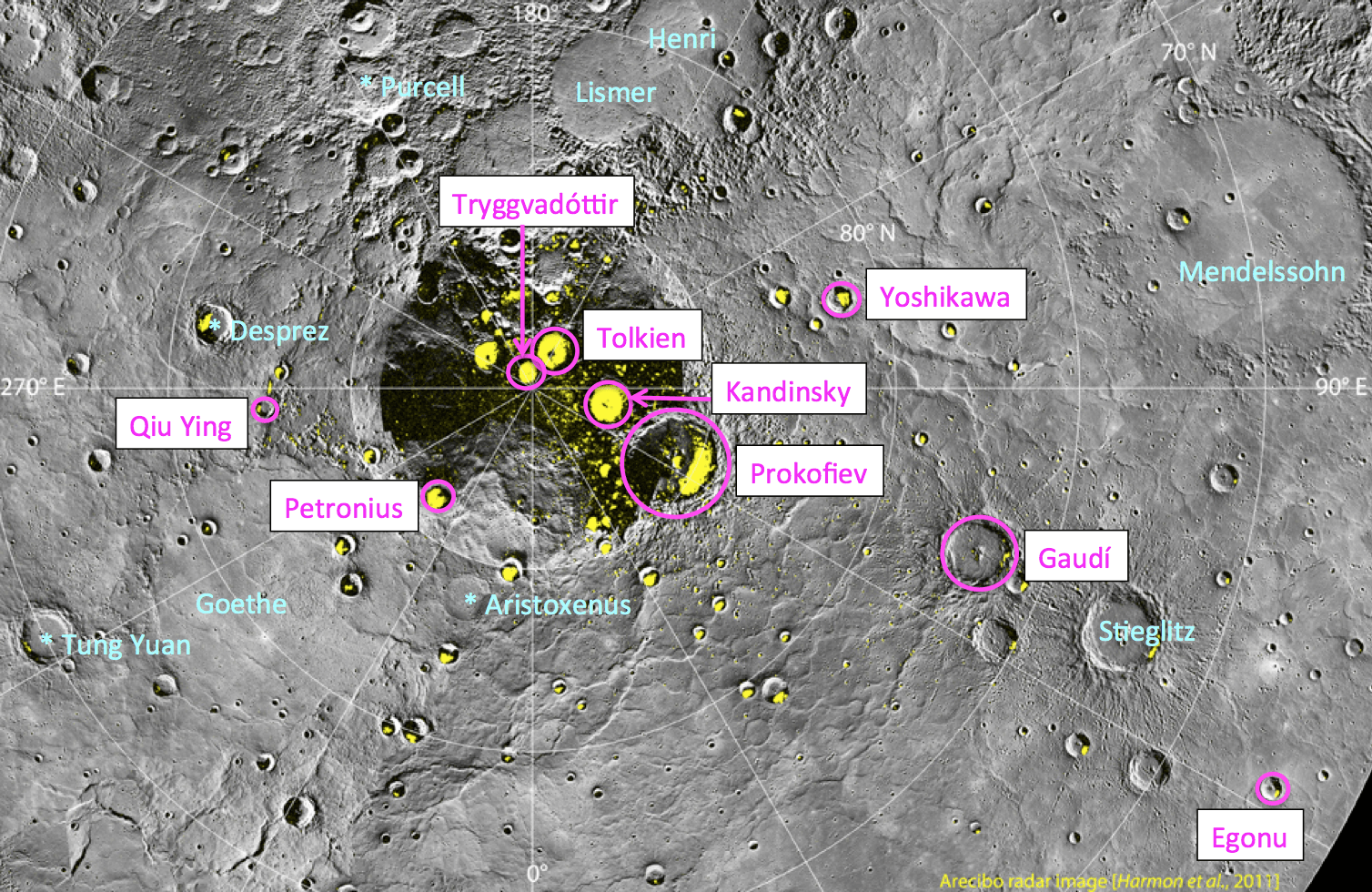
According to Tolkien's own writings, the half-elven seafarer Earendil (you know, Elrond's papa) carries the shining Silmaril on his brow as he crosses the skies. Now, the little bit of Mercury that we can see shining, chasing the sun, is Tolkien's vessel. He shines like a diamond ... explaining the rather bad pun in the title above.
More on why Mercury has craters named for artists on it can be found here.
Thursday, July 26, 2012
The Van Gogh Painting Hidden in the Sun's Corona
Quick question: Is the sun solid, liquid, or gas? I know, trick question ... it's none of the above, mostly being composed of plasma, a fourth state of matter beyond the typical three terrestrial states. Being its own unique state of matter, scientists are going to study it, and even something as simple as watching it heat up and cool down can yield unusual beauty.
Here's a picture of how the temperature of the sun's plasma changes:

Here's a video of how they did it:
And here's links to previous entries on the blog about how an island, the ocean and dominoes can look like Van Goghs, with various degrees of intentionality. Apparently since this is the fourth post on this kind of things, I need to create a category for "Van Gogh" in my labels section.
Here's a picture of how the temperature of the sun's plasma changes:

Here's a video of how they did it:
And here's links to previous entries on the blog about how an island, the ocean and dominoes can look like Van Goghs, with various degrees of intentionality. Apparently since this is the fourth post on this kind of things, I need to create a category for "Van Gogh" in my labels section.
Tuesday, July 10, 2012
A Music Box Made of Planets
"Natural" music doesn't often sound very musical -- except once in a blue moon. Here's some that does. This example of "natural" music works, and even makes a point. The astronomer Alex Parker put this together by assigning different tones to six different planets observed circling around a distant star (the Kepler-11 system), as explained on the YouTube notes:
Here, I’ve taken each transit seen by the observatory and assigned a pitch and volume to it. The pitch (note) is determined by the planet’s distance from its star (closer=higher), and they are drawn from a minor 11 chord. The volume is determined by the size of the planet (larger=louder).Even my untrained ear can tell the tones never converge or coincide, they keep plinking along like raindrops, and so this music shows that the planets never come together into "orbital resonance". It's just doing it with music rather than numbers. Or numbers as music, that's more like it. I think someone should expand this and maybe combine it with DNA music. (A challenge for the next generation of composers!)
Saturday, June 9, 2012
Venus Refracting Sunlight
Here's a nice picture of refraction in a close-up of the recent transit of Venus. The thin, even ring of light around Venus is its thick atmosphere catching the sunlight and bending it so that the atmosphere is filled with light -- a halo for the planet of beauty.

Originally seen at the Bad Astronomy blog.

Originally seen at the Bad Astronomy blog.
Subscribe to:
Posts (Atom)

 Posts
Posts


