The first day of class is always fun. I try to review two things:
1.) Cell Biology: Zoom in and out through the cell. How big are different biomolecules?
2.) Instrumentation: How to separate and analyze the parts of the cell with everyday items that could be used globally -- e.g., in Burundi. In the past few years this has expanded exponentially thanks to portable phones and 3D printing.
If I had a theme park, the first point would make a really great dark ride and the second would make for some EPCOT-like interactive exhibits.
Here's so you can listen in if you like (sorry for the loud scratchy mic at the beginning when I have to quiet them all down!):
Showing posts with label education. Show all posts
Showing posts with label education. Show all posts
Monday, September 26, 2016

Monday, June 22, 2015
Understanding Brain Science with Inside Out

Inside Out is not just an entertaining movie, it's also a worthwhile movie. It had enough bright colors and pratfalls for my four-year-old and enough deep psychological subtext for me. I may never look at certain thought processes the same way again. The subtext is sturdy enough that it provides another dimension to the movie: it forms a framework for understanding brain science. As Exhibit A, I submit a recent Cell paper that Inside Out can illuminate.
(Before I continue, let me say that this contains MILD SPOILERS for a location visited relatively late in the movie. If you want to discover this location for yourself, go see it right now and come back!)
The paper I'm thinking of is titled "Sleep Facilitates Memory by Blocking Dopamine Neuron-Mediated Forgetting." Like any good title, it contains the key point of the paper, which can be illustrated using the imagery of Inside Out.
Researchers started from the knowledge that sleep helps build memories. In the Inside Out world, the sky turns black during sleep time and the memories roll out to Long-Term Memory storage, which fits precisely with this knowledge. Some memories don't fit in Long-Term and are rolled down to the Memory Dump. By studying memories of smell in fruit flies, the researchers dug into the tubes and found one gatekeeper who determines which memories roll where.
Imagine an Inside Out Forgetter (as pictured above) who sits at the entry to Long-Term Memory, kicking some memories out of the rolling chute and down into the black funnel that is the memory dump. This Forgetter is Dopamine -- the same molecule that gives you that euphoric dopamine rush so many people talk about. Maybe this particular Forgetter is moonlighting, constructing pleasant sensations by day and working as a Forgetter by night.
What the scientists did is they kidnapped the Dopamine forgetter, and more memories rolled into Long-Term storage. The science is a lot more detailed and complicated, mostly because dopamine has so many jobs, but the basic message is smaller than a Pixar short.
Speaking of which, can we enlist the Inside Out crew to make some educational videos for psychology courses? Something tells me profs teaching next year's courses will have a whole new set of references in them thanks to this movie. Which provides one more small reason to see it.
Saturday, April 18, 2015
BJM Bujumbura Report 2: Teaching Biochemistry to 173 Without Electricity
I just finished my first week of teaching. Every day there
was some problem. My first day was delayed 10 minutes because I couldn’t get
the outlets on the display wall to work. Then only 60 students showed up
because 100 were taking a Histology exam (I thought about 50, but was wrong, as
you will see from what happened on my fourth day). My second day was delayed 10
minutes because another class was taking a test and stopped exactly when my
class started. My third day was delayed by an intense thunderstorm. My fourth
day I had made 110 copies of a quiz and then 173 students showed up to take it.
(I improvised and said they could share copies and discuss this quiz since it
was the first one.) My fifth day the power was out for the first half hour, so
I used my battery-powered projector and the blackboard.
Teaching is an actual workout under these conditions. The
room was built as a music hall, not a classroom. It is hot in there as I teach,
but I can see many ways in which I feel prepared for this. I sometimes teach 70
students at once in the states – 173 is not completely different from that
number. (Plus, most of the students passed the first quiz!) I grew up in Florida and can tolerate the African heat just fine. I don’t
know French, but I know enough Latin that I can compare French and English and
see how they lines up.
One preparation that’s working particularly well is that I
bought a small, bright, battery-powered LED projector. On this, I project
French text to go along with the English text and pictures on the bigger but
electric-powered projector. I like to point to the pictures and words as it is,
so this gives me another set of “targets” in the French words that I can point
to. I think I’m learning to speak slowly and clearly so the students can
understand my English as they read the French. (About 10% of the class is
stronger in English, but most are stronger in French.)
When I was talking to the rector of the school, he mentioned
that students are culturally conditioned to listen. I notice that they do not
move as much as American students, and don’t give the same type of non-verbal
feedback. I’m looking for the ways I can pick up from them, but they are good
at focusing on the class and are not expecting me to entertain them (which is a
good thing, because entertaining another culture isn’t one of my gifts!).
This is harder than I thought it would be, and a bigger job
than I thought it would be, but I have to trust that I have been prepared for
such a time as this, and that I can give the students the specialized knowledge
they need to graduate as doctors. Please pray for me as I work these things
out.
Thursday, July 31, 2014
Why I Teach Where I Teach
I teach at a small Christian liberal arts school for a number of reasons. One of them is given in this probably overlong but still entertaining and pretty much right article titled "Don't Send Your Kid to the Ivy League". For example, I'm working with a nation-wide group that is trying to bring real knowledge-generating research into the teaching laboratory for ordinary science classes. None of us is at an elite school, and I think all of us are teaching our students in ways that the elite schools don't attempt.
But even at my institution, especially in conversations with those "above" me in the administrative order/Great Chain of Being, I find myself slipping into technocratic, job-focused justifications for what I do. It's one of those things where the playing field is so tilted that unless you put forward active effort you slip into the default pattern of thinking, even if you've consciously built your career around thinking differently. Don't be conformed -- be transformed.
Here's the quote that stands out to me:
But even at my institution, especially in conversations with those "above" me in the administrative order/Great Chain of Being, I find myself slipping into technocratic, job-focused justifications for what I do. It's one of those things where the playing field is so tilted that unless you put forward active effort you slip into the default pattern of thinking, even if you've consciously built your career around thinking differently. Don't be conformed -- be transformed.
Here's the quote that stands out to me:
Elite schools like to boast that they teach their students how to think, but all they mean is that they train them in the analytic and rhetorical skills that are necessary for success in business and the professions. Everything is technocratic—the development of expertise—and everything is ultimately justified in technocratic terms.
Religious colleges—even obscure, regional schools that no one has ever heard of on the coasts—often do a much better job in that respect. What an indictment of the Ivy League and its peers: that colleges four levels down on the academic totem pole, enrolling students whose SAT scores are hundreds of points lower than theirs, deliver a better education, in the highest sense of the word.
Thursday, April 24, 2014
Data on How Much Professors Work
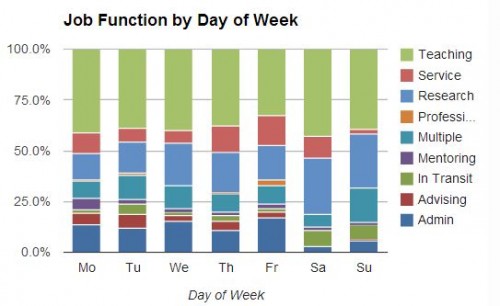
Finally, someone is tracking how much and what professors do all day. Here's a graph for "How much do professors work each week"?
 This fits with my experience. If anything, after becoming full prof I have worked more, not less. It's because I love doing what I do and the security of tenure actually gives me the chance to do it more.
(So ... maybe I shouldn't be so worried about the time crunch of becoming chair after all? Something tells me that bar may not be true for all institutions!)
The graph that subdivides each day shows that my experience is slightly different from others'. In my experience the teaching bar is more than 50% and the service bar is closer to 20-25%. But then again, the research bar and the teaching bar can blend together in some cases for me. The bottom line is, for a complex subject, this feels accurate to me:

(So ... maybe I shouldn't be so worried about the time crunch of becoming chair after all? Something tells me that bar may not be true for all institutions!)
The graph that subdivides each day shows that my experience is slightly different from others'. In my experience the teaching bar is more than 50% and the service bar is closer to 20-25%. But then again, the research bar and the teaching bar can blend together in some cases for me. The bottom line is, for a complex subject, this feels accurate to me:
Monday, March 17, 2014
Comedians Show Us Why MOOCs are Doomed
I just finished Furious Cool, a book that argues that Richard Pryor was a genius. Before I read the book I knew he was funny, and a brilliant performer, but a genius? The guy from Superman III and Brewster's Millions?
But he was a genius, and the book shows how, as well as a book can for demonstrating the genius of a live art like stand-up. (Surprisingly well because stand-up is about words.) The fact that Pryor's work didn't translate to Hollywood is a general rule. The best stand-up comedians have always had a hard time transitioning to TV and movie screens, and this is true for this century's comedians as well.
The Procrustean box of the screen doesn't just cut off the top, bottom, and sides of the comedian's act. It is a Procrustean cube that erects an impenetrable 4th wall between the performer and audience, severing the ties and feedback loops between the two. Because TV is sanitized, you know that it's not true that anything can happen, and the best comics like Pryor and the others mentioned in that article thrive on that unpredictability and connection to the audience. The best comedy is a relationship, even if the direct manifestation of that relationship is the duration of the laughs and the occasional heckler. The audience is always in on the joke.
TV desperately tries to compensate for this disconnect with laugh tracks and live stunts like Carrie Underwood's Sound of Music -- viewers tuned in not for the perfection, but for the imperfection of a stumble or stutter. Audience voting in something like American Idol also attempts to break down the wall of the Procrustean cube, but the more successful the show, the more the 4th wall slams shut against any illusion that you have an actual say in what happens next.
The most successful TV compensates for the impenetrable 4th wall not through comedy but through drama. A long story arc can show a character developing (like Breaking Bad or George Clooney back when ER was good). Even more, it can set up long philosophical mysteries like those on LOST, even if delivering on those mysteries is a debatable point (which I have debated earlier on this blog, I'm mostly in the pro-LOST camp). The audience participates when it empathizes with the growth of the characters, and chatters about what might happen on next week's episode. This is what an episodic form of spectacle like TV can do.
And this is why MOOCs are doomed if they intend to become anything but supplemental, vocational education.
Teaching is like stand-up. Even on a day when the lecturer is lecturing non-stop, there is still student participation and feedback. I even get a laugh once in while, and I can tell you that the best jokes are not the ones that are deliberately funny, but the personal ones or the ones that personalize something else (like giving emotions to a protein). This is what Richard Pryor did so well, and why no one could steal his jokes. He wasn't about jokes, he was about observing and inhabiting everything else around him. A teaching professor should do that, too, but focused on a single subject and bringing centuries of knowledge together to intensely dissect that subject and challenge the students to a new level.
So taking a teacher and putting her in a screen for a MOOC is like throwing a script at Richard Pryor and expecting him to rekindle his stand-up magic on a screen. It can happen, but it takes more than a camera and a routine and a genius. It takes specific work to make the MOOC work for that medium, and even then, I'm convineced that real learning, like real laughter, requires a real connection that cannot be replicated through a screen. Online comments are different from conversation. Even multiple choice testing is different in person.
I think MOOCs are very useful for topics where the student has a direct interest in making money from the information given, or for direct low-level instruction that can be reduced to the resolution of a video screen. I hope to use them myself to expand my knowledge in a few fields. But lasting upper-division education is about the person and about the relationship, just like stand-up is about the whole environment and music is about the performance. MOOCs have their place but they can never supplant the Biochemistry class.
But he was a genius, and the book shows how, as well as a book can for demonstrating the genius of a live art like stand-up. (Surprisingly well because stand-up is about words.) The fact that Pryor's work didn't translate to Hollywood is a general rule. The best stand-up comedians have always had a hard time transitioning to TV and movie screens, and this is true for this century's comedians as well.
The Procrustean box of the screen doesn't just cut off the top, bottom, and sides of the comedian's act. It is a Procrustean cube that erects an impenetrable 4th wall between the performer and audience, severing the ties and feedback loops between the two. Because TV is sanitized, you know that it's not true that anything can happen, and the best comics like Pryor and the others mentioned in that article thrive on that unpredictability and connection to the audience. The best comedy is a relationship, even if the direct manifestation of that relationship is the duration of the laughs and the occasional heckler. The audience is always in on the joke.
TV desperately tries to compensate for this disconnect with laugh tracks and live stunts like Carrie Underwood's Sound of Music -- viewers tuned in not for the perfection, but for the imperfection of a stumble or stutter. Audience voting in something like American Idol also attempts to break down the wall of the Procrustean cube, but the more successful the show, the more the 4th wall slams shut against any illusion that you have an actual say in what happens next.
The most successful TV compensates for the impenetrable 4th wall not through comedy but through drama. A long story arc can show a character developing (like Breaking Bad or George Clooney back when ER was good). Even more, it can set up long philosophical mysteries like those on LOST, even if delivering on those mysteries is a debatable point (which I have debated earlier on this blog, I'm mostly in the pro-LOST camp). The audience participates when it empathizes with the growth of the characters, and chatters about what might happen on next week's episode. This is what an episodic form of spectacle like TV can do.
And this is why MOOCs are doomed if they intend to become anything but supplemental, vocational education.
Teaching is like stand-up. Even on a day when the lecturer is lecturing non-stop, there is still student participation and feedback. I even get a laugh once in while, and I can tell you that the best jokes are not the ones that are deliberately funny, but the personal ones or the ones that personalize something else (like giving emotions to a protein). This is what Richard Pryor did so well, and why no one could steal his jokes. He wasn't about jokes, he was about observing and inhabiting everything else around him. A teaching professor should do that, too, but focused on a single subject and bringing centuries of knowledge together to intensely dissect that subject and challenge the students to a new level.
So taking a teacher and putting her in a screen for a MOOC is like throwing a script at Richard Pryor and expecting him to rekindle his stand-up magic on a screen. It can happen, but it takes more than a camera and a routine and a genius. It takes specific work to make the MOOC work for that medium, and even then, I'm convineced that real learning, like real laughter, requires a real connection that cannot be replicated through a screen. Online comments are different from conversation. Even multiple choice testing is different in person.
I think MOOCs are very useful for topics where the student has a direct interest in making money from the information given, or for direct low-level instruction that can be reduced to the resolution of a video screen. I hope to use them myself to expand my knowledge in a few fields. But lasting upper-division education is about the person and about the relationship, just like stand-up is about the whole environment and music is about the performance. MOOCs have their place but they can never supplant the Biochemistry class.
Monday, February 3, 2014
Draw Your Own Graphene Circuits

The distinct electronic properties of carbon when layered in graphene sheets have always intriguied me. What kind of electronic properties lurk in what is mistakenly called pencil "lead"? And now it turns out that you can unleash some of these properties ... by drawing with a pencil on paper.
In this story the implications of this are explored. Bending even a simple circuit changes how it conducts electricity, and vapors affect the resistance of the pencil circuit lines. Because of this, you can actually draw your own circuit and make a vapor sensor from pencil lines.
So can this be used in the teaching lab? Or could the answer to a test question be drawn on a piece of paper -- and then checked by attaching electrodes to each end?
Thursday, January 9, 2014
Heirloom Chemistry Set
If there's a word that's overused right now, it's "artisan." Its definition is so squishy it can be applied to any material, and if the material is shoddily made it may be considered more realistic and therefore more worthy of the label! But this item on Kickstarter is worthy of the word: an artisan's chemistry set.
Not only is the box sturdy and wooden, not only are the instruments and glassware simple, elegant, and thick, but each of the chemicals is homemade (ok, home-purified but you get the idea). The campaign was funded above and beyond the necessary, so now I'm caught outside the shop window wondering how I can get one of these for myself. What a great idea!
(The shop that the set-maker owns looks pretty incredible as well. I'll have to drop by if I'm in the area ... )
Tuesday, November 19, 2013
How to Hack Where's Waldo
Slate has a nice article about how to use an objective method to determine the optimal search pattern for Waldo. There are certain places where Waldo will be more than half the time, so you look there first. I can't wait to try this out on my kids. It also may be a good teaching exercise for a stats class ... or even a psychology, or design class? Are there other methods of analysis we can apply to Waldo's xy coordinates?
Wednesday, October 16, 2013
Another Chemistry Recruiting Scandal
Most of the sites that try to imitate The Onion are hit and miss. I think this one is a hit, although it might just be my chemistry bias showing through. (Title: "Chemistry Major On Probation After Allegations of Improper Benefits from Big Pharma Recruiters")
Wednesday, October 2, 2013
Biochemistry Lectures (2013)
Another year of lectures has begun. I always like to link to the lectures from here, so here's the link for this year. Pass it along and enjoy!
Thursday, September 12, 2013
A Summer Making Proteins
This summer I supervised a student project in which a student made four new versions of the protein we study, and then we tested them for binding to learn about the molecular basis of transplantation immunology. The data is coming in now and it looks good. This is just one of a dozen projects that went on over the summer in the chemistry/biology area, and they all got together for presentations and an end-of-summer BBQ.
Here's pictures and titles to give you an idea of the scope of what went on. Water bears! Next-generation sequencing! Metal-organic frameworks for hydrogen storage! Our students will have a lot to say when people ask what they did over summer vacation. Nice job, everyone.
Here's pictures and titles to give you an idea of the scope of what went on. Water bears! Next-generation sequencing! Metal-organic frameworks for hydrogen storage! Our students will have a lot to say when people ask what they did over summer vacation. Nice job, everyone.
Wednesday, September 11, 2013
Everything You Need to Know about Radiation
When I was in tenth-grade US history, the teacher allowed us to take one sheet of paper along for the test as a crib sheet. Anything could be hand-written on that sheet of paper. I was the sort who'd cram in basically all possible text onto every inch of space so that from a distance it looked like one big blue ink-spot covering both sides of the paper. (I didn't notice at the time that in the process of creating the crib sheet I learned everything twice, so I rarely used it on the test!) If I had those same parameters for physics tests on radiation, it would have looked something like the picture below, but it wouldn't have been half as nice. Also, the fundamental physics is the same so all the information is as relevant today as it used to be when the chart was made. Enjoy! (Here is where I found it and a link to a bigger version.)

Monday, July 15, 2013
To Succeed, Keep Your Eye in FRONT of the Ball

I always heard that the way karate fighters break through all those boards is that they focus on a point below/past all the boards. (Not sure if that's true, but at least it correlates with this post!) This recent study in PLoSONE fits with that for baseball. The best baseball hitters don't keep their eye on the ball, but in front of it. Their gaze automatically anticipates the location of the ball where it will hit the bat. This may be too fast for them to even know what they are doing, but they are not so much reacting as predicting. They are literally seeing -- or at least anticipating -- the future.
This is what learning can do, make prediction automatic. I propose that if learning anticipation is the trick to baseball and to karate, then it's also the trick to science and biochemistry and all sorts of other things.
And no number of Google searches will compensate for this trick when it comes to abstract knowledge. This is what I will try to teach -- keep your mind in front of the ball.
Scientists Redesigned
Here's a nifty little set of logos designed (by Kapil Bhagat for Science Day in India) to explain what scientists are best known for. Looks like a good teaching tool, especially for a science and history course:


Thursday, June 20, 2013
DIY Molecular Gastronomy
This article describes itself as Molecular Gastronomy but it's really just cooking with possibly-hard-to-find ingredients. Most of the chemistry is biochemistry, especially the transparent ravioli with an explanation that involves phospholipids. I am going to have to look into that one a little more because I'm not sure the explanation explains. But the point of this is first to do something cool with chemistry and only second to explain it: the proof is in the pudding, or the parfait, or whatever the end result is. This article will be bookmarked for possible inclusion in next year's biochemistry lectures ... or could it form the basis for at-home labs? Something to consider.


Thursday, June 13, 2013
Why Does Slate Think Basic Biology is Esoteric?
The news for today is not that the Supreme Count unanimously ruled against patenting naturally occurring genes in the Myriad case. At least, I saw that as such an obvious no-brainer that my fingers will not type a sentence that unequivocally states that such an item is actual news. No, the surprising part was in the Slate article I read on it, ostensibly about Justice Scalia's ignorance of the science, a key paragraph clearly condemns us all:
I'm left spluttering at the idea that a high-school biology sentence (which I italicized in the quote above) can be classified as "most esoteric" in any way. That is about as straightforward a description of DNA structure as you can get. It's probably at about the level of the letter Francis Crick wrote to his 5th-grade son describing the Watson-Crick DNA structure.
I don't want to name the particular author because it's not about that one author -- there's an editor, there's a readership, there's a whole culture implicated here, including me, because it's my job to let everyone know how this stuff works. It's about a whole culture that depends upon, even worships, science, and yet considers the word "nucleotide" to be excruciatingly esoteric, even boring. And that's the worst word in that sentence, folks. All of the other words are numbingly common. In fact, to me, those other words are the boring ones.
Power to the people through general biology and chemistry courses required for all college grads! Those courses are crucial. We need to understand how genes work, and I need to teach my students to the utmost end of my ability to prepare them for a world in which they will need to know DNA structure to understand Supreme Court rulings. Their language needs to include the word "nucleotide."
Also, the polticial angle in the wording of the headline: in my view Scalia is not being ignorant here -- he's being honest about his own limits in the face of complicated science. The article is clear on this, but the headline is not, and I have the feeling that an anonymous editor is more responsible for that tone than the byline author.
On the other hand, come on, the science is really not all that complicated, not compared to thousands of daily tasks. It's just that it seems complicated because it is not a daily task to you. That's fine, but we've got to try and address that, perhaps by making it closer to a daily task to use the word "nucleotide." You have a citizen's responsibility to learn biochemistry, just as I do to learn law. I promise not to be bored by law if you promise the same for my topic!
To Scalia’s credit, the science in Myriad is convoluted, especially for someone who hasn’t taken biology in decades. Justice Clarence Thomas, who wrote the majority opinion, takes an admirable stab at elucidating it at the outset, explaining the basics of genes, chromosomes, and “the familiar ‘double helix.’ ” He even expounds upon nucleotides for a time, penning what must be the most esoteric sentence in the court’s modern history: “[T]he nucleotide cross-bars are chemically connected to a sugar-phosphate backbone.” (One suspects Thomas was less than enthused to be assigned this case.)
I'm left spluttering at the idea that a high-school biology sentence (which I italicized in the quote above) can be classified as "most esoteric" in any way. That is about as straightforward a description of DNA structure as you can get. It's probably at about the level of the letter Francis Crick wrote to his 5th-grade son describing the Watson-Crick DNA structure.
I don't want to name the particular author because it's not about that one author -- there's an editor, there's a readership, there's a whole culture implicated here, including me, because it's my job to let everyone know how this stuff works. It's about a whole culture that depends upon, even worships, science, and yet considers the word "nucleotide" to be excruciatingly esoteric, even boring. And that's the worst word in that sentence, folks. All of the other words are numbingly common. In fact, to me, those other words are the boring ones.
Power to the people through general biology and chemistry courses required for all college grads! Those courses are crucial. We need to understand how genes work, and I need to teach my students to the utmost end of my ability to prepare them for a world in which they will need to know DNA structure to understand Supreme Court rulings. Their language needs to include the word "nucleotide."
Also, the polticial angle in the wording of the headline: in my view Scalia is not being ignorant here -- he's being honest about his own limits in the face of complicated science. The article is clear on this, but the headline is not, and I have the feeling that an anonymous editor is more responsible for that tone than the byline author.
On the other hand, come on, the science is really not all that complicated, not compared to thousands of daily tasks. It's just that it seems complicated because it is not a daily task to you. That's fine, but we've got to try and address that, perhaps by making it closer to a daily task to use the word "nucleotide." You have a citizen's responsibility to learn biochemistry, just as I do to learn law. I promise not to be bored by law if you promise the same for my topic!
Wednesday, May 8, 2013
Best Commencement Speech Ever?: The Film
In 2007 (is it possible I've been blogging that long?) I commented on the full text of David Foster Wallace's commencement speech at Kenyon College, so you should check that out again. A different part of the speech has been made into a film, with visuals that don't interfere with but rather amplify DFW's words. Well worth checking out the film at this link.
(In a side note, I tried to tell the fish joke at the beginning in my biochemistry class about water, in 2008 or 2009. I initially thought it didn't "work" because it didn't get a laugh, but I don't think it's intended to be a haha funny joke, come to think of it. Still, it turns out that Sam and Aidan were "visiting" the class that day and I named the fish Sam and Aidan, and Sam still remembers that. So it had a different level of value than intended. There's something appropriate about that.)
(In a side note, I tried to tell the fish joke at the beginning in my biochemistry class about water, in 2008 or 2009. I initially thought it didn't "work" because it didn't get a laugh, but I don't think it's intended to be a haha funny joke, come to think of it. Still, it turns out that Sam and Aidan were "visiting" the class that day and I named the fish Sam and Aidan, and Sam still remembers that. So it had a different level of value than intended. There's something appropriate about that.)
Friday, April 12, 2013
Book Review: How Children Succeed by Paul Tough

I'm tired of teaching-reform books. Finding a good one is as difficult as finding most anything on the Internet these days: you have to wade through hundreds of half-baked attempts to find the gem you're looking for. And there's a lot of them too: here's an op-ed on the topic running today/tomorrow in the New York Times. Good ideas, but a definite sense of futility, and I feel like I've read it before. Also, couldn't it really be edited to one page instead of two?
It's in this context that How Children Succeed really does stand out. It's not a perfect book, but it's the best on the topic that I've read. Paul Tough writes like he has a personal stake in the topic, and by the end of the book you find out that he indeed does, in multiple ways. He covers ground from the famous KIPP academy to public schools in Chicago to a tournament-winning chess team from the Bronx. There's some good science in here, but it's not wielded like a club, it's integrated into the conclusions, and it points beyond itself (perhaps that is the sign of good science).
A few of the points are contradictory -- is it optimism or pessimism that builds success? -- and a few of the initiatives, like the new "character GPA" focus, are so new they are untested and feel faddish. (There's nothing more faddish than education reform ... ) These are exceptions. Most of this book is much more solid than average.
And don't be thrown by the "children" in the title: several parts of the book have to do with undergraduate retention and definite "young adult" areas of success.
One point Tough hits on but also tends to shy away from is how close all these character-building traits are to a traditional concept of virtue. I understand that, recently, virtue tends to bring to mind compulsive Republican gamblers (it's a long story if it doesn't for you), but to me at least, the notion only works if it is grounded in a community of oft-confused pilgrims working their way toward a goal rather than having arrived at it. In that context, virtue is the best single word to describe what this book recommends. Virtue and love, especially the love of a parent. That definition of virtue must involve love.
My best recommendation of this book is that Tough covers the same ground as Malcolm Gladwell in several places, in a much less flashy yet somehow more lasting manner. So in that sense, he's a more humble and more accurate Gladwell, writing in book length rather than essay length. What's not to like about that?
Tuesday, March 12, 2013
Intro to Quantum Mechanics (Using Light Bulbs)
Did you know: The colors of fire are a big shining clue that light is made of discrete packets, or quanta? At least historically, the color of light emitted by a hot item led to the conclusion that light must be like a particle as well as like a wave. Via a few brains, including Einstein's. Now we can look at a star's color and tell its temperature. If you'd like to know how it all fits together (with stick figures to illustrate), here's a video of it, which you can be sure will find its way into my next physical chemistry course:
Subscribe to:
Posts (Atom)

 Posts
Posts


