Showing posts with label Tolkien. Show all posts

Wednesday, July 17, 2019

A Letter to My Son About the Soul


Monday, May 7, 2019

Dear Aidan,

It was a blessing and a curse watching you compete Saturday. Yes, it was Bible Quiz (of all things), but it’s the same emotions any parent feels watching their kid play a weekend sport. I hoped you would take to this, and you have beyond any expectations.

So it was a blessing watching you remember words precisely and play the little parts of the game expertly, especially when you guess right and gain a lot of points.

But your high-risk strategy has a necessary downside, when you guess wrong and lose a lot of points. You take a lot of three-point shots, and the percentage is worse, but they’re worth more.

After that one prelim round, when your losses clustered all together, I saw my own reaction mirrored in yours. You couldn’t talk. You collapsed into yourself and walked away. I tried to put a hand on your shoulder but I don’t know if you even felt it. I could only let you be, and wait for the next round, if there was a next round.

There was, and you brought it all. You sailed through it with a tight precision. Then you went on, climbing step by step to take the top prize, winning a trophy so big it can only be classified as baggage. The trophy shows in its own ludicrous size that it is not the point. Who wants this chunk of wood and “gold” paint?

I wasn’t happy to have to make space for that thing in the trunk, but I was happy because it culminated months of your hard work. You wanted this, you considered the cost, planned a path, executed a strategy, ran into an obstacle, and overcame it.

I thought about why you were doing this, and I recalled the musical version of Percy Jackson that we had seen two nights before. The first song was all about the young demigods trying to catch their distant god-parents’ attention by accomplishing something big, something that the distracted gods just HAVE to notice. Did you notice how even their camp schedule was based around competition, and how the daughter of Athena honed her own battle strategy so that her god-mother would notice her? That’s the natural consequence of a world of competition: winning forces people to take notice. It was true for the Greeks, it was true for the Egyptians, and the Norse, and the soccer moms today.

Percy Jackson is missing his god-father, and that aspect to his character fits with the Greco-Roman world. All the powerful people believed this 2000 years ago: a god was a powerful man who gave you life but is off on business now and has left you to make a mark. Make some noise and maybe he’ll notice.

Jesus contradicted all this. He said God is near, God is love, God scatters life through a world like a sower scattering seed through a world of obstacles -- but God doesn’t just leave it there. God makes every seed grow, even the tiniest mustard seed, without us knowing exactly how. God gives Godself, overflowing as the Spirit, a bubbling stream to anyone who asks.

This is very different from a world where the person who captures the flag or wins the quest might get his father’s attention. Jesus was building on a foundation of Hebrew prophecies, laws, and songs showing that God is the good creator and sustainer of all things. Jesus took it farther by saying God is so good at giving gifts that God knows not just what you want but what you need. What we need is, ultimately, the Spirit of the Good Giver, who made us to need that Spirit.

Since it’s the week after Easter, I’m reminded of John’s picture of Jesus, risen from the grave, giving the disciples the Spirit by breathing on them. Kind of weird -- not the kind of image that has been repeated in Western Art that often -- but deep and resonant in its weirdness. That action means a lot:

First, don’t miss the obvious. Jesus had breath, a physical body that does the one thing physical, living bodies do all the time, in that it exhaled air.

Second, he gave that breath away, emptying himself to lift them up.

And he did so in a deliberate repetition of what happened thousands of years before in the Garden of Eden, when God breathed into Adam’s nostrils the breath of life, and he became a living soul.

This last image is from Genesis 2. It takes place in the same Bible as John 20, but many pages before, written at a different time in a different language. The Genesis verse doesn’t have much detail beyond a few solid, earthy words: “blow”; “nostrils” (they were face to face); and the mysterious term “soul.”

At this point in the story, God had formed Adam’s body from the dust, but that wasn’t enough. God was the good father to the first man and gave the gift of breath, and Adam started to move. I like the Latin term for soul best: “anima.” (Knowing the many sides of this word is why you’re learning Latin!) God blew on Adam and Adam became ANIMA-ted. “Soul” is an earthy term like “dust” and “nostrils,” and can be applied to all things that move. But in Adam’s case it was a special gift of God, reflected in the special phrase “breathed into his nostrils the breath of life.” God only knows precisely how that worked, but somehow something thin, active, and without parts flooded the physical, soulish body of Adam.

I can take apart an animated thing in the lab and learn something about how it works. The amazing thing is how much I can see. Living things are built from an untold number of chemical cycles, in which food comes in, is broken down, is used to build new cells, is breathed out as carbon dioxide, which a plant can “breathe in” and build up. The atoms are constantly cycling. As you breathe in and out, some atoms get lodged in your body but others fly away. I read once that 98% of the atoms in your body are replaced every year.

But you’re clearly the same Aidan who competed in Bible Quiz last year, right? So whatever it is that makes you “you,” it’s not the atoms. And whatever made Adam Adam, it wasn’t the atoms. The point of Genesis 2 is not to trace the atoms, it’s to show God giving the soul, face to face with the first man. (The point of chemistry is to trace the atoms, and that’s so relatively unimportant that we could wait a couple more millenia before learning it.)

Adam’s body of chemical cycles, reproducing and repairing, breathing air in and out, it all came from the earth. Each cycle moves because it is missing something: the atoms bind and the chemicals react to make something new. Also, each cycle has a hole in the middle. There’s a lot of empty space in the cycles. Even the atoms themselves, which seem so solid to us, are mostly empty space, with each dense nucleus relative to the atomic radius being only the size of a pea in a cathedral. Even the most solid things and the most dynamic things are open and empty, matter moving in the void. If this seems inadequate, that’s because it is inadequate. I think this is a sign that behind the void is a Creator without parts who has non-material, non-dissectable ways of filling all that emptiness.

Can I reiterate how much I don’t know here? It doesn’t really matter how long it took for these cycles to build from the dust, because there wasn’t anyone around to be impatient about it. Adam only became a soul when his eyes faced God’s (we know that that means on his side but not on God’s) and God’s breath became his. Whatever atoms were involved would soon leave him.

What would always remain in him was thin, strong, and without parts: Adam’s memory of the fact that there was once a relationship, face to face, Creator to creature. God had the same memory. God remembered Adam and his descendants.

The word-picture in Genesis 2 is like the verse in Genesis 1 where humans are all made in God’s “image,” to bring in another mysterious word. The simplest way to make an image of something is to hold a mirror to it. When Adam saw God, imagine God’s own image reflecting off Adam’s eyes, being pieced together in Adam’s brain, and therefore flooding and shaping Adam’s being. Carefully put Genesis 1:27 and Genesis 2:7 side by side, and imagine Adam face to face with God, reflecting his Creator, shining for all others to see.

There’s a lot of questions you probably have about the rest of Genesis 2, but this letter’s already long enough. In the rest of Genesis 2 relationships are made, and in Genesis 3, they are broken.

The image language shows up in a few other places scatted through the Hebrew scriptures. In Psalm 73, the same Hebrew word for image is used for God looking on the proud and mighty, the demigods of this world, but here something is broken: “Like one waking from a dream, Lord, when arising, you will despise their image.” We’ve all warped the mirror and defaced the image in some ways, all of us except Jesus, the perfect and accurate image of God. Paul uses the word “image” to say this exact thing in Colossians 1.

Adam’s body was a bottle of flesh, made with dynamic cycles of atoms with empty space scatted throughout, from the dust of this world, according to the patterns of this world. God gave Adam a puff of “breath” that made him a living soul, able to move deliberately, think, and speak, able to relate. God gave you this same “breath,” through Adam and Eve, through Cain and Cain’s wife or Seth and his wife, through … … … , through Grandpa and Nana, through me, to you. You can also move, think, speak, relate, and choose. For example, you can choose to work hard to win Bible Quiz, and I respect and admire that choice. I want it to pay off, even as I know it won’t always.

The gift of God comes from above and is not subject to scientific study or dissection. It has no parts we can pry open, but a secret center only you (and God) can detect. The rules of science, worked out over hundreds of years, apply to atoms, but the soul was forged by a relationship with a God not made of atoms, or any parts at all.

Science can only dissect what’s below it, so that God’s gifts of spirit and soul were excluded from it at this beginning. We can hear the sound of God’s breath with our own God-given minds, but we can’t tell where it came from or where it is going.

But we have something better than science for studying the soul. I have my own soul and you have yours. This is the secret place at the center, the closet where Jesus says only the Father can see. Only God knows what was going on inside you when you had that terrible round of quizzing, I could only guess. I couldn’t reach you, but God heard every word you prayed, however frantically or half-heartedly or even unknowingly in groans too deep for words.

Others have talked about this mystery: the soul as a gift of God, embedded in but independent from the atoms of the flesh. Philosophers like Descartes and Spinoza might have something to offer, some good, some not. However, my current favorite word-picture for the soul comes not from a philosopher but from a poet.

That poet is John Davies, who lived around the time of Shakespeare, when people were struggling with this same question and we started to learn how to take the world apart. From this struggle, Davies wrote a poem in which he approached the problem systematically, like a scientist, but with poetry in the place of the scientific method. Davies tries on eight metaphors and discards each as not fitting:

The soul doesn’t dwell in the body like a tent;
it’s not like a pilot sitting in a ship;
or a spider in its web;
or an imprint in wax;
or water in a bottle;
or as a liquid mixed in another;
or as heat emitted from a fire;
or as a voice spreading through the air.

Each of these has its points (I’m intrigued by the idea of a soul as an imprint in wax), but each also has a flaw (if the soul’s an empty imprint, then what is the part that thinks and feels and stays with God, that part of the dying thief that Jesus promised would be with him this day “in Paradise”?).

Davies finds a metaphor that exceeds the rest when he finally compares the soul to sunlight through air. Specifically, the soul is in the body the same way that morning light fills a room, which “in an instant doth herself unite / To the transparent air, in all and part.”

This works really well as a metaphor, especially given all the empty space inside atoms and in the biochemical cycles of life. Imagine how the light is independent of the air, how it can be blocked by the air, but it’s still there. The sun still shines outside, and the sunlight is still given to even the most clouded room.

In the same way, if the body corrupted by disease or decay, or weighed down by stress or depression, the soul is still there, given by its Giver, diffusing every part of the body as the sunlight fills the room. You can’t dissect or control the sunlight, you can only reflect it. And I read somewhere that God made the light and Jesus is the light of the world: “God from God, Light from Light, true God from true God,  begotten, not made, one in Being with the Father” as Christians have recited for more than a millennium in the Nicene Creed.

Another Christian picked up on the same sort of image in a different way, this one a father of four called J.R.R. Tolkien. You probably figured I’d bring him into this sooner or later. Tolkien’s metaphor of soul and body is the Phial of Galadriel. Galadriel, one of the characters closest to the Creator, gives Frodo a tiny bottle. I remember being disappointed the first time I read this. Bilbo got a glowing sword, but Frodo gets a fragile bottle?

Of course, this isn’t just any bottle. The water holds the light of Earendil’s star, from a jewel called a Silmaril that itself holds the brilliant light of the Two Trees that once lit the world, in a chain reaching back to the beginning of creation. Imagine it glimmering like the light of Venus or Jupiter, unwavering in the western sky on our evening walks. It doesn’t seem like much, but it drives the darkness of monstrous, entangling evil away.

Your soul is a light filling the bottle of your flesh. You choose how you hold it up and pour out its light. This is the gift God gave to you, through Adam and through me.

Jesus reflected and embodied this light, with a hidden, humble glory that only some saw. Take care of your soul like Frodo took care of the Phial of Galadriel, and at a moment when “even the memory of colours and of forms and of any light faded out of thought” you may find yourself holding it high as you recite ancient words in the moment of need. Frodo found that “another voice spoke through his, clear, untroubled by the foul air of the pit.” This voice can speak through you too.

As you trudge along the path, you might wonder if that light is even there, but in the darkness it will shine. When you struggled on Saturday at the Quiz Meet, things got dark and you had to trust that the habits you formed in secret would return by God’s grace. That’s just a foretaste to the bigger challenges that you cannot meet alone. Saturday, you met a big spider, but Shelob herself is out there.

Fear not. Jesus defeated the darkness by standing firm and taking the worst sin can do – which is that it killed him and stopped all his motion, all his “anima,” down to the atoms. Jesus stood firm as others mocked because he knew that all they could do was destroy his body. Jesus trusted that God would give him a new “bottle” after the old one was destroyed.

Jesus was right. God’s light shines on even when the body is destroyed by death, and that part of you that perceives and feels and dreams will be with Jesus always. God will hold you safe, as the good Father who is better than we can ask or imagine.

Jesus studied his Bible, the Hebrew Scriptures, as you studied. Those scriptures told him that God has always worked this way: God’s Messiah would suffer shame and would die, then would rise after three days. Even study itself is filled with empty spaces and pauses, with times of blankness that God fills with the light of God’s Spirit. As you work to push these words into your memory, they shape faith and literally reshape the atoms in your neurons into windows that light can shine through.

I believe that shaping your brain to follow his words will open the space to let God’s light fill your body and soul. It’s not about the words themselves, but the space they open for God to move.

Even if this space closes, and you lose sight of God’s grace in the heat of competition, and if a fleshly and idolatrous brain drains the meaning from words by rote repetition, even if the quiz round crashes and burns and you don’t move on, God is in the failure too, because God himself failed according to the world’s standards, yet we call that day of failure “Good Friday.” Trust that God sees in secret and God gives life in secret, even in the face of failure, whatever befall.

Even in a stuffy Bible Quiz room when you’re hungry and tired and you have hours to go, and you’ve disappointed yourself after months of work, you have never disappointed me and you have never disappointed your heavenly Father, who always runs with open arms toward his prodigal son.

Remember that God’s light shines like the sun behind the clouds, and that Jesus himself is the reality that made everything and sits enthroned above and behind everything. Let God’s light be your vision, filling you and lifting you to see the hidden, generous glory of Christ that has sustained creation since God first said, “Let there be light.”

On March 25 fifteen years ago God said “Let there be Aidan.” I held your tiny form and saw that light when I first looked into your eyes, face to face. The light between us revealed to me that God gave us to each other. At that moment God created a truth that will never change: that I am filled with light when I remember you, because I love you. And I love you because God loved you first, and made you for this.

Love, Dad

Tuesday, April 9, 2019

Book Review: The Fall of Gondolin by JRR Tolkien

With this book, Christopher Tolkien's repackaging of his father's legendarium should be complete. Although there have been versions of Beowulf, Sigurd, and even Lancelot from Tolkien's old cabinets, the books like this centered on Middle-Earth form a trilogy, and each has a purpose: The Children of Hurin shows Tolkien's tragic roots, Beren and Luthien shows his heart, and The Fall of Gondolin shows his trajectory.

The Fall of Gondolin doesn't have any of Beren and Luthien's crystalline, transcendent moments, nor does it have any of The Children of Hurin's depth of narrative or mythological resonance. What it does have is both early Tolkien and late Tolkien telling the same story, so you can contrast his growth as a writer. The last version of the story was written after Tolkien completed The Lord of the Rings and leaves off in 1951 at a low point for him, when he despaired that his grand story would never be told. But the last version has some turns of phrase and imaginative inventions that only Tolkien can really pull off.

The first half of the book only shines in contrast with the last half. The real surprise for me was in the retellings of the story of Earendel at the very end of the book, because those put Tolkien's theodicy and eschatology -- what's wrong with Middle-Earth and how it will all be fixed (basically the Purpose of Middle-Earth) -- more clearly than even the Silmarillion does, possibly because they're repeated and redrafted in quick succession. I KNEW why the Elves had to leave Middle-Earth, but I had forgotten, and now I'll never forget again. It's a revelation that I believe puts to rest all the misgivings people have about Tolkien's old-fashioned talk about bloodlines and light vs. dark. If Peter Jackson had this book (and paid attention to it), I'm convinced the Hobbit movies would actually have been good.

So this is a fitting conclusion to Tolkien, and this trilogy is far more approachable and digestible than the Silmarillion. It scratched my Tolkien itch, probably for the last time (with new material). Guess it's time to start reading it again, then.

Thursday, June 28, 2018

Book Review: That Hideous Strength by C.S. Lewis

This book is unwieldy and frustrating at times and challenging and troubling and ultimately wondrous. I don't think it quite comes together. How can it bridge Arthurian legend with modern academic politics and a critique of technocracy, medieval god-planet-angels, gender psychology, and the Tower of Babel? But I like books that burst at the seams and that I want to argue with, so, yeah, I really liked this book. The Fisher King's advice on marriage is not complete ... but I'll maintain that it's not entirely wrong either. I took the whole book too seriously in the past, but this time I took it as satire, which made the academic committee meetings funny and horrifying, as funny in this vein as Jane Smiley's Moo. But how can you help but take a story this dark seriously? What's particularly thrilling is to see the ideas of the other Inklings in the mix: Barfield is name-dropped specifically, Tolkien's Numenor is part of the story, and the whole things has that awkward not-quite-real mystical quality of Williams. It doesn't quite work but it's a glorious, provocative mess. It's five-star parts mixed with three-star parts, so I end up giving it four.

Wednesday, July 15, 2015

Book Review: The Fellowship: The Literary Lives of the Inklings by Philip and Carol Zaleski

The easy access of information through the Internet has made some books smaller. These are the popcorn books, with large fonts and big colorful pictures. On the other hand, the Internet has allowed some types of books to grow larger and better, taking in more with their more expansive view brought in by artful integration of all this easy information. The Fellowship must be one of the latter category, and it pulls off some tricks of intellectual breadth that I didn't think were possible.

 The Zalekskis weave a narrative from four strands that meet in mid-20th-century Oxford: J.R.R. Tolkien, C.S. Lewis, Owen Barfield, and Charles Williams. My book reviews include numerous examples of all of the above. Of these, Tolkien and Lewis are preeminent and the obvious draws. Barfield and Williams are the ones you discover because of their association with the better-known duo. Barfield's story is more active near the beginning and end (he lived until 1997!) and Williams only gathers the equivalent of a chapter or two in the middle, fitting with his firework-like entrance and exit.

It's a lot of ground to cover, but I read it in just a few days. This book succeeds because it takes the Inklings' orientation toward story to heart. The narrative is told as stories that make a single story, at times even with suspense-building tactics on the part of the Zaleskis. I stayed up late reading it even though I knew the ending.
 
Much must be edited out, but what is kept in is what most Lewis and Tolkien fans want to know. What did Lewis and Tolkien really believe? How did they sharpen each other? This provides the deep connective tissue of the narrative.

Only real flaw I can put my finger on at present is that of proportion: there's too much bio that can be gleaned elsewhere, and too little of the interaction between the Inklings. So little is recorded about the actual meetings that this is completely understandable, but I focused on anything about who influenced whom and what came from where -- the chemistry. I think that some factual detail could have been sacrificed for more conjecture about the connections between, for example, Middle Earth and Narnia, or Williams and That Hideous Strength.
 
For example, the Zaleskis mention tentatively that Tolkien may have been influenced by Barfield. and quote Vernon Flieger. In my mind this is such a proven, sensible, and foundational connection that it underlines the importance of Barfield to the group -- but here, it is mentioned as peripheral. I don't mind such speculation; it's what makes a book like this sing! This book is about the connections, not the nodes, and a shifted focus more toward the connections would have allowed more integration of the minor Inklings as well. As it is, many works are mentioned with little speculation on possible cross-influences. However, I have already read several books on and by each of the authors here, so a more general approach may fit the audience this is really for.
 
On the whole, the juxtaposition of the authors allowed me to glean some of the connections that I crave, and to relate it to my own work and writing, so I must highly recommend this unique and highly readable book to anyone with any interest in how creativity works, or how faith works, or how Oxford worked in the mid-20th century.

Monday, July 7, 2014

Book Review: Beowulf by J.R.R. Tolkien

For years I have wanted to sit in Tolkien's class on Beowulf and hear him talk about the poem and culture he knew so well. If only they had MOOCs back then! But now I feel that my wish has been granted. Christopher Tolkien put together a book of his father's translation of Beowulf and the accompanying lecture notes.


This is actual academia, so it may be an uphill battle for those without a deep interest in Tolkien. But I found an invaluable window into the mind of Tolkien between the lines of these notes. In addition, at the end is appended Tolkien's own fairy-tale version of Beowulf (without all the Geats/Swedes/Danes history stuff and actually beginning "Once upon a time ... ). I just read that to my older boys and they enjoyed the parallels with Rohan in the Lord of the Rings, although neither they nor I were expecting quite so many decapitations in a fairy-tale.


My favorite part of all this was reading Tolkien being a professor, discussing academic claims and translations and historical debates. Ultimately, academic discussions are very similar, and even if I didn't care about the debate, I did care about the debater.


Tolkien had a sharp mind and an amazing grasp of Anglo-Saxon literature. For example, he could tell you if a word was used or a name alluded to anywhere in the literature, such is his love for the field. But for all his ability to parse out the trees, what truly amazes me is Tolkien's ability to always remember the forest as well. Tolkien often solves tricky translation problems by appealing to the piece as a whole and how this part works within the entire poem.


He also spends a lot of time talking about the faith of the author and how that author applied his own Christian theology to the pre-Christian history/myth he was writing in this poem. There's some fascinating theology in there for someone interested in that to chase down with a dissertation, in how that aligns with Tolkien's Catholicism and Biblical passages on this topic like Romans 2. Most important, Tolkien never checked his faith at the door, but brought it in robustly, with academic skepticism where appropriate, but with the obvious conviction that this matters. And he's right -- those (to me) are the most interesting parts of the lecture notes.


So I'm not sure how someone else would react, but I loved the chance to sit under Professor Tolkien. I just wish I could have heard him in person declaim the opening "Hwaet!" of the poem. Some things books cannot do.

Tuesday, December 17, 2013

The Middle Earth Weather Report

A few years back there was a writer from Eastern Europe or Russia who wrote a version of the Lord of the Rings from Sauron's perspective, I think it was. That "Wicked"-esque stunt didn't attract my attention as much as that writer's claim that the geography of Middle Earth doesn't fit with its climate at all. I think that last comment would have rankled Tolkien (although he almost certainly didn't actually have climate in mind when drawing the maps, so he'd be right to concede the point!). It did sort of rankle me, because if you're going to make such claims you should back it up.

Yet here is a real climatologist analyzing the climate of Middle Earth and coming up with detailed weather maps of it. Lo and behold, it all fits together with Tolkien's description. The Shire's like some parts of England, and Mordor's like the Sahara and/or Los Angeles. Yeah, that works.

What initally caught my eye are two things: high CO2 levels from Mount Doom (which fits nicely with Tolkien's anti-industrial and even anti-auto bent) and how the global map of the planet looks suspiciously like our planet, if drawn by someone with the accuracy and perspective of the sea voyagers of the 16th century. Tolkien always claimed that Middle Earth was supposed to be part of our history, and that global similarity just confirms it to me.

So there you have it. Not only did Sauron cause the enslavement of peoples and the pseudo-eugenic experimental abominations of the Uruk-Hai (along with Saruman, yes, yes), he also caused global warming in Middle Earth. I knew it.

Tuesday, November 26, 2013

Tolkien, in Nature, on Science

Nature recently published an editorial on the 50th anniversary of Doctor Who, but it was the quote at the end by J.R.R. Tolkien that really got my attention. Then I noticed that the quote was about science, and I realized I had just read my favorite Nature editorial of all time. Tolkien gives some very good advice about writing, stories, and magic:

"Perhaps the most surprising critic of such technological fixes was the great hobbitmonger himself, J. R. R. Tolkien, as revealed in his unfinished story The Notion Club Papers (published posthumously in 1992 in Sauron Defeated, edited by his son and literary executor Christopher Tolkien). Much of the story is a discussion between academics and writers on the dishonesty of using scientific-sounding MacGuffins to get one from here to there. If one insists on doing such a thing, one might as well dream oneself to Mars or wave a wizardly wand. The story centres on criticism of H. G. Wells’s The First Men in the Moon (1901), in which the protagonist, one Dr Cavor, invents a material, cavorite, that provides insulation against gravity. “Gravity can’t be treated like that,” complains one of Tolkien’s characters. “It’s fundamental. It’s a statement by the Universe of where you are in the Universe, and the Universe can’t be tricked by a surname with ite stuck on the end, nor by any such abracadabra.” Which suggests, perhaps surprisingly, that even if time travel and warp drives are impossible, the world’s best-selling fantasy author knew a thing or two about the general theory of relativity."

Saturday, July 13, 2013

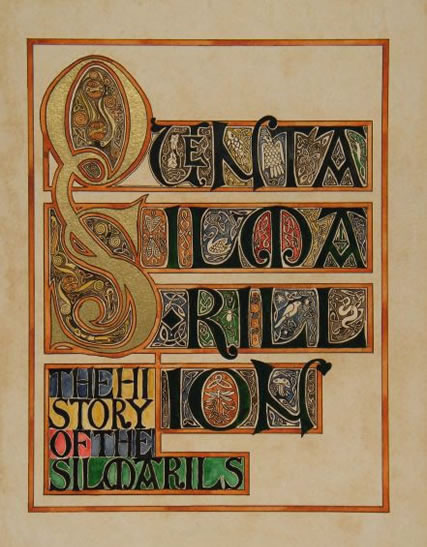
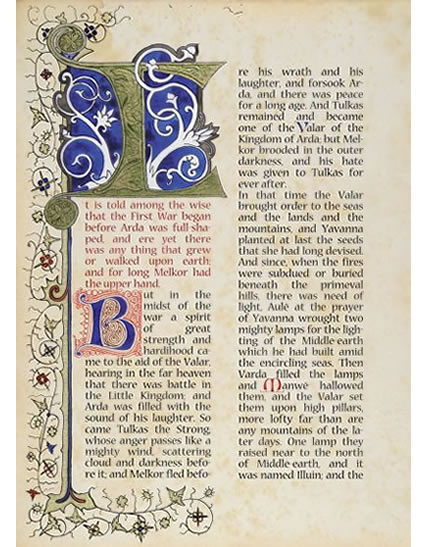
An Illuminated Manuscript of Tolkien's Silmarillion

This just plain fits: someone has made an illuminated manuscript of the Silmarillion. I can think of no modern book that better meshes with this physical presentation. (Although it feels wrong to use the modifier modern for a book like the Silmarillion ... )


This is amazing, and it also points out to me how the Saint John's Bible is even more amazing (made by a group of people with more time and resources). What could a group like that do with this as a starting point?

Nice interview with the creator and more pictures here.

Friday, June 28, 2013

Book Review: The Fall of Arthur by J.R.R. Tolkien


Tolkien fans are currently reduced to purchasing books by Tolkien that probably should be labeled “25% pure Tolkien”. At least, that’s about the percentage of words directly written by Tolkien in this book. Many other words are written by Christopher Tolkien, who represents about half of his father’s genes, and the rest are examples of the English and French poems of Arthurian legend, so depending on how you count we may consider a near majority.


Yet even 25% pure Tolkien is still very much worthwhile. Tolkien’s unfinished poem itself opens the book and it is so dense with meaning that it warrants most of the rest of the book to explain it. Only near the end does the analysis begin to bog down in reconstructing edits that seem to mean less and less as you near the end. But then the very end is a lecture by Tolkien on Anglo-Saxon poetry, which would fit earlier as well but at least ends the book on a high note.


So for the Tolkien fan but non-expert in Arthurian legend and poetry, this book is pretty much exactly what it should be. Did you know that Tolkien toyed with the idea of identifying the isle of Avalon with Tol Eressea, the Lonely Isle off Valinor? Placing Arthur and Lancelot in Middle-Earth with the legends of the Silmarillion is tentative but intriguing. Can you imagine Frodo arriving in his gray boat and seeing on the shore Arthur in a golden crown? (Don’t tell Peter Jackson, he might try to make a nine-hour set of movies about it … )


This book is for anyone who read the Silmarillion and liked it. You know who you are. Not necessarily as bad as Stephen Colbert-level interest, perhaps James Franco-level or even less. Itn other words, it worked for me.

Sunday, February 10, 2013

Robert Jordan vs. J.R.R. Tolkien, Part 4: Plot and Endings

[Back to Part 1, Part 2, and Part 3]

And now we come to the real spoiler-filled part: what does the ending say about the compare and contrast between Jordan and Tolkien?

As was shown in one way with the heroic charges at the end, always coming when all hope (or some amount of said hope) is lost, a formula that Tolkien even formalized as the "eucatastrophe": both books are eucatastrophic in multiple ways, which requires dense, precise plotting. It's one of the joys of the genre. Tolkien obsessed over making sure that his entire plot fit together neatly, so that when, for example, Frodo and Pippin are looking "at each other" across the expanse between them without knowing it, the time and phase of the moon work out precisely. Again, for all his historically-based fulmination about industry, Tolkien has a place for detail and even mechanism in his stories. Jordan's story is, if anything, even more mechanical. Min, for example, seems like a fairly useless character who becomes elevated to a particular role in the Seanchan all of a sudden and then is able to use her "fortune-telling" power to out a spy. Even the non-warriors, the Ogier and the Tinkers, have a role in the Last Battle. Some of the build-up is incommensurate to the pay-off -- I'm looking at you, Padan Fain -- but how could it be truly commensurate? After all, Sanderson's already expanded Jordan's timeline by three books that are all faster-paced than the 11 previous books. I'm just happy to be done and gain surprises like Min's where appropriate. That was fun.

In fact, Jordan's mechanisms are, if anything, too obviously mechanical at the end. I don't blame Sanderson for this; I blame Jordan for imagining he had only one book left to write when he truly had four or five, "condensed" into three by Sanderson. I would have loved to see Jordan's full treatment about how all the nations could be brought together by Rand as a treaty, for example, or the Seanchan realizing they owe fealty to Rand (although I really wonder why they didn't figure this one out before, it's awfully obvious to me). One of the hidden joys of these books is the very detailed procedure that at first glance looks boring, which is presaged famously in Tolkien by The Council of Elrond. This happened when Egwene was elevated to the Amyrlin Seat and in some ways in Elayne's ascent to queenhood as well, but there just wasn't time for it when it mattered most. This is not Sanderson, because Jordan himself did not allow time for it in his own 12-book plan. Another testament to just how amazing Tolkien was in orchestrating his storylines in three books: on an overall basis, it's a close call but I judge that Tolkien is still the king of plot.

Earlier I mentioned how I didn't really know how to assess Jordan's entire work till I saw how he ended it. I would have loved for Jordan to have "pulled a Tolkien" with his ending, with an element of Tolkien's world that not many people know about. Let me explain, and yes, this does involve the Silmarillion. Wake up, now!

The way I read it, Tolkien's world used to be flat and is now spherical like ours. It happened like this: Numenor was the great continent of men that could see all the way to the Blessed Lands in the West (if you squint). But Sauron preyed on their pride and they tried to assult the Blessed Lands by force, which of course failed, but to make the failure really concrete, the Valar literally severed the Blessed Lands from the rest of the world and made the world wrap around itself. They made the world spherical, so I guess the directions to the Blessed Land change from "go west young man" to "go west and UP." This is one of the way the Fall happens in Middle Earth.

Since in Jordan, time itself is circular, I was hoping Rand would throw a fast one by literally breaking the Wheel of Time and making it linear again. Is this unexpected enough? It would have been to me (at the point at which I began to half-expect it, that is). Instead of the world breaking, the cycle of revolutions would be broken and redemption would be possible. The cycle of re-births would also be broken, making each life more independent and in my view, important. I like the theological implications of all this too.

Despite my detailed and well-reasoned plans, Jordan didn't do any of this. He kept time in a wheel and the Dark One in a bottle. The only moderately interesting theological "debate" was whether the Dark One should be destroyed or not. Leaving aside the implications of how a human could destroy a god, the only question seems to be, would a world without evil be any good? The scenes of a world with too much evil, and with too much good, are mildly interesting but nowhere near as richly realized as the world itself. Some passages says Shai'tan is a personified force, but the whole confrontation depends on Shai'tan being a force-bearing personality. The whole philosophical side of this has the complexity of a late-night bull session in a dorm. (Not that there's anything wrong with that.) Because evil is necessary it must be imprisoned rather than destroyed, and, um, what does that really mean? Death is ultimately a friend, not an enemy, and in my opinion no true redemption is possible. Which fits because time is still stuck in a wheel. Alas. Conversely, in Tolkien, evil is defeated by the humble, the patient, and the suffering as was as the noble and heroic. In fact, the heroes come to the point of sacrificing themselves so that the hobbits may sacrifice themselves! This carries a deep echo that maybe, in real life, evil can be defeated with the same spiritual judo move. That's a better ending than Jordan's solution: returning to square 1 while, this time, actually caring about all these people who are dying for you while you get off just fine in your enemy's mortal flesh. The death of Lews Therin is more resonant for me than the post-battle life of Rand al'Thor.

So that's the ending, but it's not the very ending in Tolkien. In the very ending,Tolkien has the scouring of the shire, one of the most enduring parts of the book (at least in my experience of multiple readings) in which the hobbits truly grow up and Frodo's persistent wound and unfitness for the world is clear. In its place, Jordan ends abruptly instead of lovingly. I have this vision of Sanderson collapsing on the floor with exhaustion unable to write another word. Rand rides off into the sunset alone with three women contentedly pining away in the background. After all the wounds that won't heal and taints and tragedies inherent in power in Jordan, it's all washed away by reversion and we are back where we started, and the wheel continues to turn. I guess saidar is cleansed, that's something. But how was it cleansed? Some very powerful magic that has no emotional or personal equivalent beyond requiring male and female cooperation and a really big ter'angreal. In Jordan, the world is saved to be back where it was. In Tolkien, the world is saved for the new healer-king to rule and the one who saved it is not fit for it anymore. I have to tell you, one of these resonates more with me, and it's not the one with the women left behind. It's the one with the women ruling alongside their spouses and healing the land itself. Jordan's ending is, indeed, too happy. It does not ring true, and I only teared up a little, once. When reading Tolkien I couldn't even finish when Frodo sees the white sands at the end ...

So, in the end, the very end, a very good place to end: as I've grown up Robert Jordan has grown in my estimation and is now my second-favorite fantasy author. First place used to be Tad Williams but as you can tell, with time and seasoning he dropped to third place (I still don't think he's topped To Green Angel Tower). As you can tell, in my reading, Tolkien's genius endures and grows with depth the more it is explored. Long live the tweedy king.

Monday, February 4, 2013

Robert Jordan vs. J.R.R. Tolkien, Part 3: People and Heroes

One huge difference, perhaps the largest, between Tolkien and Jordan is in the way they write people. The differences are evident in the population of the world: Jordan's is clearly more "human" in focus. Of non-humans, the evil creatures are the diverse ones (Trollocs, Myrddraal,  Draghkar, Gray Men, the entire ecosystem of the Blight), although we understand more of Tolkien's orc society than we ever do of the evil non-humans in Jordan.  Don't even start about the Aelfinn and Eelfinn, they're just plain weird. As for good creatures, you have the Ogier, and I suppose the weird Seanchan beasts, but really all the diversity is in the human culture itself. Jordan's people are truly distinct, almost a little too distinct in that if you've seen one Domani, you've seen them all, and there's so many permutations of hairstyles that I lost count. Two of Jordan's greatest creations are the social structures of the Aiel and the Seanchan. And then there's an entire other people, the Shara, who drop in without warning to make the Last Battle a fair fight for the bad guys. Only in Robert Jordan can the reader forget an entire subcontinent.

This societal diversity in Jordan's world is mirrored by racial diversity in Middle-Earth: elves, dwarves, two (three?) kinds of orcs, trolls, dragons, Balrogs, and of course hobbits. There's a few nations of humans but who can tell them apart? One of them likes horses and mead-halls. The interesting thing here is that there's more fluidity between Tolkien's races than there is between Jordan's societies, in that you have the half-elven and the fact that orcs were made in imitation of (and if I recall correctly, FROM) elves. The Rohirrim and the Gondorians have many deep connections. Much of Tolkien's emphasis on race rubs 21st-century sensibilities the wrong way, but the barriers are not as strong as they seem on first glance, even between species. I do wish we knew more about the Harad men and Easterlings, because after all my Tolkien study they still seem like crudely drawn stereotypes to me, in a way that even orcs do not. Of course, we spend time with orc companies on two occasions and we never see the other human countries except in battle.

As for the "made male and female" form of diversity, Robert Jordan clearly has the edge in obvious, strong female characters. All the wizards are women, at least at first, and they do fine at taking care of themselves, thank you very much. One of the most resonant parts of Jordan is the limitations on men, the "taint" on male saidin magic that means all the magic power goes to the women of his world. This "taint" is like its own substance and is driven out with power. This is quite the opposite of Tolkien's version of corruption (the ring, but also the dragon-sickness and the dwarvish greed for vengeance), which is more a subversion of the will and seems to come from within rather than be imposed from without.

Jordan clearly has the edge on female charcters that are believable and important. Yet I still want to point out that in the context of Beowulf, the kind of story Tolkien was trying to write, the female characters in Lord of the Rings stand out from that just as much as Jordan's women stand out from Tolkien's! And for all the strength of the female characters, in Jordan, it's really the male characters that we follow and that run the show: Rand, Mat, and Perrin. One of the aspects of the Wheel of Time that continues to bug me is Rand's harem, that somehow he's such a ta'veren that he makes three different, strong women fall in love with him and share him without issues. I remember when that kind of thing happened in the Old Testament and I don't believe it was too stable of an arrangement.

But there's another but to this but: Egwene. I would never have predicted this, but in the last 4 or 5 books of the series, basically since she became Amyrlin, she became my favorite character. And (I TOLD YOU THIS WOULD HAVE SPOILERS) it seems incredibly fitting that she dies in the end. She is the youngest Amyrlin seat, and believably wields authority. She fights back against incredible odds, politically, in taking back the White Tower. My biggest surprise from Jordan is that my favorite sequence involves how this young magic-user negotiates the politics of sacrifice and endurance to plausibly defeat her enemies from within, without "firing a shot" of magic power in her own defense. I thought my favorite sequence would be the last battle, but it was Egwene winning the White Tower. Even her role in the Last Battle is one of my favorites, as she figures out anti-balefire and self-immolates in the light, stamping the entire ending with an entirely appropriate sense of loss. I thought that would be Rand, and perhaps it should have been Rand too. But in that scene, I think Egwene did what Rand also should have done. At least someone did it.

Which brings us to the heroes of the Last Battle. Jordan gets what Tolkien also got: battles are about heroism, not tactics. The key part of the Battle of Pelannor Fields is the charge of the Rohirrim and the arrival of Aragon in the ships of the Corsairs, the thrilling turns of the tide. There's enough of that in Jordan but it's more on the personal level, at least in the Last Battle, than it is on the level of surprise tactics. (The surprise tactics in the Last Battle include ambushing people with gateway cannon, which just seems unsporting and downright non-heroic, though still kind of a cool idea.) The sequence of attacks against Demandred, beginning with Gawyn riding off on a doomed march with the bloody Seanchan rings, and running through Galad, Logain, and finally Lan, is just what heroism is about. I do wish more of them had died, actually. Lan's ending move to defeat Demandred was obvious but perfectly fitting in that obvious kind of way. I only think it would have been more perfectly fitting if he had indeed lost his life in taking Demandred's. For a series that is fully ending, A Memory of Light was a little light on the body count. But, really, so was Lord of the Rings.

The best moment of the Last Battle? Olver blowing the Horn (something no one expected, thinking it would have to be Mat), all alone, almost ended, and then ... his old friend rides up as one of the resuscitated Heroes of the Horn, back from the grave to save him one last time. That little moment with that (literally) minor character, perhaps because it caught me off guard, was my favorite of that 200-page chapter. That's what heroism is about.

On the whole, I think Jordan's people resonate with me more, but I also have to remember that, while Jordan took all the time he could to make his characters detailed and relatable, Tolkien was looking for a bit of distance in his people and how he wrote them. Tolkien deliberately made his characters stilted (except for the hobbits, of course) and made them say things like "alas" and "behold" and all that. Tolkien just didn't place as high a priority on humanizing his characters, because he was consciously writing an epic, not a novel. So there's certainly more humans in Jordan, but I do wonder if, in 50 years, that will seem as archaic and odd as Tolkien's -- only not deliberately so. And all those heroes did what they did, but none literally walked through the valley of the shadow of death like Aragorn on the paths of the dead. Hard to be more heroic than that.

[Next in Part 4: Plot and Endings]

Friday, February 1, 2013

Robert Jordan vs. J.R.R. Tolkien, Part 2: Science and Magic

The worlds Jordan and Tolkien have created are built out of the ordinary atop a substrate of extraordinary. I'd like to look at the invisible forces first, that is, how their worlds are constructed and the forces, technological and magical, that manipulate each one.

Science/Technology:

Both Jordan and Tolkien have an implicit direction of technological advancement. This is obvious in Jordan, with characters who invent cannons, gunpowder, and steam engines. I like those details, it gives the books a steampunk vibe that is different from Tolkien's vision. True, Jordan's visions of the distant past include flying vehicles and other futuristic images, but it's never clear if those are magic or science (or, in Clarke's famous quote, both?). Whatever happened in the Age of Legends, for the current age, science and mechanism is providing a way forward.

What most people don't realize is that Tolkien has a more tragic, less mechanical vision of progress, but he has a vision nonetheless. Although he's vague on these points, Tolkien at times told others he intended Lord of the Rings to be our own myth, in our own past. As such, it shows the ascent of man and the departure of the elves. The dwarves, ents, and even the Astari/wizards are also clearly on their way out. The closest thing to a mechnical inventor is Saruman -- Tolkien clearly has a less "mechanical" vision of how humans should progress! -- but the return of the King is leading to a world of less magic and more humans. I can imagine someone inventing a cannon in the future. Anybody care to write fan fiction about cannon vs. balrog?

Magic:

Jordan's magic is divided up into five elemental-like substances (the four usual suspects + spirit) consisting of the One Power. The male/saidar and female/saidin components of this are separate classes as well. Then, in a move that I'm still not sure is exactly parsimonious, he introduces a different power, the True Power, in the later books that is part of the "Dark One's Essence". Does that mean Shai'tan is being tangled around when one of the Forsaken weaves the True Power? Whatever is going on there, it's a bit like chemistry in that magic-users combine elements and, well, make reactions go, like fireballs or Healing. It's a nice system that conveys complexity and the need for skill in determining the power of different magic-users. You even have specializations in that Nynaeve can Heal well and Androl can make gateways but do little else.

The gateway magic itself seems to be something that Jordan only graadually realized could be so powerful, but it certainly became perhaps the hallmark spell of the series. Not only gates to transport or see new things, but spinning Deathgates were invented. Some of the rules seem arbitrary (thank goodness Trollocs can't go through Waygates) but there's an empirical process of discovery and trial and error in which the reader, and presumably the author himself, figures out the implications of these magical gates as we go along. In this way the magic is like science, and is somewhat technological as well.

Tolkien's magic is never emphasized the way it is in the later examples of the genre he founded. We never find out what it really is, or what constitutes strength in a field, or what makes it go. What we do see is usually explainable by other means, such as Gandalf's delaying the trolls till the sun comes out, or the mano-a-mano confrontation of Gandalf and Denethor. It's important to remember that Denethor is in some senses an equal of the great wizard Gandalf, so magic and political power overlap at least somewhat. Also, the political power of King Elessar is combined with a healing hand, another way in which social power and medical power overlap. Tolkien is saying something about the healing of all of creation, in which body and soul are joined and a good king is also a good doctor.

As you get into the story, Tolkien's magic seems more real and Jordan's less so. The fact of the matter is that fireballs are cool the first time and after a few go-rounds seem just like fancy cannonballs. Think of the difference between the way magic feels at Dumai's Wells and in the Last Battle. Even balefire becomes normal with overuse. The more powerful a detailed magic element is, like balefire, the less easy it is to work out its implications. What makes something disappear vs. lose a bit when balefire hits it? Shouldn't there be a popping sound when air is balefired out of the Pattern? (Note that Perrin finds out that creating a vacuum prevents the propagation of sound at one point in the last book!) Strength in Tolkien's magic is closely related to the human will itself, something that I think in our 21st-century enlightment we discount or even forget.

Perhaps Jordan's magic is ultimately mechanical and Tolkien's is organic, growing from life itself and the ties that bind creature to environment. Tolkien never forgot that "spell" means "word" at its root, and the very act of speaking and persuasion is therefore a form of magic, useful for healing or destruction. That makes Tolkien's magic more enduring, more relevant, and more real. The persuasive powers of Saruman's voice constitute a magic spell ultimately more chilling than balefire.

Next up in Part 3: People and Heroes

From Owen Barfield to Wes Anderson

At the end of the Responding to Barfield series (see sidebar), I felt left with the question, what does it look like to "put things back together"? Some hints of that have been found in other books by Barfield, and Tolkien's Lord of the Rings may be the best example of it, but I want more. I want examples, diagrams, panoramas. This excellent essay by Michael Chabon shows how the films of Wes Anderson may show us something about that. The best example of this, and Anderson's best film, is Moonrise Kingdom. Now I need to go back and watch those other films again ...

Wednesday, January 30, 2013

Robert Jordan vs. J.R.R. Tolkien, Part 1

Having just finished Robert Jordan's Wheel of Time, I can finally look back over the whole thing and compare it to the trilogy that started it all, J.R.R. Tolkien's Lord of the Rings (considering The Hobbit as prelude). Lest this seem like simply an "ugliest orc" and "sharpest sword" type comparison, I'm going to focus on the more fundamental aspects of their work. How do the authors see the world? Having the chance to "sub-create" (in Tolkien's terms), how did they craft their worlds? In essence, what is the natural theology of the worlds they have made? It's interesting how I could not make a real comparison between the two until Jordan had finished his story. So much depends on the ending.

Theology is not an accidental or artifically imposed term. Both were commited Christians, Tolkien a Catholic and Jordan a self-described high-church Episcopalian (almost like Tolkien's friend C.S. Lewis?). There are distinct differences, the biggest being that Tolkien grew up in the first half of the 20th century while Jordan grew up and wrote in the second half. But they both imagined worlds that are attractive just for the level of detail in them, worlds with magic and swords and evil monsters and heroic deeds.

Sometimes I'm disappointed looking around with the level of detail that is present in, say, an ordinary church built 100 years ago vs. one built (or more likely, repurposed) today. Tolkien and Jordan give evidence that the faithful detailing that used to go into the stone through a craftsman's chisel may now be evident in the interior spaces carved out by our authors. The keyboard as the new chisel. Both worlds are certainly as intricate as a vast mosaic or a cathedral's statuary.

Since I'm convinced that this fantasy genre is indeed valuable (convinced enough to have spent hundreds of hours reading about people and places that don't technically exist), I think it's valuable to dig down into it. Since this introduction is long enough in itself for a blog post, I'll split it up into parts and work my way through the comparisons over the next month.

It should go without saying in huge letters: SPOILER ALERT. Part of the whole tension of waiting for an ending is seeing what it reveals about the author's beliefs, intentions, and view of the world. So, yeah, I'll be talking about how it all ends. The Internet sort of forces immediate consumption of any new media for spoilerphobes at any rate. (But my recent review of the last book is indeed spoiler-free!)