Showing posts with label geology. Show all posts

Wednesday, March 14, 2018

My Answer to "Is Design Detectable?"

The Henry Center's Creation Project just asked a bunch of scientists and philosophers a simple question: "Is Design Detectable by Science?". My answer starts like this:

As a chemist, I turn naturally to the evidence of the past that is amenable to geochemical or biochemical analysis, and integrate that with other lines of evidence. This evidence tells a story with order and even direction.

Geology, Biology, and the Story of Data

The rocks give a timeline showing how the environmental chemistry of the planet has changed radically over billions of years. In the oldest layers, geologists detect rocks that can’t exist in today’s world with its high oxygen levels: rounded, previously exposed pebbles of iron pyrite and uranium. Those rocks went away as time elapsed, and then, we detect rust-orange iron-oxygen compounds worldwide, called “Banded Iron Formations.” These formations tell a story with a direction: the oldest earth was oxygen-free, then oxygen filled the air and reacted with the rocks. Eventually, after the rocks had reacted, oxygen could fill the ocean. The geologist Robert Hazen has threaded these data into a story of “mineral evolution” over time in his book The Story of Earth.Robert Hazen, The Story of Earth: The First 4.5 Billion Years, from Stardust to Living Planet (New York: Penguin, 2013).

These pieces of data from the geological environment coincide with other pieces of biological data, which show that oxygen can increase biochemical complexity. In old genes, at the time of the first great oxygen increase, DNA sequencing detects a burst of newly invented oxygen-using genes.Lawrence A. David and Eric J. Alm, “Rapid Evolutionary Innovation During an Archaean Genetic Expansion,” Nature, 469 (2011), 93-96. Biochemical models project that oxygen metabolism allows the most complex biochemicalOnce enough data are collected, the question becomes whether the story being told about the data is true—that is, whether the story is something real that we are uncovering, or merely a collection of arbitrary dots connected by imaginary lines like so many constellations. networks, so that increased oxygen supports increased metabolic complexity.Jason Raymond and Daniel Segrè, “The Effect of Oxygen on Biochemical Networks and the Evolution of Complex Life,” Science, 311 (2006), 1764-67. In the presence of oxygen, life could build more complex things.

The end of this essay can be found here: http://henrycenter.tiu.edu/2018/03/a-story-we-can-understand-told-with-chemistry/

Wednesday, July 20, 2016

BioLogos Blog Post about Finding Fossils with Kids

Here's a blog post about finding fossils from the Cambrian Explosion with my four boys, and what I think about the chemical causes that could have got us there:

http://biologos.org/blogs/kathryn-applegate-endless-forms-most-beautiful/the-surprising-chemical-story-behind-the-cambrian-explosion

It's kind of like a real-life Pokémon Go, with a purpose!

More details (and more science) are in the three-part series posted earlier, starting here:

http://arrowthroughthesun.blogspot.com/2015/09/finding-burgess-shale-fossils-with-kids.html

Monday, October 12, 2015

"Streams in the Martian Desert" Posted at the BioLogos Blog

I wrote a response to NASA's recent press conference about water on the surface of Mars, and the resulting public shrug from most commentators. It also has a paragraph about a recent scientific finding that highlights the unique nature of Earth's geology. Here is the article, enjoy!

Monday, September 15, 2014

Chemical Faithfulness, Part 2: How Water Shapes Geology and Biology


In Part 1 of this series I wrote about the chemical power hidden in a glass of water, and how, chemically speaking, water is truly the “living water” of Scriptural metaphor. Living water is creative -- its flow shapes both your feet and the ground beneath them.

Every place on Earth, even the driest desert, has been shaped and washed by the power of water. Twenty years ago when I moved from Florida to Seattle, I moved from one place shaped indelibly by water to another.

In Seattle, our rainfall is famous. Our familiarity with water also runs deep in time. Long ago frozen water carved the landscape of the Pacific Northwest with flowing, “living” glaciers. Long ago, an advancing ice sheet from Canada traveled southwest and ran into the Olympic mountains around where Vancouver is today. The mountains stood firm, cracking the ice in two. One sheet turned west and joined the Pacific, carving the Strait of Juan de Fuca. The other turned south and scooped out the Puget Sound.

In Florida, the water is different, both temperamental and constant. Routine 4pm summer thunderstorms suddenly pour down rain that pools in your sandals, then just as suddenly stop. There are no glacial valleys in Florida, but there are miles of beaches, rock atomized by surf. The water has also carved deep aquifers underneath Florida, which would stay hidden if not for the occasional sinkhole.

All this power is wrapped up in a tiny package. Water is the mustard seed of molecules. It is composed of two hydrogens and one oxygen, bonded with electrons, as H2O.

You can make a molecular model of water with two grapes (for the hydrogens), two toothpicks (for the shared electrons), and a plum (for the oxygen). If you can make the grapes stick out from the plum with an angle of 104.5°, then you have just made a scale model of the molecule that carved Seattle’s valleys and fills Florida’s aquifer. In a sense, you’d be making the model of water from water -- the fruit that you’d be using to make this model is mostly water itself, sweetened with some natural sugar.
 
Water may be small but this makes it more exceptional, because it is small yet liquid. It’s always easier for a bunch of molecules to go to extremes than to sit in the middle.  It’s easy for big molecules to stick together tightly and freeze (to become solid) or for small molecules to fly apart in a thousand directions (to become gas). It’s not easy for a molecule to find an inbetween state, neither too hot nor too cold, close enough to touch and yet energetic enough to slide around, flowing as a liquid, condensing into an ocean. Life needs to be in this inbetween state, its atoms coherent yet always in motion. Therefore, life as we know it needs water, and you are alive because of the liquid water in you.

If liquids are living, then the universe is mostly dead, because liquids are rare. Looking at the periodic table, only two elements out of more than 100 are liquid at room temperature: mercury and gallium. Likewise, most molecules as small as water are gases. Big, complex molecules are harder to make. Here on earth, only water is the only molecule that combines liquidity with simplicity, and we literally have oceans of it.

Oceans are Earth’s defining characteristic in the solar system, a gift to our planet that changes its distant color to that of a “pale blue dot,” perceptibly different from yellow Venus and red Mars. Oceans made our rocks different as well. The geologist Robert Hazen estimates that the action of water on the Earth brought about more than 3000 new minerals when there were only about 500 before, a multiplication of diversity in the rocks from this one chemical.

Jade, sapphire, emerald, all were made when water mixed and reacted with the Earth. Mother lodes of ores are found by following the ancient paths of water to where precious metals were deposited. Panning for gold requires a stream of running, living water.

Look at a drop of water in a microscope and you’ll see another way it is “living” water. Even the most crystal-clear pond water is home to thousands of undulating, spinning, pulsing amoebae and protozoa, a microscopic menagerie. Remove all of these, looking even closer at the atoms in water, and you would see that water is constantly moving around itself, forming, unforming, and reforming bonds, in what Bill Bryson described as a “quadrille.” This movement is unbridled, even joyful.

Liquid water hosts life even in extreme conditions. In the deepest parts of the oceans, ecosystems hidden from the sun cluster around bubbling clefts where hot, energy-laden gases escape from the earth. These vents are rich with crabs, lobsters, octopi, pale white dappled with red. Six-foot-long tube worms waving like ghostly grass. These animals bask and feed on the sulfurous energy of the earth itself, mediated by the water, which is only kept liquid at such intense temperatures by the massive pressure of the fathoms above.

The DNA of these animals can be read like a book, and it matches the DNA of more familiar species. The pale creatures near the vents came to that place without sun long ago, and were kept alive by the water and the earth’s energy. Eventually they lost what they didn’t need -- pigments, eyes, and in the case of the tube worms, even mouths (they let the bacteria that live inside them eat for them, which is just as strange as it sounds). Life can live without sunlight, but it cannot live without water’s liquid flow.

Life needed water and energy to survive, and it changed its form to survive, morphing in ways unthinkable and amazing. Through liquid water, life was able to fill what had previously been empty, to thrive and to surprise. That sounds like grace to me.

Deep-ocean vents may shed light on another dimension to water’s power. At that extraordinary place, living, liquid water may have shaped the first living things on this planet, bringing a good creation to life 4 billion years ago. I will describe experiments that point in this direction in part 3 of this series.

Thursday, May 16, 2013

The Town Built Under a Rock


This is a picture from Setenil de las Bodegas in Spain, a small town built in -- and into -- a gorge. This results in streets that have natural rock awnings. And rocks in the roof. And rock as a back wall. The village grows out of the rock like an organic development. Which, in a sense, it is.

The house built upon a rock will stand when the flood comes. What about the town built under one?

Take a virtual tour at this page, or visit the Flickr photo network here.

Sunday, May 5, 2013

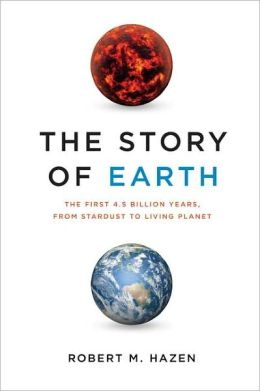
Book Review: The Story of Earth: The First 4.5 Billion Years, from Stardust to Living Planet


This is an excellent book, by a geologist (Robert M. Hazen) describing how the Earth has changed over time. And by Earth, he means earth, the stuff under your feet, and views the ecosystem as an extension of its dirt foundation. This book gives an invaluable perspective on the evolution of rocks, and organizes its chapters in a chronological color scheme: black, blue, gray, red, white and green earth. Hazen hits the sweet spot in his description of the field's development and controversies. I had no problem following his descriptions as someone outside the field. He'll describe an experiment or two, down to the apparatus, once or twice a chapter, but in simple and vivid language that I hope to emulate. Finally, Hazen himself has contributed several important ideas to the field, including mineral co-evolution, that it's not just that minerals shape organisms, but also that organisms shape minerals. This is a fascinating and solid idea, and my only comment is that I wish Hazen brought it out more. You don't usually end up wishing an author talked about his idea more, but here you do.

As a window into an under-described branch of science, I highly recommend this book.

Monday, April 22, 2013

Book Review: The Old Ways


Robert Macfarlane is usually classified as a travel writer, and that's technically correct. His pace of travel may be slow, because he always writes about walking, but it's certainly moving from one place to another and describing what happens. So he's a travel writer, and an excellent one at that -- but I wouldn't read him if he was merely a travel writer. What's remarkable about his writing is that the case could equally well be made that he is a poet, and could almost equally be made that he is a science writer or an art writer (or both). In fact, it's only toward the end when he veers more into history and biography than describing his own experiences that his writing begins to lose its unique quality.

Macfarlane writes about rocks and geology, but also people and how they live among those rocks, why their feet scraped out the paths that he later follows.This is a book about the value of walking, from the UK, a country where walking is practically the national sport. Although perhaps the best chapters are not about walking, but about taking to the sea and following the boat paths. Close enough.

Here's two quotes that give a taste of the philosophical edge to Macfarlane's descriptions:

"The massif is a terrain shaped by what Nan Shepherd once called 'the elementals'. Mountain lanscapes appear chaotic in their jumbledness, but they are in fact ultra-logical landscapes, organized by the climatic extremes and severe expressions of gravity: so hyper-ordered as to see chance-made." -- p. 192

"'As I watch [the world],' wrote Nan Shepherd in 1945, 'it arches its back, and each layer of landscape bristles.' It is a brilliant observation about observation. Shepherd knew that 'landscape' is not something to be viewed and appraised from a distance, as if it were a panel in a frieze or a canvas in a frame. It is not the passive object of our gaze, but rather a volatile participant -- a fellow subject which arches and bristles at us, bristles into us. Landscape is still often understood as a noun connoting fixity, scenery, an immobile painterly decorum. I prefer to think of the word as a noun containing a hidden verb: landscape scapes, it is dynamic and commotion causing, it sculpts and shapes us not only over the courses of our lives but also instant by instant, incident by incident. I prefer to take 'landscape' as a collective term for the temperature and pressure of the air, the fall of light and its rebounds, the textures and surfaces of rock, soil and building, the sounds (cricket screech, bird cry, wind through trees), the scents (pine resin, hot stone, crushed thyme) and the uncountable other transitory phenomena and atmospheres that together comprise the bristling presence of a particular place at a particular moment." -- p. 255

Monday, February 25, 2013

The Lost Continent Under the Indian Ocean

There is a lost continent under the Indian Ocean. It's old -- Precambrian, to be precise -- and it's fragmented, but some nifty chemistry helped make the connections that it must be there. Here's the story. Key to the narrative is the fact that they found very old sand on a relatively new island beach nearby. This very old sand is from an ancient continent shattered on the seafloor. The scientists have named it Mauritia, but I think it should be called Numenor. Oh well, I went into the wrong field for naming lost continents.

The reason this is a blast from the past for me in more ways than one is that I just found a self-bound book I wrote in the 5th grade titled Bendiana Stretch and the Lost Continent. It's, um, not very good, but it does show that the romantic notion of a lost continent has all-ages appeal, and it's a funny coincidence.

Thursday, February 21, 2013

A Little Green Meteorite from Mercury

It's not quite the shade of the aliens from Toy Story 3, but it's close:

This odd rock is definitely from outside our planet, and the best hypothesis right now is that it's from Mercury. Its color comes from chromium and there's a lot of magnesium and calcium in it, but the weirdest thing is that it is almost completely devoid of iron. Iron is the most stable nucleus possible and there tends to be a lot of it in our rocks and normal asteroids. Although there's a lot of it around here, there's not a lot of it closer to the sun. Mercury is the best candidate for this profile of elements in the local environs (taking "local" somewhat loosely, of course).

So do we have a piece of rock that reflected traveling light ages ago -- a fragment of the messenger of the gods? Not sure yet, but there's several chemical tests to find out, detailed here. More to come ...

Wednesday, December 12, 2012

Book Review: Evolution's Destiny

Yesterday, Stephen King. Today, RJP Williams. What other blog gives you this?

I have written (and spoken) about the idea of Williams before and as for his ideas, I summarize many of them in my Survey of Physical Chemistry course (last I checked, the only Survey of Physical Chemistry course on iTunesU). If Owen Barfield's right and all authors write the same book repeatedly, then Williams definitely stays true to that statement and to his own character in this one. Evolution's Destiny: Co-evolving Chemistry of the Environment and Life is another facet of the same ideas, and the ideas are fascinating enough that it's worth reading them again.

Perhaps it's because I'm reading Return of the King aloud to the boys as I went through this book, but the essential Britishness of Williams's and Tolkien's writing really stands out to me. Even the sentence construction and the drawing of the graphs (or maps) is understated. Reading Williams is not like reading science writing, it's reading real science -- after all, it's a scientist emeritus putting together inorganic chemistry with evolution. Those are kind of big subjects, and this is kind of a big-idea book of the sort that we need more of.

This new book of Williams's finds him with a new co-author, R.E.M. Rickaby (those with a mere two initials need not apply), who is a geologist. As a result, in the first third of the book, geochemistry takes precedence over geobiochemistry, and there's some interesting passages about the chemistry of rocks and the like. If there's something I wanted to change about Williams's writing before, it's that I wanted more references and evidence along the way rather than sweeping (yet still scientific) generalizations. Rickaby's geological chops make it clear that this book is more substantial in that regard from the beginning.

The really nice thing is that the second two-thirds of the book, when Williams recapitulates his to-me-familiar scheme of biogeochemistry driven by oxidation, the references and evidences (mostly) keep up. I was already familiar with the work of Dupont, Alm, and others published since 2006, and how it supported Williams's earlier hypothesis with genetic analysis, but it's awful fun to see Williams incorporate their findings into his work. Bottom line: Williams was right. And for those who don't have the patience to read a chemist for a whole book, I'll work on translating Williams for the masses. Stay tuned.

Another thing about Williams is that after several books he has come out with the most evidence to go along with his most provocative title. Evolution's Destiny is determined by chemistry. I'm enjoying this meta-story and I enjoyed this latest installment. May there be more ...

Thursday, December 6, 2012

The Largest Work of Art is Under Your Feet

Speaking of the value of nuance, here are some incredibly nuanced NASA satellite photos of the Earth, which are particularly beautiful and diverse. A lot more complexity here than simply dirt, ice, and water. The whole gallery is found here at Popular Science. Enjoy! (In order, the landscapes I chose are from Iran, Iceland, Mongolia and the Mississippi.)


Saturday, October 27, 2012

Singing Sand: The Rocks Cry Out


Several dunes around the world "sing" when the sand is disturbed, and no one knows quite why. But now we seem to be closing in on what it is: not the shape of the dune but the type of sand in it. In other words, not so much the topography as the geochemistry and the geophysics.

The two different-sounding dunes in the video above still sound different when the sand is put in a shallow pan in the lab, and sifting the sand will change the sound. I find this all very cool. What kind of musical instruments could result from this? Something like the theremin at the very least.

More on the data, and another video, can be found here.

Wednesday, September 19, 2007

On the Third Day, Part 1: A Plate That Can Move Mountains

Then God said / “Let the waters under the heavens be gathered together into one place / and let the dry land appear” / and it was so / and God called the dry land Earth / and the gathering together of the waters He called Seas / and God saw that it was good.

One of the perks of scientific study is the chance to go to conventions in far-flung places. I just got back from one near Munich, and yes, Sam, as you kept reminding me before I left without you: "Daddy, I've never been to Germany." (Substitute: Austria, Switzerland, etc.) You've never been on a plane for 14 hours in one day and disembarked at 11am, either, Sam. You'll get your chance soon enough.

So your mom and I rented a car and drove south from Munich, toward the Alps, to the small town near a lake where the convention took place. The airport is on very flat land, and by the time we got south of the city, the land began rippling in green waves a little like a bedsheet, but in a easy farmland-pasture cowbell kind of way. But that was nothing compared to the green wall ahead of us; even the smaller, eastern half of the Alps looms over the mountainscape like a sudden escarpment. It's the reason the border between Germany and Austria is where it is: there's just this big, sudden wall that's hard to get over. Good fences make good neighbors, for countries too. Here's the best picture I could find, although even this doesn't do full justice to the sudden, looming nature of the Alps:


This border is geographical and political, and it's sudden. On the southern side of the Alps (all the way into Italy), it's not nearly so sudden. I like to have an idea for why the land looks like that. The best current idea is that we were looking at the back side of a "continent crash." To imagine what this might be like, take a look at Google Earth and click on a "hybrid" view that will superimpose roads and city names onto the satellite view of the mountains and lakes. On the highest zoom level, look at the Alps. and imagine that a very large hand is pressing Italy into the rest of Europe. Imagine that the Alps are the ripples from that continental attack. Click back and forth on the view, zoom in and out. With Google Earth, you can look at it from any angle you like. Also, look at India pressing up into Asia: the Himalayas are a larger version of the same phenomenon. I'm not sure if this is geologically sound, but I like to think that because Italy is pressing northward, the ripples on the north side of the Alps are more sudden, and it's more like a wall on that side, but for now that's just a hunch.

Now, I realize this may seem like a lot to swallow. After all, something moving too slowly to observe is something that must be taken on faith. This idea, that Italy and India are scooting around on the earth like cards on a playing table, is just about 100 years old to science, and it was understandably controversial at first. I'll save you the debates, and just show you the ideas that are the current, uncontested results: the Alps for one, the Himalayas for another, and for another provocative idea, look at the east side of South America and the west side of Africa. Not only do they look like puzzle pieces that have been torn apart, there are also mountain ranges/types of rock and even fossils that match on each side, separated now by an ocean but hinting that the two were once together. I know how much you like puzzles, and it's kind of satisfying to think of the Earth as a giant, moveable puzzle. I mention this now because the third day of creation describes the land separating oceans, the definition of borders, and land and sea becoming defined. These things are geology, and we see that geology has been very active and dynamic, much like God's hand is described on the third day.

I think that to accept such an outlandish idea as dancing continents, it helps to have a reasonable scientific mechanism, preferably chemical. It might be just because I'm a chemist, but there actually is a chemical -- well, at least atomic -- reason to adhere to this theory. The hand of God shuffling land is an interesting idea: what if he left fingerprints? He did, but in his typical, low-key, intricate and natural way, a way that we can retrace by being chemists and looking at the atoms.

It all has to do with why Lord Kelvin was wrong. If you recall from Day 2, Lord Kelvin was the venerable old scientist who calculated the age of the earth by assuming it had cooled down from a molten state and asking, how long would it take to cool off to the current temperature? His answer was it would take millions of years to cool off. Yet the Earth's age from the pitchblende experiments is in the range of BILLIONS of years old. How could Lord Kelvin be so wrong when his basic ideas were right? The problem is he didn't know his chemistry. (Take this as a lesson, young sons!)

To be specific, he didn't know his nuclear chemistry. In Day 2, the message that "atoms fall apart" is actually a statement of "nuclear" chemistry, because the part of the atom that falls apart is the hard core in the middle: the nucleus. Lord Kelvin didn't know about the nucleus because he was a 19th-century scientist and the nucleus wasn't known at all until the early 20th century. Once it was found, scientists studied how it falls apart, with the result being one of the most ambiguous yet defining discoveries of all time: the atomic bomb. Clearly when an atom falls apart, it releases energy. When lots are made to fall apart at once, you get an extraordinary, even demonic?, amount of energy. When you have a big ball of tons of atoms, which is what the earth is, there's a few falling apart deep inside, releasing little bits of energy. They act like tiny spaceheaters, because the energy warms its surroundings just a bit (much more gentle and spread out than a bomb). This means the decay of atoms deep within the earth keeps it warmer than it would be without that decay. This warmer earth means it took longer to cool down and is therefore older than the most prominent 19th-century chemist could calculate. It also means the earth, deep down, is still pretty warm. In fact, it's still liquid underneath its crusty shell.

Although we can't yet drill down and scoop this liquid up for examination, we can see it (from a healthy distance) when it shoots out of a volcano and we can observe its effects by just rubbing a magnet on a floating needle: the magnetic field that keeps a compass pointing north is caused by the liquid inside the earth. The crust is actually very thin compared to the rest of the earth, like the skin of an apple. If you think of it that way, it's possible to see how the continents are floating on a sea of magma and, very slowly, can move about. The chunks of dry land are wide and flat and eventually came to be called "plates." The movement of the plates is "plate techtonics."

And so, there's the theory that as the surface of the earth cooled, and as rains fell and seas formed on the lowest parts of that surface, that continents became defined and moved about on the million-year scale. One theory is that a huge land mass formed first and then broke apart along the line of the African-South American coast. I can read the third day of creation in the Bible and see that happening in my head, with God commanding it (perhaps from the very beginning of time) and the radioactive nature of atoms causing it. Or, if you prefer, of God causing the atomic cause. It's all chain-of-command detail once you identify the source.

The clincher for me is that we have GPS systems and laser measurements where we can actually measure movements as short as the wavelength of light, and using these fine tools we can actually observe Greenland moving west at about an inch a year, for example. We can work on the details of what moves where and when -- but it looks pretty clear that the continents are moving and have moved. (By the way, did you know that GPS does not work unless you account for "relativity" in the math? As strange as physicists may seem when they talk about relativity, you need to account for it to get the resolution that a GPS system provides, or GPS simply does not work.)

So the seas formed around the land, and continents separated waters from waters. "Seas" and "dry ground" were defined. Then something really remarkable began to happen, too small to see at first, but an event so amazing we're still having a hard time trying to see just how it happened. That event is the subject of Day 3, part 2, coming next. Let me give you a hint: it has something to do with chemistry.

To be continued ...