I wasn't sure how it would be listening to Paradise Lost, but it went better than expected. The audiobook by Blackstone, read by Ralph Cosham, hits a good middle ground between poetic rhythm and shaped-phrase listenability. I was able to follow most of the action as I drove, and any classical or biblical allusions that I missed are fully mea culpa. The one thing that was hardest to follow was when a new character spoke or when the subject of a long passage changed, and my one thought as a listener is something in the shape of phrase or rhythm might be able to convey that better. But as it was, this was as clear as listening to a good rendition of Shakespeare.
As for the content, well, how can I review that? It is interesting to note that what Milton's doing here is similar to midrash or to the book on the resurrection by Fabrice Hadjadj that I just read: he's filling in the gaps between the bible verses and interpreting them. He is asking the big questions, like Dante, and I wish I had read more of this stuff growing up, although I probably wouldn't have appreciated it nearly as much. But for teenagers asking the big questions, shouldn't they be exposed to these things?
Milton's vision of the Fall has shaped us much more than we know. I've always been a little mystified by how insistent some people are that there could be no death of any kind before the Fall, because it's not really emphasized in scripture in my reading as much as people seem to think. Well, it IS emphasized in Milton, but I noticed a few indications that it's not as important to Milton as people seem to think, and that the presence of animal death before the Fall shouldn't be as big of a stumbling block as it seems to be.
Also, the language is gorgeous, and the character of Satan is diabolically intriguing. Hollywood screenwriters should take note -- THIS is how you write a good villain, entirely believable, entirely inventive, yet also entirely evil. The treatment of Eve is a low point for me. I just can't interpret some of her character as anything but misogyny. I don't get nearly as much of that vibe from Shakespeare, for example, and it was the part that bugged me most as a modern reader.
At the end of the day, this gets me thinking about the big questions and arguing with Milton, and I think that's the way he wanted it. That's what literature is for.
Showing posts with label biology. Show all posts
Showing posts with label biology. Show all posts
Wednesday, December 6, 2017

Monday, August 28, 2017
Dr. Lucy Van Pelt, Scientist (Part 3/3)
I hope you’ve enjoyed seeing Lucy count so many things and
ask the question why they happen. She won the science fair by counting and
writing down what she saw, after all. She’s good at it.
But sometimes Lucy goes too far and says things that sound
pretty ridiculous! Here’s one example:

(It might help to know that today we call a “man-made moon”
a “satellite”, so Lucy is talking about satellites. I was confused myself on
this at first!)
Q: What’s wrong with what Lucy is thinking here?
A: Here’s my list:
1.) The satellite isn’t falling toward the Earth (it actually is falling, but the Earth is falling
too – it’s a long story for another time!).
2.) It’s so small that it would burn up if it did
start to fall toward the Earth.
3.) It’s so big that it would cause a problem for
more than just one poor little dog if it did make it to the Earth!
You can tell Charlie Brown is thinking at least one of these things.
Here’s another one where Lucy makes a different kind of
mistake.

Q: What is Lucy’s mistake?
A: Lucy knows what a lava formation is and what one looks
like, but again, she chooses a complex explanation when a simple one will do.
If Lucy wanted to test her driveway, she’s find out soon that it’s only a
little bit like an ancient lava flow.
At this point I wonder what tests Linus could do to show
Lucy that their driveway is not an ancient lava flow. If you start thinking
about these things, that’s thinking like a scientist. It’s all about arguing
based on evidence of the things you can take apart.
(Or you could just decide to laugh at the comic strip and
move on. That’s good too!)
Here’s a third kind of mistake that’s different from the
last two.

Q: What is Lucy doing wrong here?
A: The Earth does not revolve around Lucy! It’s not a good
idea to put yourself at the center of anything. But sometimes it’s simpler to
talk as if the sun rises rather than the earth spins. Or you can talk like
Sally in this strip:

This next strip may be my favorite. Lucy is wrong, wrong,
wrong, in every single panel. You’ll recognize these from the song “Little
Known Facts” in You’re a Good Man,
Charlie Brown.

But here’s my main point: Even when Lucy is wrong, she’s
always thinking like a scientist. That means she can be proved wrong and learn
the right thing!
Since Lucy is a fussbudget, she’s making it up and enjoying
the “authority” of science for a second. Once Linus is older, he starts to take
things apart and put them together for himself, and he thinks more like a
scientist too. Then he joins Charlie Brown in realizing when Lucy’s
explanations don’t add up.
This works even when the cartoonist, Charles Schulz, thought
the wrong thing. What do you think of these comic strips?


Schulz heard in school that no two snowflakes are alike. For
many decades, that’s what scientists said and what students learned.
But recently a scientist at Cal Tech named Kenneth G.
Libbrecht found a way to grow identical snowflakes in the lab. So much for that
idea. Also, as that last strip shows, even if two snowflakes were alike, how
would you know?
The story that “no two snowflakes are alike” is probably not
true, but when Charles Schulz wrote his comic strips, it was something
“everyone knew.” Charlie Brown says “it’s the truth” but, actually, Lucy’s
right. It’s more of a legend.
So, you see that thinking like a scientist isn’t so simple,
and you have to do it differently at different times. It’s not a simple game
like checkers, it’s more of a complex game like chess.
Scientists say a lot of things. Once in a while, like Lucy,
they go too far. But in those cases, you can be a scientist yourself by asking three right questions.
1.) Ask “What did they measure or count?”.
Sometimes, like Lucy counting twelve suns, a
scientist can measure carefully, and then get the explanation wrong. But their
measurements are usually right.
I trust a geologist who looks at
rocks, counts the chemicals in them, and says they are billions of years old.
(That’s chemistry and I can check some of it myself.) I trust a paleontologist
who measures dinosaur bones and puts them in order. They can also pull DNA out
of living animals and read information off of that.
2.) Ask “How many
scientists are saying this?”.
If, like Linus and Lucy counting snowflakes,
two scientists have found the same thing, you can trust it more. There are
times when a lot of scientists are wrong, but the way they find out they’re
wrong is by measuring or counting something new, not by arguing over the old
measurements.
Thousands of geologists and
biologists think that our planet is very old. I agree with them and with the
thousands of scientists who think that every living thing is related through
evolution. We can talk about all the reasons why when you’re older, but for
now, this is what I think after decades of thinking about it. Evolution adds up
and makes sense of how animals, plants, and even minerals work.
Through it all, I’ve kept an open
mind to God’s sudden action in making life. That’s because I’ve seen His action
in my own life – even on the day you were born.
I know God can work any way He
wants. It looks like God made us in a way that we can understand, looking back.
We can follow along through billions of years of evolution from the evidence,
learn how He did it, and even control some parts of it. He gave all of that history
and possibility to us.
3.) Ask “Is
this a question science can ask?”.
This boils down to asking the question at the
beginning of the first letter: “Is it something I can take apart and put together
again?”. We can take apart a lot of things: computers, chemicals, bacteria, rocks,
even things that were put together long ago, like old fossils or very old DNA. In
this way we can take the past apart and put it together again.
But I cannot take you apart and put
you together again. Only God can do that. When you were born, after five years
of waiting for you, I couldn’t claim that I did very much at all in putting you
together. God did that, and then He gave you to us. I thank Him every day for
that.
The love God gave me for you on
that day is like the love Linus showed to Lucy when she couldn’t count her
blessings. Science cannot measure that love.
On your first day, God gave you
breath and opened your eyes. He did that on this day, too. He gave you the gift
of waking up this morning, of the food you ate today, of the videogames you
played, and of the minutes you’re taking to read these words.
I know as a scientist that some of
those gifts came through the oxygen in the air and the sugar in the food and
the electrons in the electronics, because I can take apart the chemicals in them.
Those gifts came through the atoms,
but the gifts came from God.
There’s so much more to say, but this is enough for today.
We can only think so many thoughts in one day, after all. (Which might be one of
the reasons why the story of God creating the whole
earth in Genesis 1 is so short!)
I wanted to take some of God’s gifts to me and use them to
tell you about His gifts to you. It can get pretty mind-blowing, but at the end
of the day, it’s pretty simple.
Every bit of life is a gift from the Maker of Life.
That means air, food, dinosaurs, DNA, the moon, the sun,
others moons and suns around other planets … You can’t put your arms around
God’s love. You can’t measure its size, because it’s too big. You can’t measure
its speed, because it includes every second of every day.
You can trust in the world to act the same way when you take
it apart. That too is a gift from God.
You don’t have to be afraid of what you’ll find when you ask
questions about dinosaurs or DNA. Even when we refuse God’s gifts, He forgives
us because He is love. So be bold and explore the park by the creek. (Just be
safe when crossing the creek!) Take the things apart that you can take apart.
Breathe in every bit of air God gives you. When His time for you is done, He
will hold you in His arms even then.
Today He’s given me the chance to hold you in my arms. That
is the best gift in the world and it is all that I need.
Love, Dad
Dr. Lucy Van Pelt, Scientist (Part 2/3)
Let’s talk more about why I think Lucy is the scientist in the Peanuts gang. In the last letter I showed you how Lucy won the science fair. Can you think of other comic strips where Lucy acts like a scientist?
Of course, since Lucy’s a bit of a fussbudget she can be kind of an annoying big-sister scientist. But I still think she’s a scientist at heart.
Here’s one that shows how much Lucy cares about watching the world around her very closely:

Q: What word did Linus use that probably made Lucy mad?
A: Linus calling the bugs “stupid” didn’t help that conversation start well. I think when Lucy looked at the bugs she was probably counting them.
I say this because there’s many other comic strips where Lucy carefully counts things in the world around her.
Or, at least she tries to. She counts the stars:


Then she counts the raindrops, although she may be a bit
over her head with this project:

Then she counts the snowflakes:

Linus can count the snowflakes, too:

Q: Do you think that 13,000,004,003 is the right number of
snowflakes?
A: If Lucy said it by herself, I wouldn’t believe her, but
Linus got the same number. I wonder if it is the right number?
When two different scientists do the same experiment and get
the same result, I’m much more confident that it’s the right result. If they’re
both counting snowflakes and they get the same number, then they’re more
certain that it is probably the right number. So it’s always important for
scientists to talk to each other and see where they agree and disagree. And
everyone knows Lucy’s not shy with her opinions.
Lucy’s always counting something. Like a scientist, Lucy
counts how many times she’s “fallen in love” with Schroeder:

Lucy counts the electrical outlets in her house:

Here Lucy counts how many times she beats Charlie Brown at
checkers:

But sometimes Lucy makes mistakes in her counting. Here she
tries to improve her position to count the stars better:

Q: Can you think of a reason why the chair won’t help Lucy
count more stars?
A: I’d say the distance to the stars is so big that the
chair doesn’t make any difference.
Here’s another set of strips where Lucy gets an explanation
wrong, but I think she’s still thinking like a scientist thinks.
Q: Can you tell what’s wrong with Lucy’s counting in this
next series of strips?


A: I think Lucy’s problem is that she’s trusting too much in
what her own eyes see! She won’t listen to Charlie Brown, who has a simpler
explanation. It’s simpler to have one sun than to have twelve, with a new sun
being made every day. After you count and make careful observations, you still
have to listen to other people. Lucy still needs to learn to listen, in this
area and in many other areas as well. So do I!
There’s one more way that Lucy thinks like a scientist and
it gets her into trouble. It’s hard to count the things you can’t see. Think
about what Lucy is trying to count in this comic strip:

Q: How does Linus help Lucy count her blessings in this?
Does he help her count something she can see?
A: Lucy’s problem isn’t that she needs to count
better. She needs to know that her little brother loves her (despite all the
fights they have). Linus is right. That is the right thing to say.
When you say this to your brothers, it gives life to my
heart too. Lucy needs to see and count her brother, and that’s what really
counts here.
So Lucy is a scientist at heart because she likes to look
closely at the world and count the things around her. This helped her win a
science fair. Lucy is good at counting. She gets the right answer (or least an
answer that agrees with Linus’s answer) when counting the snowflakes.
Sometimes she can have the right answer for one question and
still get something wrong, like with the sun and Charlie Brown. But she’s wrong
because of what happens after she counts. Her counting is still right.
In the last letter, I’ll tell you about some of the strips
where Lucy plays the scientist. She usually gets one thing right and other
things wrong. Those are some of my favorites, and I think you’ll laugh at them,
too.
Dr. Lucy Van Pelt, Scientist (Part 1/3)
Note: This letter is for a first-grade student. Click here to read a similar letter that I wrote for my high-school son last October. (Since I have four sons I have two more chances to get this right!)
Dear Brendan,
Dear Brendan,
I heard your favorite class in first grade is science. I’m so proud that you’re interested in the same type of class I teach. As you learn about scientists, I thought I’d let you learn something from me about what science means to me. If you want to really understand science, you have to know how to listen to scientists. It’s like if you really want to understand how God works, you have to listen to Him (in the many different ways that He speaks!).
So to understand science, first you have to understand the words scientists use. You’re learning the words scientists use in science class. Sometimes the words are long but that can be part of the fun. Then the real fun begins, when you use those words to look at the world around you.
A scientist can take the world apart and put it back together again, like a LEGO set. It’s great fun, but there are some things that you can’t take apart like that. (For example, you can’t take God apart, right?) It’s hard to tell “what you can take apart” from “what you can’t take apart.” I’m not always sure which things are which myself. But this is also part of the fun of science -- you’re never quite sure.
To really understand science, you have to understand scientists. I’ve watched you read through our Fantagraphics Peanuts comic books. I think one of those Peanuts characters is surprisingly close to being a scientist, or at least thinking like a scientist: crabby big sister Lucy, of all people, thinks like a scientist!
It’s OK if you don’t think of Lucy as a scientist. I only just realized it myself. Let me show you why I think this:
For one thing, Lucy plays at being a psychiatrist with her “Psychiatric Help” stand. But she actually does science at one point. Did you know that Lucy is the only Peanuts character to win a science fair?
It’s true! First, she looked at the world around her and decided which part of it to study (click on it to read the whole thing):

Of course, I think you should ask him (and us) before you run any experiments on your little brother. Linus isn’t exactly happy to be Lucy’s science project, but Lucy takes charge:

Then, Lucy starts her experiment and takes careful notes, like a good scientist:

Then Lucy reverses what she did and sees something change. She writes this down, too:

Did you notice how much Lucy is enjoying what she’s doing? Yes, she enjoys annoying her little brother, but, other than that, it seems like she really likes science. Once Lucy finishes her experiment, she makes a poster and presents her project:

Q: What do you see on her project that the other ones don’t have? (Other than a sighing little brother.)

Q: Which do you
think is the better project? Why?
A: I think Lucy ran a good science project. Peppermint
Patty’s wasn’t as good.
But you can make it better!
Q: Maybe you can come up with a better project to run with
toast? How could you do that?
I think you could come up with a pretty good project if you
did it like Lucy:
-- changing things one by one,
-- watching closely,
-- writing down what you do, and
-- measuring it.
It doesn’t matter so much what part of the world you’re
looking at. You could experiment on a piece of toast, or on your little
brother, or anything inbetween. (Just be sure to be nice to him, and pay him
with candy or something, please?)
What matters in science is that you do your experiment back
and forth, many times, and measure what happens carefully. In this story,
that’s exactly what Lucy did.
Even without this story, you could tell that Lucy’s a
scientist at heart from other comics. Did you know that there are many other
comic strips where Lucy acts like a scientist? I’ll tell you about those in the
next letter.
Tuesday, October 4, 2016
A Letter to My Son About Creation
Dear Sam,
Today you are fourteen. I am so proud of how you’ve grown up
from a little drooling turkey-sized thing to the young man you are today. I
keep thinking about how we really only have four more years with you until you
move out to college. I’m left with too many things to say in such a short time.
You inherited half of yourself from me. I see myself in your
constant reading, in the way you are interested in so many things that it’s
hard to pick a single thing, even in the way you file away the comics in your
head. And it makes me remember what it felt like to be fourteen.
I had a lot of questions about how to put all that reading
together, especially trying to reconcile the first few pages of my Bible with
the first few pages of my science textbooks. After three decades of these
thoughts, I’ve tried out just about every possibility to see how it works. When
I was your age I read many people who insisted that the stories of the Bible
and the stories of evolution don’t fit at all. These people said you have to
trust one set of stories and throw away the others. Creationists said throw
away the science, and Isaac Asimov (my favorite science writer) said throw away
the Bible.
I remember a Saturday afternoon I spent sitting in church
learning about how the six days that I read from the first chapter of Genesis
were 24 hours long and each creation event was an abrupt creation from nothing.
I started out believing them when they said that it gave God the glory to trust
His Word over that of the scientists. But the more I learned and did
experiments myself, the more I felt like there must be other ways to read all
these books. So, I went through an “Intelligent Design” phase, and then a “God
created everything else with evolution but Adam and Eve were separate” phase,
and now?
I’d like to tell you where I am now in a story. I could tell
you my biographical story, of how I changed my mind and why, but instead I’m
reminded of the recent movie version of Noah.
This movie took a lot of risks, and all of them didn’t work, but one of them
worked very well. In the darkened ark, during the 40-day deluge, Noah sits down
with his family and tells them the story of creation. In the movie, this is
animated beautifully with images of nature, and I’m sure you remember how I’ve shown
it to you on YouTube. (I even have a few issues with how the movie did this,
but it’s better to tell your own story than correct someone else’s!)
Noah’s children walked out into a new world after 40 days.
For you, it’ll be four short years. You need to know where you came from, and
that God was here before you, me, anyone, or anything.
Here are a few words trying to capture a fraction of that
story. Some of my words will be proved wrong, but the story remains true if it shows
you who God is.
The story starts in the darkness. In the beginning, there
was God. The Spirit of God fluttered over the empty chaos like a bird over the
ocean. He spoke a word, and a pinpoint of something emerged, bright with light.
Time and space flashed open, inflating like a balloon, obeying his command. Matter
separated into pieces with positive charge and negative charge. These attracted
each other like a swarm of magnets and joined into a multitude of indivisible
bits that could snap together like so many LEGOs. God called these bits atoms. God
set a limit for these atoms: they could not travel faster than light. God saw
the atoms obey his limit, and he saw that it was good.
We watch as evenings and mornings pass. This ends the first
part of the story.
God said, let many lights form. God made gravity, and the
atoms gathered together. In some places, billions upon billions of atoms
pressed down with enormous pressure. God called these places stars, and saw
that they were good. Inside the stars, some atoms were squeezed into newer,
bigger atoms, and the extra energy leaked out as light. One by one, the stars
caught fire, blooming like flowers. They grew, and aged, and burst like seeds,
spreading the new atoms across the universe.
We watch as evenings and mornings pass. This ends the second
part of the story.
And God said, let a disc fly out from a new star and let it
gather into new planets. After an intricate dance, eight planets obeyed his
call. God saw that it was good, and he called that star the sun. Some say that
the biggest planet moved in and out around the sun, clearing the space for the
four planets inside. God set a limit: the planets settled into cycles, like
dancers repeating the same steps again and again around the central star.
We watch as evenings and mornings pass. This ends the third
part of the story.
One of the planets was not like the others. It was wet and
open to the sun, warm but not too hot. God called this planet earth. God gave
it a single moon that lit up its night sky and pulled the oceans over the dry
land. God said, let the water form a cycle of weather, and, look, the water
went up into clouds and came down as the rain. The water mixed with the dry
land and, like an artist, drew shapes on its surface. And God said, let a cycle
of life spring up from these atoms. And the earth brought forth tiny creatures,
and they ate food that God gave them from the hot insides of the planet in
chemical cycles. God blessed them, and the creatures built shelters and grew and
changed. They filled the earth, and God saw that it was good.
We watch as evenings and mornings pass. This ends the fourth
part of the story.
And God said, let the earth bring forth green things. And plants
grew from the waters and the earth. These caught the light from the sun that
God made, and turned it into sweet sugar and fresh oxygen. Oxygen’s power rusted
and reacted with the planet and took away most of the food. There was a famine
and life fell back. But, faithfully, the sun kept giving its light, and that
light became more oxygen, and the oxygen became new life. Creatures learned to
breathe the new air, and to use cycles of oxygen for energy and for building
new things. These cells grew abundantly and joined together into animals big
enough to see, but there was no one to see them yet.
We watch as evenings and mornings pass. This ends the fifth
part of the story.
And God said, let the earth bring forth different kinds of
animals, and the earth brought forth amphibians that crawled from the water,
reptiles that basked in the sun, great sea creatures that lurked in the oceans,
and birds that flew through the air. Some kinds ate plants and evolved strength
and defense. Other kinds ate animals and evolved quickness and intelligence.
Together the animals grew into cycles of biology that turned together to make
ecosystems, like dancers repeating the same steps. Great extinctions pulled
back on life, yet great expansions of new life followed.
Then God said to the earth, let us make humans in our image,
after our likeness, male and female. God spoke, and his breath went out, and new
cycles formed in the brains of humble primates. Out of those brains emerged minds
that could see, understand, and even control the plants, the cattle, and the
birds. And these humans became living souls reflecting the Creator into the
creation. And God blessed them, and said unto them, Be fruitful, and multiply,
and replenish the earth. I have given you all this – take care of it.
And God saw every thing that he had made, and, yes, it was
very good.
We watch as evenings and mornings pass. This ends the sixth
part of the story.
In the seventh part, God ended his work. The heavens and
earth were complete. God set a limit: God blessed the seventh day of the week,
and set it aside, so that we too can enter God’s rest.
We watch as evenings and mornings pass.
Then, something happened that was not good. The father and
mother of us all were deceived because they did not believe that God was good.
They followed evil whispers and stepped outside of God’s limits. We all
followed in their footsteps, and death ruled in us. Brother killed brother in broken,
decaying cycles of greed and fear, and we were lost.
Into this darkness, God again brought light. God called a
man named Abraham to leave the limits of his father’s country. From this man
God called the nation Israel. The name Israel means “struggle,” and they indeed
struggled with God. They received stories and limits from God, but they forgot
them and failed to trust God. So God gave them judges and kings, but they fell
back. One day the light of God’s glory left them. They did not notice.
Then, as a humble carpenter, God’s glory returned. We did
not notice. Life ruled through Jesus, a different kind of king. He was full of grace
and truth -- yet he was cut off and killed by the people of Rome and Jerusalem
together. It was another broken cycle of violence and fear.
But the broken cycle was fixed! On the third day, on the
first Easter Sunday, God vindicated Jesus by giving him new life, through the
same Spirit that formed the earth, recreating and raising him from the dead,
with a new body that goes beyond our limits.
The Gospel of John hints that Easter Sunday was the eighth
day of creation, recorded not in rocks or trees but in transformed minds,
bodies, and words. Like the first seven days, it was a unique act of God that
built on and emerged from the previous events in surprising and creative ways.
This Eighth Day is repeated when Jesus is born again in
someone’s heart and mind. Together we look forward to that day when God will
raise the bodies of all who believe as he did Jesus’ body, and will restore all
of God’s creation, and will reveal God’s Kingdom here on earth.
If you look in the right places, with eyes of faith, you can
already see God coming, as God is creating new life and filling the earth with
good things through the community of believers. The best part is that you don’t
have to just watch -- you can join in as God uses your life to bring more life
to this beautiful, broken world. God made you with love, as he made this
planet, to be part of the continuing, evolving act of new creation.
I hope this shows you how I have found peace in reading
first the Bible and then the science books. God told us some of this story in
each book, and part of life is putting it all together. Now, what questions do
you have? This story isn’t complete without them.
Love, Dad
Monday, September 26, 2016
Hall of Fame of Cheap Science
The first day of class is always fun. I try to review two things:
1.) Cell Biology: Zoom in and out through the cell. How big are different biomolecules?
2.) Instrumentation: How to separate and analyze the parts of the cell with everyday items that could be used globally -- e.g., in Burundi. In the past few years this has expanded exponentially thanks to portable phones and 3D printing.
If I had a theme park, the first point would make a really great dark ride and the second would make for some EPCOT-like interactive exhibits.
Here's so you can listen in if you like (sorry for the loud scratchy mic at the beginning when I have to quiet them all down!):
1.) Cell Biology: Zoom in and out through the cell. How big are different biomolecules?
2.) Instrumentation: How to separate and analyze the parts of the cell with everyday items that could be used globally -- e.g., in Burundi. In the past few years this has expanded exponentially thanks to portable phones and 3D printing.
If I had a theme park, the first point would make a really great dark ride and the second would make for some EPCOT-like interactive exhibits.
Here's so you can listen in if you like (sorry for the loud scratchy mic at the beginning when I have to quiet them all down!):
Thursday, August 18, 2016
A World from Dust (Plus): Yes, Air-Breathing Fishes Evolved Dozens of Times
I couldn't help myself. I was sitting there, with the proof of A World from Dust in hand, facing a deadline, and unable to change anything beyond the occasional sentence. Yet I had just read The Runes of Evolution and just had to cram in one more datum. Here's the paragraph, with the addition in the middle:
If I had space ... well, if I had space I would have put a lot more in, but if I had a few more characters I could have put in a big "NOTE ADDED IN PROOF" in from of the "Some estimate that fish overall evolved air breathing 68 independent times." And, perhaps due to my own haste and newness to this whole writing thing, the citation to that 68 times reference was dropped! So let me provide it here. In The Runes of Evolution, Simon Conway Morris writes on page xxiv:
Whichever road it [evolution] used, it appears to have happened repeatedly, because swim bladder genes evolved and converged four times in teleost fish, providing many structures from which a lung could develop. Some estimate that fish overall evolved air breathing 68 independent times. These fish took evolutionary paths that differed in the details, but they reached the same destination dozens of times, predictably.
Graham concludes, “air breathing has independently evolved among the fishes at least 38 times and perhaps as many as 67 times,” a point that Karel Liem echoes in his analysis of ABOs [Air-Breathing Organs].
"Graham" is Jeffrey B. Graham, author of the aptly titled book Air-Breathing Fishes: Evolution, Diversity, and Adaptation. The book was published before high-throughput genomics techniques, such as the analysis that gives evidence for four convergences in teleost fish mentioned in the previous sentence. As such, it's based on classic biology: comparing lots of fish and noting just how many fish breathe air, using organs that have many, many different shapes with one oxygen-gathering function. You could rewrite Red Fish Blue Fish with all the different fish that breathe air in Graham's book (an idea I'm just going to leave out there for free considering the burgeoning children's convergent evolution market).
Notice also that I was content to use the hedge words, "Some estimate," and that's good because I made another slip of the keyboard, putting 68 instead of 67. (I try to type independently to avoid plagiarism and I must have fused the two numbers from the quote maybe? Sigh.) But the important word is in the final sentence of my paragraph above: whether 38, 67, 68, or something else, these are big numbers and are all in the range of "dozens" (as in greater than 24).
That in itself was a dramatic surprise to me, and should be a dramatic surprise to most people. The very fact that we are so surprised shows us that our mental image of evolution should be changed. Evolution is not always an inefficient and undirected process that depends on lucky chances. Or, if it is, there are so many lucky chances that it can be counted on to increase resource efficiency and even complexity. Conway Morris refers to evolution as a "search engine" working on a planetary level, returning complexity and intelligence. That's not what most people think of when they hear "evolution" -- and yet that's what Conway Morris and Graham see, and it's one of the points of my book. Here's one more bit of evidence to back it up.
Thursday, June 2, 2016
A World from Dust (Plus): DIY Squid Beak
The squid beak is as sharp and tough as a knife, yet it contains no metal. How could such an amazing structure ever have evolved? The answer is it's surprisingly simple to make a material like squid beak in six words: "by oxidizing sugar and a neurotransmitter."
The recipe sounds like something from the witches' trio in Macbeth: thou makest beak of squid from strands of sugar and dopamine, once thou oxidizest it in thine cauldron. (Ok, so "dopamine" isn't a very Edwardian word, and don't even start about "oxidizest," let's just move on ...) That sentence is a fairly complete description of the protocol. Everything you need is shown on the left side of part b in this figure from the paper:

A few more details on the ingredients: The strings of sugar are strung-together variants on glucosamine, which you can buy in big jugs at Costco for your joints. I've even seen it advertised at the gas pumps, so it must be a big seller. The cross-linking agent is L-dopa, which is dopamine's cousin molecule. These molecules' cross-linking abilities are mentioned in A World from Dust Chapter 9 -- the same family of molecules that gives you a dopamine rush also defends algae with its cross-linking chemistry. And the important chemical activity is oxidation, which connects to the theme of oxygen and oxidation that runs through A World from Dust.
If you oxidize those two ingredients a little, you get a soft, white sheet. If you oxidize a lot, you get a stiff, brown ribbon, a lot like the Humboldt squid's sharp beak.
Evolution accessed the latent chemical power of sugars, dopamine, and oxidation (outside the cytoplasm, where oxidations are predicted to happen) to make a squid beak. In the lab, we can access that came power to make a stiff, sharp blade without an atom of metal in it. Sounds pretty alchemical to me.
For more, see the original research at Zhang et al., Journal of Materials Chemistry B, "Squid beak inspired water processable chitosan composites with tunable mechanical properties."
The recipe sounds like something from the witches' trio in Macbeth: thou makest beak of squid from strands of sugar and dopamine, once thou oxidizest it in thine cauldron. (Ok, so "dopamine" isn't a very Edwardian word, and don't even start about "oxidizest," let's just move on ...) That sentence is a fairly complete description of the protocol. Everything you need is shown on the left side of part b in this figure from the paper:

A few more details on the ingredients: The strings of sugar are strung-together variants on glucosamine, which you can buy in big jugs at Costco for your joints. I've even seen it advertised at the gas pumps, so it must be a big seller. The cross-linking agent is L-dopa, which is dopamine's cousin molecule. These molecules' cross-linking abilities are mentioned in A World from Dust Chapter 9 -- the same family of molecules that gives you a dopamine rush also defends algae with its cross-linking chemistry. And the important chemical activity is oxidation, which connects to the theme of oxygen and oxidation that runs through A World from Dust.
If you oxidize those two ingredients a little, you get a soft, white sheet. If you oxidize a lot, you get a stiff, brown ribbon, a lot like the Humboldt squid's sharp beak.
Evolution accessed the latent chemical power of sugars, dopamine, and oxidation (outside the cytoplasm, where oxidations are predicted to happen) to make a squid beak. In the lab, we can access that came power to make a stiff, sharp blade without an atom of metal in it. Sounds pretty alchemical to me.
For more, see the original research at Zhang et al., Journal of Materials Chemistry B, "Squid beak inspired water processable chitosan composites with tunable mechanical properties."
Wednesday, November 25, 2015
The Natural Chain of Command
One of the take-home messages of A World from Dust is that concepts like causation and function can look different at different "levels" of the world. I was listening to Walter Isaacson's The Innovators: How a Group of Inventors, Hackers, Geniuses and Geeks Created the Digital Revolution this morning when a historical analogy occurred to me.
You may have heard that the Internet was created as a radically decentralized system so that it could withstand a nuclear attack. You have also have heard the scientists who invented the Internet loudly proclaiming that it had no such purpose. Which purpose was it? Both are true, and Isaacson does a good job of showing how.
The engineers and academics working on the nascent Internet technology were building a new way to pass around information. They had no reason to anticipate its military use or purpose. Yet the higher up the chain of command you go, the more you find the military purpose layered on top of the basic communications purpose. The people getting the money from Congress justified its expense with the military purpose that it could withstand a major, disruptive attack. The scientists didn't need that purpose at their "layer" of knowledge; the politicians required it at theirs.
In the same way, a process that is for one purpose locally may serve an additional purpose globally. A chemical process may serve and shape a biological function. Random gene flow and change may interact with a chemically ordered environment to produce a predictable change and even increase in complexity. In fact, a random process can gain a function at a higher level. The genes and elements may not "know" that the network they're building has a biological purpose, but that in no way negates the biological purpose. (For more on how this might happen, read Terrence Deacon's Incomplete Nature.)
In A World from Dust I focus on the "politicians" of the process, the legislative branch of chemical law-makers that we call the periodic table. These chemical rules result in predictable patterns emerging from random flow. You can stand close to the waterfall to see the random flow, or step back to see that it inexorably flows down and looks similar from moment to moment. It's all a matter of the width of your scope and your point of focus on the chain of command.
You may have heard that the Internet was created as a radically decentralized system so that it could withstand a nuclear attack. You have also have heard the scientists who invented the Internet loudly proclaiming that it had no such purpose. Which purpose was it? Both are true, and Isaacson does a good job of showing how.
The engineers and academics working on the nascent Internet technology were building a new way to pass around information. They had no reason to anticipate its military use or purpose. Yet the higher up the chain of command you go, the more you find the military purpose layered on top of the basic communications purpose. The people getting the money from Congress justified its expense with the military purpose that it could withstand a major, disruptive attack. The scientists didn't need that purpose at their "layer" of knowledge; the politicians required it at theirs.
In the same way, a process that is for one purpose locally may serve an additional purpose globally. A chemical process may serve and shape a biological function. Random gene flow and change may interact with a chemically ordered environment to produce a predictable change and even increase in complexity. In fact, a random process can gain a function at a higher level. The genes and elements may not "know" that the network they're building has a biological purpose, but that in no way negates the biological purpose. (For more on how this might happen, read Terrence Deacon's Incomplete Nature.)
In A World from Dust I focus on the "politicians" of the process, the legislative branch of chemical law-makers that we call the periodic table. These chemical rules result in predictable patterns emerging from random flow. You can stand close to the waterfall to see the random flow, or step back to see that it inexorably flows down and looks similar from moment to moment. It's all a matter of the width of your scope and your point of focus on the chain of command.
Saturday, September 19, 2015
Finding Burgess Shale Fossils with Kids, Part 3: The Science
We found a great family day hike in Kootenay National Park in Canada and found small but important fossils. It worked well for our kids, and also for me -- I dug up some of the scientific literature describing this find after the fact. I'll describe what we found in three parts: The Prep, The Hike, and The Science.

So after our hike we found fossils. Or at least what I could pass off to the kids as possibly fossils? We took pictures of our putative fossils and left them in the field.
This looks like a leaf-shaped form with fuzzy appendages flowing out from it (found by my wife):

This looks like a bean with legs:

And these might be trails of something wormy (found by my 12-year-old):

Notice how, at least, these are all in a similar type of rock. This is the shale that used to be sandy seafloor. I think they might actually be something.
Finally, I looked up a little on the science of the area and pieced together some interesting leads for further study in the academic literature. First off, this appears to be a newer site than the others. At least two major sites are located north a few dozen kilometers, close to the town of Field and Kicking Horse Pass, including the Wolcott Quarry and the area where the first specimens were found.
It wasn't until 2010 that a paper came out describing the Stanley Glacier site. This paper discusses how the previous sites were part of a "thick" formation but the Stanley Glacier rock is part of a "thin" part of the formation. Previously scientists had thought the thin part wouldn't preserve specimens, but from our own exploration we can confirm that it did.
I imagine that someone may have been hiking the trail to the glacier, noticed the black-stained layered cliffs on the west end of the valley, and crossed over to the waterfall to check for fossils. Maybe other sites can be found by similar cliffs. We caught a glimpse of some in the area of Kicking Horse Pass, for example, where the older sites are located. Seems to be a good excuse for more hiking in the area.
Here is the map from the paper showing the site and how it relates to the other sites near Field, which are part of the Cathedral Escarpment:

In 2014, word got out that yet another site was found north of the Stanley Glacier site, across the road near Marble Canyon. This was a major find with many diverse new shapes, showing that buried in those rocks there are many, many lifeforms waiting to be discovered. Connecting the dots (or the "F's" in the map above), perhaps there are other sites located along this line. How many unknown shapes are stacked up in those black-stained cliffs?
I believe the other sites are rightfully kept off-limits to the public, so the Stanley Glacier may be the easiest way to play paleontologist and see for yourself what this kind of discovery is like. As we showed, even a four-year-old, with some help, can do it. There's nothing like a treasure hunt to motivate small legs to keep moving, and the likelihood of finding fossils seems amazingly high.
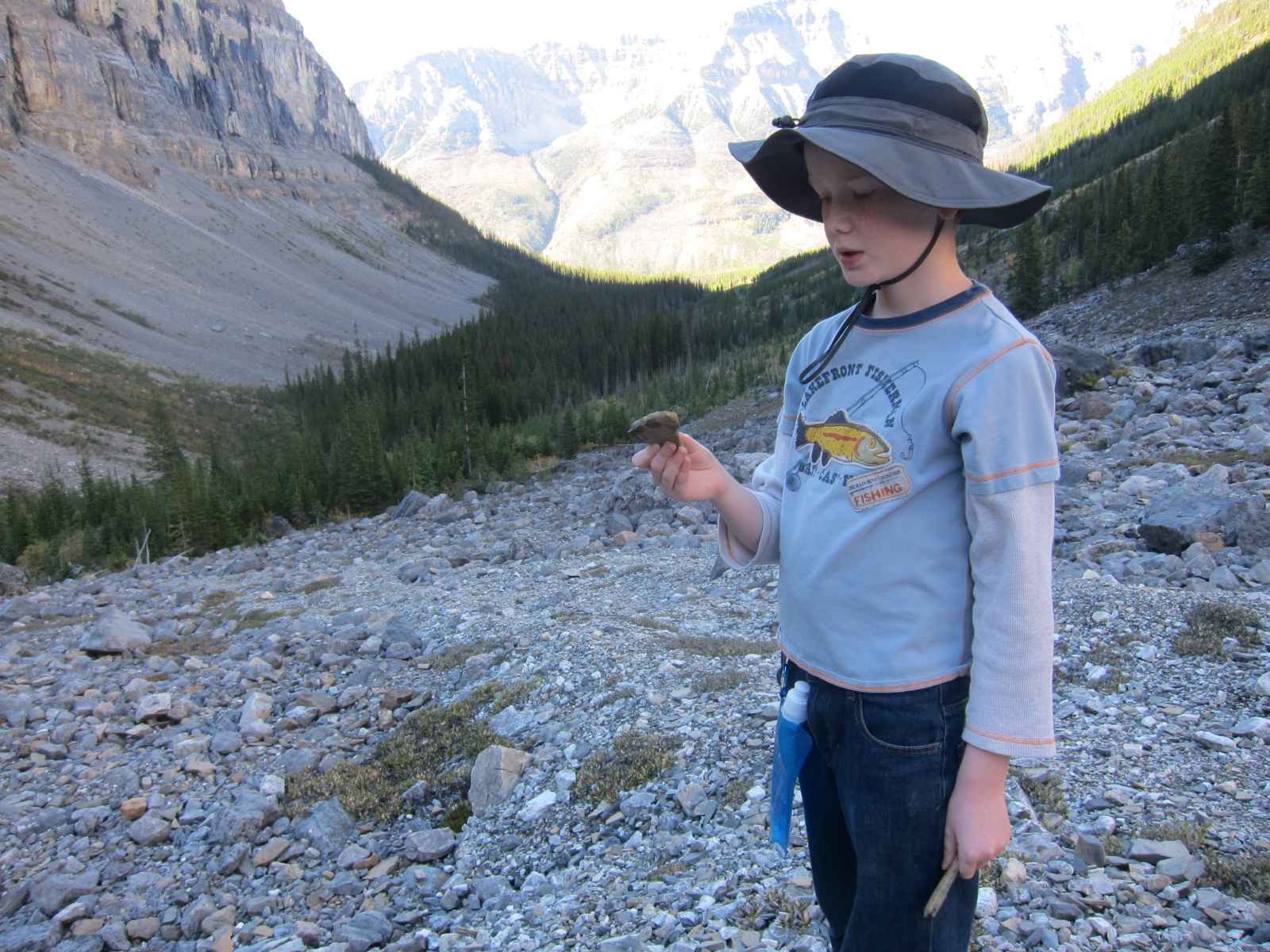
So after our hike we found fossils. Or at least what I could pass off to the kids as possibly fossils? We took pictures of our putative fossils and left them in the field.
This looks like a leaf-shaped form with fuzzy appendages flowing out from it (found by my wife):

This looks like a bean with legs:

And these might be trails of something wormy (found by my 12-year-old):

Notice how, at least, these are all in a similar type of rock. This is the shale that used to be sandy seafloor. I think they might actually be something.
Finally, I looked up a little on the science of the area and pieced together some interesting leads for further study in the academic literature. First off, this appears to be a newer site than the others. At least two major sites are located north a few dozen kilometers, close to the town of Field and Kicking Horse Pass, including the Wolcott Quarry and the area where the first specimens were found.
It wasn't until 2010 that a paper came out describing the Stanley Glacier site. This paper discusses how the previous sites were part of a "thick" formation but the Stanley Glacier rock is part of a "thin" part of the formation. Previously scientists had thought the thin part wouldn't preserve specimens, but from our own exploration we can confirm that it did.
I imagine that someone may have been hiking the trail to the glacier, noticed the black-stained layered cliffs on the west end of the valley, and crossed over to the waterfall to check for fossils. Maybe other sites can be found by similar cliffs. We caught a glimpse of some in the area of Kicking Horse Pass, for example, where the older sites are located. Seems to be a good excuse for more hiking in the area.
Here is the map from the paper showing the site and how it relates to the other sites near Field, which are part of the Cathedral Escarpment:

In 2014, word got out that yet another site was found north of the Stanley Glacier site, across the road near Marble Canyon. This was a major find with many diverse new shapes, showing that buried in those rocks there are many, many lifeforms waiting to be discovered. Connecting the dots (or the "F's" in the map above), perhaps there are other sites located along this line. How many unknown shapes are stacked up in those black-stained cliffs?
I believe the other sites are rightfully kept off-limits to the public, so the Stanley Glacier may be the easiest way to play paleontologist and see for yourself what this kind of discovery is like. As we showed, even a four-year-old, with some help, can do it. There's nothing like a treasure hunt to motivate small legs to keep moving, and the likelihood of finding fossils seems amazingly high.
Finding Burgess Shale Fossils with Kids, Part 2: The Hike
We found a great family day hike in Kootenay National Park in Canada and found small but important fossils. It worked well for our kids, and also for me -- I dug up some of the scientific literature describing this find after the fact. I'll describe what we found in three parts: The Prep, The Hike, and The Science.
The trailhead for the hike is only about fifteen minutes west of the main highway through Banff, along Highway 93, just across into Alberta, so it's central and easy to get to from either the towns of Lake Louise or Banff. (We came in from Calgary and spent a couple hours in Banff, including a stop at the rock store to show the boys what fossils look like, before grabbing lunch from the supermarket and driving to the trailhead while eating on the way.) We left Banff at 1:15, started the hike at 2pm and got back to the car at 6:30. From there it was a quick hour's drive to Golden, BC for our next hotel stay.
The trail runs south from the trailhead, up to a hanging valley between ridges that you can see from the beginning. You proceed through very different stages, which can be used as goals to motivate the little ones. First you climb up through a landscape recovering from a fire maybe a decade ago:

You're climbing up a hill, and the grade is taxing on little legs, but actually easier than the grade on the Lake Agnes Tea House trail in Lake Louise that we had done the previous day. There's little shade on the slope, so an early afternoon start meant that the sun was getting easier to take as we went.
Early on there's a stream running to the east as you switch back and forth:
 The top of the stream is about where this first stage ends. At our pace it's about an hour, and you can tell the kids that the hardest part is first.
Once you get to the top of that slope, the trail flattens out and turns toward the valley. Soon you cross a stream that used to be spanned with just a two-log bridge but now has a wider bridge that you could cartwheel across if you like:

This is a view heading south into the valley. The glacier is ahead and up to the right. Closer on the right is a sheer wall of layers of tan and brown rock smeared with black. This contains the shale of the Burgess shale and forms the backdrop of most of our pictures. There's a waterfall running down it at the south end that had helped to pull down some rocks from the cliff for little fossil hunters.

The flat part lets you catch your breath until the trail starts to climb again. It's not nearly as steep as before but much more rocky. At some point you'll feel a wave of chilly air blowing in your face from the valley, definitely cooler than the air on the sunlit hill. We also crossed into shade and at this point, were more certain that we could actually do this thing.
When you see this rocky staircase, you know you're maybe half an hour from your goal (and if you have a four-year-old you're probably going to have to carry him):

The trail is rougher from this point on. As you get closer to the glacier, you will soon be able to make out the waterfall, tiny against the huge cliffs of rock. This is your goal.

The glacier is just beyond it. If you have the energy you can hike all the way up to it, but for us, turning off at the waterfall was certainly enough. Here you can see the glacier peeking out on the left.

Stay on the trail until you are almost directly across from the waterfall on your right. There's a place where it looks like the trail branches, and stay on the rightward, downward branch. This takes you right next to a rock field in the center of the valley that is your final challenge. Scramble across to the base of the waterfall and you're there. I think the littler ones had an easier time with scrambling than we did, but we all had to watch out for shifty rocks.

Once across (and even before), look for tan or beige flat ones with multiple layers, about the size of a dessert plate or a dinner plate (I may have been getting hungry by this point). Flip these rocks over and examine them closely. Just from a few minutes of searching ,we were able to find several tiny fossils.
The nice part about mountain hikes is that down is faster than up. It took us an easy 90 minutes to get back to the car.
In the next post, I'll show what our "fossils" looked like and describe some of the scientific literature about this particular site.
The trailhead for the hike is only about fifteen minutes west of the main highway through Banff, along Highway 93, just across into Alberta, so it's central and easy to get to from either the towns of Lake Louise or Banff. (We came in from Calgary and spent a couple hours in Banff, including a stop at the rock store to show the boys what fossils look like, before grabbing lunch from the supermarket and driving to the trailhead while eating on the way.) We left Banff at 1:15, started the hike at 2pm and got back to the car at 6:30. From there it was a quick hour's drive to Golden, BC for our next hotel stay.
The trail runs south from the trailhead, up to a hanging valley between ridges that you can see from the beginning. You proceed through very different stages, which can be used as goals to motivate the little ones. First you climb up through a landscape recovering from a fire maybe a decade ago:

You're climbing up a hill, and the grade is taxing on little legs, but actually easier than the grade on the Lake Agnes Tea House trail in Lake Louise that we had done the previous day. There's little shade on the slope, so an early afternoon start meant that the sun was getting easier to take as we went.
Early on there's a stream running to the east as you switch back and forth:

Once you get to the top of that slope, the trail flattens out and turns toward the valley. Soon you cross a stream that used to be spanned with just a two-log bridge but now has a wider bridge that you could cartwheel across if you like:

This is a view heading south into the valley. The glacier is ahead and up to the right. Closer on the right is a sheer wall of layers of tan and brown rock smeared with black. This contains the shale of the Burgess shale and forms the backdrop of most of our pictures. There's a waterfall running down it at the south end that had helped to pull down some rocks from the cliff for little fossil hunters.

The flat part lets you catch your breath until the trail starts to climb again. It's not nearly as steep as before but much more rocky. At some point you'll feel a wave of chilly air blowing in your face from the valley, definitely cooler than the air on the sunlit hill. We also crossed into shade and at this point, were more certain that we could actually do this thing.
When you see this rocky staircase, you know you're maybe half an hour from your goal (and if you have a four-year-old you're probably going to have to carry him):

The trail is rougher from this point on. As you get closer to the glacier, you will soon be able to make out the waterfall, tiny against the huge cliffs of rock. This is your goal.

The glacier is just beyond it. If you have the energy you can hike all the way up to it, but for us, turning off at the waterfall was certainly enough. Here you can see the glacier peeking out on the left.

Stay on the trail until you are almost directly across from the waterfall on your right. There's a place where it looks like the trail branches, and stay on the rightward, downward branch. This takes you right next to a rock field in the center of the valley that is your final challenge. Scramble across to the base of the waterfall and you're there. I think the littler ones had an easier time with scrambling than we did, but we all had to watch out for shifty rocks.

Once across (and even before), look for tan or beige flat ones with multiple layers, about the size of a dessert plate or a dinner plate (I may have been getting hungry by this point). Flip these rocks over and examine them closely. Just from a few minutes of searching ,we were able to find several tiny fossils.
The nice part about mountain hikes is that down is faster than up. It took us an easy 90 minutes to get back to the car.
In the next post, I'll show what our "fossils" looked like and describe some of the scientific literature about this particular site.
Finding Burgess Shale Fossils with Kids, Part 1: The Prep
We found a great family day hike in Kootenay National Park in Canada and found small but important fossils. It worked well for our kids, and also for me -- I dug up some of the scientific literature describing this find after the fact. I'll describe what we found in three parts: The Prep, The Hike, and The Science.
Right after Labor Day, we wanted to take a quick vacation that would take advantage of the fact that under the quarter system, school doesn't start till the last week in September. So we drove from Seattle to the Canadian Rockies for a five-day vacation.
Since I've written about the Burgess Shale fossils, I wanted to take the family to hike up and see a place where those fossils were found. The Burgess Shale contains evidence of life's Cambrian explosion, where diverse forms most wonderful suddenly appear in the rocks a little more than half a billion years ago. I wondered if there was anything special about the rocks up there and wanted to feel what it would have been like to find these fossils.
Before we went I found an official site for this hike and several trip reports indicating that it would work for older kids, such as this one. We also found the guided tours offered to the two other official Burgess Shale sites, but we were too late to sign up, had kids below the age cut-off, and wanted to be able to go at our own pace (and turn back if need be). The Stanley Glacier hike looked like the one we could do, and it's a public hike that we can try on our own.
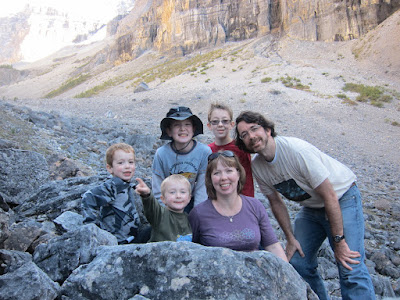
We have four boys, age 12 (going on 30), 11, 6, and 4. I wasn't sure that we'd make it, but I promised them if we did, they might find their own fossils. And it worked -- here's the proof, with the fossil area in the background:
I'll describe the hike in detail in the next post, so you can decide if your kids will make it. Most kids ages 10 and up should have no problem with this hike. It was a challenge for our little ones, but it actually got a bit easier as we went along. I want to publish that it worked for us, so it might work for you.
We spent four and a half hours total on this hike: 2 hours up, maybe an hour looking for fossils, and 1.5 hours back. To get to the fossils, you don't go all the way to Stanley Glacier, but turn off after about three miles. The first mile or so is a medium-grade upward climb that went the slowest for us, then there was a flat, fast part before the trail roughened and climbed again for the last half mile (ish). Then you turn off toward a waterfall on your right, scramble over some rocks, and there are the fossils.
Next I'll describe the hike in detail and how to find the fossil site.
Right after Labor Day, we wanted to take a quick vacation that would take advantage of the fact that under the quarter system, school doesn't start till the last week in September. So we drove from Seattle to the Canadian Rockies for a five-day vacation.
Since I've written about the Burgess Shale fossils, I wanted to take the family to hike up and see a place where those fossils were found. The Burgess Shale contains evidence of life's Cambrian explosion, where diverse forms most wonderful suddenly appear in the rocks a little more than half a billion years ago. I wondered if there was anything special about the rocks up there and wanted to feel what it would have been like to find these fossils.
Before we went I found an official site for this hike and several trip reports indicating that it would work for older kids, such as this one. We also found the guided tours offered to the two other official Burgess Shale sites, but we were too late to sign up, had kids below the age cut-off, and wanted to be able to go at our own pace (and turn back if need be). The Stanley Glacier hike looked like the one we could do, and it's a public hike that we can try on our own.
We have four boys, age 12 (going on 30), 11, 6, and 4. I wasn't sure that we'd make it, but I promised them if we did, they might find their own fossils. And it worked -- here's the proof, with the fossil area in the background:

I'll describe the hike in detail in the next post, so you can decide if your kids will make it. Most kids ages 10 and up should have no problem with this hike. It was a challenge for our little ones, but it actually got a bit easier as we went along. I want to publish that it worked for us, so it might work for you.
We spent four and a half hours total on this hike: 2 hours up, maybe an hour looking for fossils, and 1.5 hours back. To get to the fossils, you don't go all the way to Stanley Glacier, but turn off after about three miles. The first mile or so is a medium-grade upward climb that went the slowest for us, then there was a flat, fast part before the trail roughened and climbed again for the last half mile (ish). Then you turn off toward a waterfall on your right, scramble over some rocks, and there are the fossils.
Next I'll describe the hike in detail and how to find the fossil site.
Subscribe to:
Posts (Atom)

 Posts
Posts


