Saturday, September 19, 2015

Finding Burgess Shale Fossils with Kids, Part 3: The Science

We found a great family day hike in Kootenay National Park in Canada and found small but important fossils. It worked well for our kids, and also for me -- I dug up some of the scientific literature describing this find after the fact. I'll describe what we found in three parts: The Prep, The Hike, and The Science.


So after our hike we found fossils. Or at least what I could pass off to the kids as possibly fossils? We took pictures of our putative fossils and left them in the field.

This looks like a leaf-shaped form with fuzzy appendages flowing out from it (found by my wife):


This looks like a bean with legs:


And these might be trails of something wormy (found by my 12-year-old):


Notice how, at least, these are all in a similar type of rock. This is the shale that used to be sandy seafloor. I think they might actually be something.

Finally, I looked up a little on the science of the area and pieced together some interesting leads for further study in the academic literature. First off, this appears to be a newer site than the others. At least two major sites are located north a few dozen kilometers, close to the town of Field and Kicking Horse Pass, including the Wolcott Quarry and the area where the first specimens were found.

It wasn't until 2010 that a paper came out describing the Stanley Glacier site. This paper discusses how the previous sites were part of a "thick" formation but the Stanley Glacier rock is part of a "thin" part of the formation. Previously scientists had thought the thin part wouldn't preserve specimens, but from our own exploration we can confirm that it did.

I imagine that someone may have been hiking the trail to the glacier, noticed the black-stained layered cliffs on the west end of the valley, and crossed over to the waterfall to check for fossils. Maybe other sites can be found by similar cliffs. We caught a glimpse of some in the area of Kicking Horse Pass, for example, where the older sites are located. Seems to be a good excuse for more hiking in the area.

Here is the map from the paper showing the site and how it relates to the other sites near Field, which are part of the Cathedral Escarpment:

In 2014, word got out that yet another site was found north of the Stanley Glacier site, across the road near Marble Canyon. This was a major find with many diverse new shapes, showing that buried in those rocks there are many, many lifeforms waiting to be discovered. Connecting the dots (or the "F's" in the map above), perhaps there are other sites located along this line. How many unknown shapes are stacked up in those black-stained cliffs?

I believe the other sites are rightfully kept off-limits to the public, so the Stanley Glacier may be the easiest way to play paleontologist and see for yourself what this kind of discovery is like. As we showed, even a four-year-old, with some help, can do it. There's nothing like a treasure hunt to motivate small legs to keep moving, and the likelihood of finding fossils seems amazingly high.

Finding Burgess Shale Fossils with Kids, Part 2: The Hike

We found a great family day hike in Kootenay National Park in Canada and found small but important fossils. It worked well for our kids, and also for me -- I dug up some of the scientific literature describing this find after the fact. I'll describe what we found in three parts: The Prep, The Hike, and The Science.

The trailhead for the hike is only about fifteen minutes west of the main highway through Banff, along Highway 93, just across into Alberta, so it's central and easy to get to from either the towns of Lake Louise or Banff. (We came in from Calgary and spent a couple hours in Banff, including a stop at the rock store to show the boys what fossils look like, before grabbing lunch from the supermarket and driving to the trailhead while eating on the way.) We left Banff at 1:15, started the hike at 2pm and got back to the car at 6:30. From there it was a quick hour's drive to Golden, BC for our next hotel stay.

The trail runs south from the trailhead, up to a hanging valley between ridges that you can see from the beginning. You proceed through very different stages, which can be used as goals to motivate the little ones. First you climb up through a landscape recovering from a fire maybe a decade ago:


You're climbing up a hill, and the grade is taxing on little legs, but actually easier than the grade on the Lake Agnes Tea House trail in Lake Louise that we had done the previous day. There's little shade on the slope, so an early afternoon start meant that the sun was getting easier to take as we went.

Early on there's a stream running to the east as you switch back and forth:
The top of the stream is about where this first stage ends. At our pace it's about an hour, and you can tell the kids that the hardest part is first.

Once you get to the top of that slope, the trail flattens out and turns toward the valley. Soon you cross a stream that used to be spanned with just a two-log bridge but now has a wider bridge that you could cartwheel across if you like:


This is a view heading south into the valley. The glacier is ahead and up to the right. Closer on the right is a sheer wall of layers of tan and brown rock smeared with black. This contains the shale of the Burgess shale and forms the backdrop of most of our pictures. There's a waterfall running down it at the south end that had helped to pull down some rocks from the cliff for little fossil hunters.


The flat part lets you catch your breath until the trail starts to climb again. It's not nearly as steep as before but much more rocky. At some point you'll feel a wave of chilly air blowing in your face from the valley, definitely cooler than the air on the sunlit hill. We also crossed into shade and at this point, were more certain that we could actually do this thing.

When you see this rocky staircase, you know you're maybe half an hour from your goal (and if you have a four-year-old you're probably going to have to carry him):


The trail is rougher from this point on. As you get closer to the glacier, you will soon be able to make out the waterfall, tiny against the huge cliffs of rock. This is your goal.


The glacier is just beyond it. If you have the energy you can hike all the way up to it, but for us, turning off at the waterfall was certainly enough. Here you can see the glacier peeking out on the left.


Stay on the trail until you are almost directly across from the waterfall on your right. There's a place where it looks like the trail branches, and stay on the rightward, downward branch. This takes you right next to a rock field in the center of the valley that is your final challenge. Scramble across to the base of the waterfall and you're there. I think the littler ones had an easier time with scrambling than we did, but we all had to watch out for shifty rocks.


Once  across (and even before), look for tan or beige flat ones with multiple layers, about the size of a dessert plate or a dinner plate (I may have been getting hungry by this point). Flip these rocks over and examine them closely. Just from a few minutes of searching ,we were able to find several tiny fossils.

The nice part about mountain hikes is that down is faster than up. It took us an easy 90 minutes to get back to the car.

In the next post, I'll show what our "fossils" looked like and describe some of the scientific literature about this particular site.

Finding Burgess Shale Fossils with Kids, Part 1: The Prep

We found a great family day hike in Kootenay National Park in Canada and found small but important fossils. It worked well for our kids, and also for me -- I dug up some of the scientific literature describing this find after the fact. I'll describe what we found in three parts: The Prep, The Hike, and The Science.

Right after Labor Day, we wanted to take a quick vacation that would take advantage of the fact that under the quarter system, school doesn't start till the last week in September. So we drove from Seattle to the Canadian Rockies for a five-day vacation.

Since I've written about the Burgess Shale fossils, I wanted to take the family to hike up and see a place where those fossils were found. The Burgess Shale contains evidence of life's Cambrian explosion, where  diverse forms most wonderful suddenly appear in the rocks a little more than half a billion years ago. I wondered if there was anything special about the rocks up there and wanted to feel what it would have been like to find these fossils.

Before we went I found an official site for this hike and several trip reports indicating that it would work for older kids, such as this one. We also found the guided tours offered to the two other official Burgess Shale sites, but we were too late to sign up, had kids below the age cut-off, and wanted to be able to go at our own pace (and turn back if need be). The Stanley Glacier hike looked like the one we could do, and it's a public hike that we can try on our own.

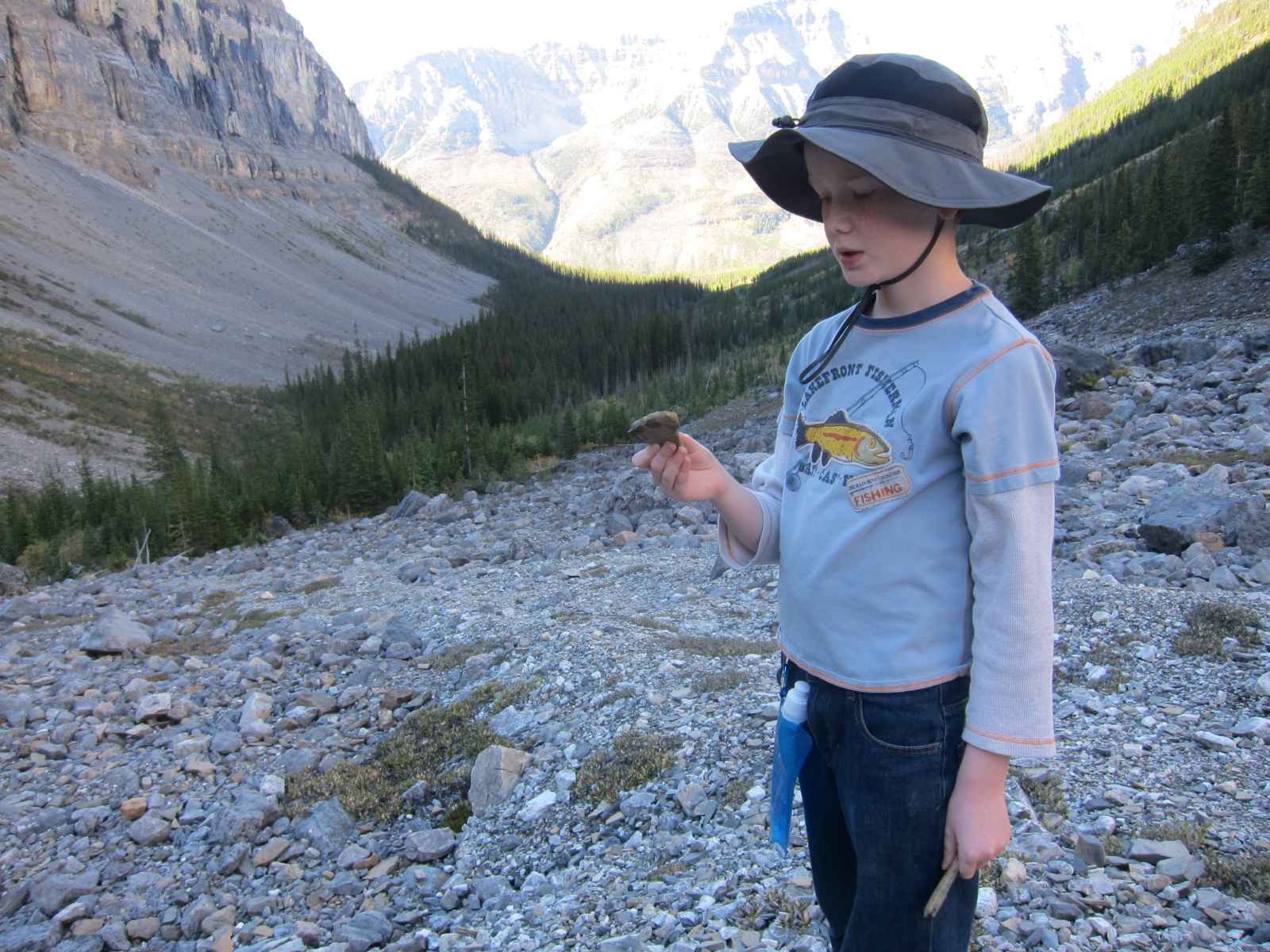
We have four boys, age 12 (going on 30), 11, 6, and 4. I wasn't sure that we'd make it, but I promised them if we did, they might find their own fossils. And it worked -- here's the proof, with the fossil area in the background:


I'll describe the hike in detail in the next post, so you can decide if your kids will make it. Most kids ages 10 and up should have no problem with this hike. It was a challenge for our little ones, but it actually got a bit easier as we went along. I want to publish that it worked for us, so it might work for you.

We spent four and a half hours total on this hike: 2 hours up, maybe an hour looking for fossils, and 1.5 hours back. To get to the fossils, you don't go all the way to Stanley Glacier, but turn off after about three miles. The first mile or so is a medium-grade upward climb that went the slowest for us, then there was a flat, fast part before the trail roughened and climbed again for the last half mile (ish). Then you turn off toward a waterfall on your right, scramble over some rocks, and there are the fossils.

Next I'll describe the hike in detail and how to find the fossil site.


Friday, September 4, 2015

Book Review: What Coleridge Thought by Owen Barfield

This may be the best of Barfield's books, or at least the most grounded and therefore far-reaching, but I really think that unless you're a Coleridge scholar, you're better off reading up to it with Barfield's previous works. In particular, Saving the Appearances seems to be a pre-requisite, and I've always thought it was hard to jump into that book without reading Poetic Diction first. The other works by Barfield are OK but I'd say these three are the most worthwhile, in this order.

The other examples of "late Barfield" I've read were too much influenced by Steiner and anthroposophy, but this one manages to avoid those topics (except for a few mentions). Also, Barfield is not focusing on Barfield's ideas so much as Coleridge's, filtered through Barfield, to be sure. I got the sense that the two are enough on the same wavelength that Barfield's filter is more a good teacher teaching than it is a partisan lobbying. I feel like I "get" Coleridge more after this book and that strengthens my estimation of both Coleridge and Barfield. This also fits with the picture of Coleridge from the wonderful history Age of Wonder.

To be sure, Barfield can't get through a whole book without making some annoying absolute and contrarian statements about modern science. I do think that my reading of Barfield can accommodate most of his intellectual puckishness by interpreting Barfield's "matter before mind didn't exist" to become "matter before mind didn't MATTER" (not in the same way as it matters now). It all comes down to what you mean by "exist," see?

But in this book that move of "translation" doesn't have to be made that often. It makes sense that Coleridge and Barfield are sympatico given the influence of German philosophy on Coleridge, which goes right along with Barfield's love for Goethe (which I'm OK with) and Steiner (which I'm not).

In the end, I think Coleridge's "polar logic" as described by Barfield may offer a way to interpret Barfield's philosophy in a way that throws light on modern experience without throwing out all of modern natural history. In fact, polar logic may be incorporated into a narrative interpretation of natural history. Barfield's own statements about the natural fit between evolution and Christianity imply that this should be possible, even when his sweeping dismissal of science of the past seems to get in the way.

Overall, a fascinating and helpful book that I'm working on integrating, but not for the faint of heart. I'm not sure how that interprets into a star rating, but Barfield's against quantitation anyway, so I'm sure he won't mind my avoiding the five stars on this one, even though I think it may be stronger on the whole than previous works I've given five stars to. This is definitely worth working your way up to.

Book Review: Annihiliation by Jeff VanderMeer

LOST meets Lovecraft meets Crichton. That's what this book is, and if that doesn't draw you in, it's probably not for you. It certainly drew me in. Since this is the first of a trilogy, many more questions are raised than are answered, and if you don't like that, it's probably not for you. (Although I think the mysteries will be resolved in a way that satisfies those frustrated by LOST's ending.) The biologist mostly acts like a biologist -- I would have liked to see her hypothesize more. Also, the plot gives hypnosis too much power, but this may be explained later. Overall, it's incredibly brisk, and manages to be both creative and realistic. I have quibbles about how things are done but again, it's hard to judge on the first book, and the overall story is compelling and interesting. My only dilemma now is how long to wait before reading book 2.

Friday, August 28, 2015

Book Review: The Corrections by Jonathan Franzen

I recognize that this book is at times exquisitely written. Franzen has a knack for vivid, unexpected, and appropriate psychological metaphor. I also recognize that we're screwed-up people living in a screwed-up world. Franzen cuts through the hypocrisy and reveals the dysfunction like no one else.

My problem's not with the head but the heart. The characters are revealed in such a stark and unforgiving light that you're reluctant to identify with any of them (although you do sound the laugh of recognition all too often). They aren't monsters but they act monstrously, and I just don't want to immerse myself in their world for that long, regardless of the skill of the author describing their actions and addictions. That skill works against him at times, as when there's a long and disgusting description of a family dinner around the middle of the book. Why should the reader endure that?

There are a few glimmers of true light here and there -- especially one scene about forgiveness near the end -- and it can be entertaining to see the characters get skewered by their own foibles, the fools caught by their folly. I think Frazen's most recent book, Purity, might be better because his targets are juicier there. And The Corrections seems to fit its time like a hand in a glove. It's just ... we've moved past that time now, and I don't think this book has retained its value with age.

Tuesday, August 25, 2015

Book Review: A New History of Life by Peter Ward and Joe Kirschvink


A New History of Life is a  natural history that stands out because of its large timescale (4.567 billion years, to be precise) and broad intended audience. Overall, it delivers on the promise of its title adjective, describing new findings and hypotheses connecting paleontology and geology, and offering genuine but grounded scientific speculation for future work. For the general reader, it provides a wealth of new information, but because its overall scientific narrative lacks momentum and internal connection, it may be most appropriate for a scientifically literate audience.

It is impressive to watch the authors address the central challenge of this genre, which I have faced myself in my writing for a general audience:  How do you filter oceans of information and translate it into general terms? Authors Ward and Kirschvink set up their filter by emphasizing physical evidence, and rocks and bones in particular. Their geological and paleontological emphasis gives this story a different tone and tempo than other natural histories that start with the Big Bang (physics) or the characteristics of life (biology). My own discipline, chemistry, is not as deeply integrated as a result – here, chemistry plays a role in dating the rocks and bones, and in transforming the environment, but the authors focus most attention on the change and flow of continents (and other aspects of geology) and body plans (developmental biology).

The flip side of the authors’ emphasis is their deemphasis. Ward and Kirschvink deemphasize evidence from genetic clocks and other results from molecular biology, which leads them a chain of reasoning that is mostly geological in nature. For example, they favor a very late evolution of water photosynthesis. Personally, I trust the genetic clocks that show how many forms of photosynthesis, including water photosynthesis, evolved much earlier than Ward and Kirschvink allow. But this is a moot point -- a few hundred million years one way or the other doesn’t change the story much for the general reader.

A New History of Life reads at the level of an undergraduate science course. Ward and Kirschvink recount the back-and-forth narrative of scientific discovery and rebuttal as hypotheses are set forward and discarded.  If the reader already understands how science works, these sections depict the drama of science in enjoyable detail. Sometimes the details seem more superfluous, as when some sections list other scientists in the field but without enough detail to make them distinct characters. A surprising number of the images in the book depict scientists working in the field but would not convey much information to the non-specialist.

The scientific detail is both an advantage and disadvantage. For example, the first chapter is all about geological nomenclature, which is too dry for a general reader. Throughout the book, the authors provide precise biological and geological terms for organisms and places, but more description of these would make the story more relevant. A photo of a fossil skull is not clearly connected to the chapter around it, and lists of details on dinosaur names and the shapes of lagoon habitats provide detailed “dots” of data, but they do not seem connected.

At such points, the book becomes more like a required course assignment than the flowing story it could be. On page 80 the authors write “We apologize for the complex chemistry necessary in the preceding section. But to get this story right requires complexity.” If this was placed before the section it described, the general reader would read that section differently – as it is, it amounts to locking the barn door after the horse is gone.

These narrative nits having been picked, this book is indeed new and interesting, both substantial and helpful for the prepared reader. In the chapters on the origin of life, the authors focus on the “RNA world” hypothesis, and include new findings that support this hypothesis, such as the nucleotide synthesis discovered half a decade ago by Sutherland and colleagues, but fail to cover recent experiments that point to “metabolism-first” explanations. The “new” hypothesis in this section is that life started on Mars, which is interesting and possible, but given the difficulties and distances, more speculative than other new proposals in the book.

Another “new” hypothesis the authors develop in several places is that major events like the Cambrian explosion and particular extinctions were started by “true polar wander” events. One true polar wander event coincided with the Cambrian explosion, but my enthusiasm is tempered by the fact that there have been thirty or so of these events throughout history, which is number large enough that the timing may be more coincidence than cause. A graph of the thirty events would have addressed my own skepticism but was not included.

The hypothesis I’m most attracted to appears throughout the book, but may have been deemphasized by the authors because it is not all that “new.” Ward and Kirschvink frequently allude to the power of oxygen, both at and after the Cambrian explosion. They connect oxygen to animal diversification and extinction more intimately than any other general text, and oxygen’s influence is found in nearly every chapter. This is an exciting and intriguing thread to follow throughout the narrative, but could have been emphasized more.

Curiously, in a section on dinosaur morphology, they downplay the power of oxygen. On page 266, they begin a paragraph with the statement, “No evolutionary history can even be pinned on one factor.” The paragraph ends, “Nevertheless, oxygen levels must have played a part.” This apparent underselling of the organizing chemical power of oxygen brought to my mind the stories of how Einstein resisted the Big Bang because of its implication that the universe had a beginning. But, as is common for popular science, philosophical and theological implications are kept implicit.

Another major theme of this book that is powerful (but not really new) is the generative power of past extinction events. As Ward and Kirschvink put it, “Over and over, however, it really looks like a dominant theme in the history of life is that times of crisis promote new innovation.” Many scientists from many fields, including myself, have converged on this finding, and it deserves to be repeated many times. What does that tell us about what kind of universe we call home?

The authors close the book by extrapolating the billion-year trends of change in carbon dioxide and oxygen levels into the distant future. This is an obituary for the future earth in which CO2 runs slowly out of the atmosphere, like air running out of a balloon.

In a book that tends to avoid large metaphors, this section stands out: “The fate of the nautilus is a metaphor for all animal life. Sooner or later evolution, competition, and the natural changing of our Earth and sun as they age will make any body plan obsolete.” The authors describe a bleak future that gives the sense of the universe running down and flickering out, which is accurate as far as science goes, but philosophically and theologically truncated.

In summary, this book is an excellent example of recent evidence in the history of life, with special emphases on geology and paleontology. Anyone with an interest in those two sciences will find new ideas and directions in these pages. The most powerful conclusions --  the emerging consensus on the driving role of oxygen and the creative power of even the most devastating extinctions -- give a sense of the vitality of life and the orderliness of creation that is somewhat at odds with the deflating final chapter. Here, new evidence is presented well, and its ultimate implications are left for the reader to ponder.